Case Study Treatment Plans: A Complete Guide for Nursing Students
Need help with this assignment?Get an original answer from a qualified tutor — from $10/page.
Get it written →Treatment plans, also called nursing care plans, translate case study data into organized, evidence-based care. Nursing students write them throughout school, from fundamentals to advanced practice. This complete guide explains what a case study treatment plan includes, how it follows the nursing process and where to find step-by-step guides and examples for medical and psychiatric conditions.
Quick answer
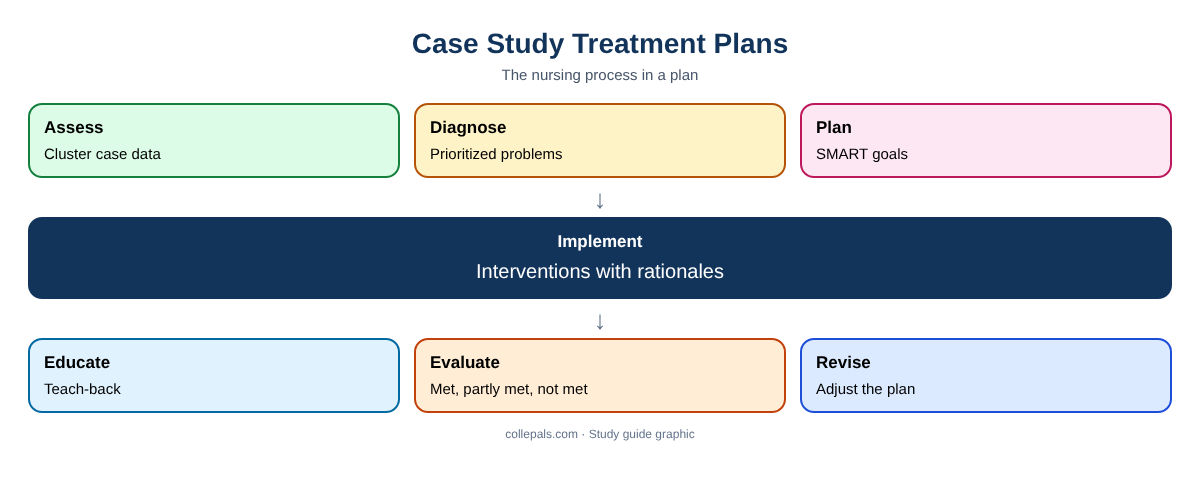
A case study treatment plan follows the nursing process: assess and cluster the case data, identify and prioritize nursing problems, write SMART goals, choose evidence-based interventions with rationales, include patient education and evaluate whether goals were met, revising the plan as needed.
Patients in this article are fictional and used for study purposes. Treatments are illustrative; follow current guidelines, provider orders, facility protocols and your scope of practice. This content is educational, not medical advice.
Sample document: a sample pneumonia treatment plan table (Word).
What Is a Treatment Plan?
A treatment plan organizes care for a patient’s priority problems. In nursing, it follows the nursing process, assessment, diagnosis, planning, implementation and evaluation, described in the ANA’s (2021) scope and standards of practice. Nursing problems are usually written using NANDA-I labels (Herdman et al., 2024), while nurse practitioner plans add medical diagnoses, prescriptions and follow-up.
The Standard Format
| Problem / diagnosis | Goal (SMART) | Interventions | Rationale | Evaluation |
|---|---|---|---|---|
| Impaired gas exchange r/t alveolar inflammation AEB SpO2 89% RA, RR 26, crackles RLL | SpO2 ≥92% on ≤2 L O2 within 24 h | Monitor SpO2 and RR q2h; O2 as ordered; HOB 30–45°; IS 10×/h awake | Positioning and lung expansion improve ventilation; monitoring detects deterioration | SpO2 94% on 2 L at 24 h: met |
| Ineffective airway clearance r/t thick secretions AEB productive cough, rhonchi | Clear breath sounds and effective cough by day 2 | Fluids 2 L/day unless restricted; cough and deep breathing; ambulate TID | Hydration thins secretions; mobility mobilizes them | Rhonchi decreased: partly met |
| Risk for sepsis r/t infection | Remains normotensive, lactate normal, T <38.3 °C by 48 h | Cultures before first antibiotic; antibiotics on time; monitor BP, HR, temp, urine output | Early antibiotics and monitoring reduce progression | Afebrile, BP stable: met |
This fictional pneumonia example shows how each column connects. See the full pneumonia case study.
Guides in This Series
- How to Write a Treatment Plan for a Nursing Case Study
- How to Develop Patient Goals and SMART Objectives in Treatment Plans
- How to Write Nursing Interventions With Rationales
- How to Prioritize Patient Problems When Developing a Treatment Plan
- How to Develop an Evidence-Based Treatment Plan From a Patient Case Study
- Patient-Centered Treatment Planning in Nursing
- How to Evaluate Treatment Plan Outcomes in a Nursing Case Study
- How to Incorporate Patient Education Into a Treatment Plan
- Treatment Plan Examples for Nursing Students
- Psychiatric Case Study Treatment Plans: Complete Guide
Condition Case Studies
Qualities of a Strong Treatment Plan
- Problems supported by case cues.
- Clear priorities.
- Measurable, time-bound goals.
- Specific interventions with rationales and citations.
- Evaluation that matches each goal.
Frequently Asked Questions
Is a treatment plan the same as a care plan?
In nursing education, the terms are often used interchangeably; both organize problems, goals, interventions and evaluation.
How many problems should a treatment plan include?
Usually two to four priority problems; follow your rubric.
Do treatment plans need references?
Most academic plans require current evidence-based sources for rationales.
Get Treatment Plan Help at Collepals
Case study treatment plans take time to research and write. Collepals.com helps nursing and nurse practitioner students:
- Identify and prioritize problems from complex case data.
- Write SMART goals, interventions and evidence-based rationales.
- Find current guidelines and format references in APA 7.
- Study model treatment plans and get your drafts edited and proofread.
Browse our free model assignments or learn more about our nursing assignment writing service.
Use Collepals examples as study guides and follow your school’s academic integrity and AI policies.
More treatment plan guides
Collepals is an independent study resource. Follow your program’s care plan format and rubric and write your own work.
References
American Nurses Association. (2021). Nursing: Scope and standards of practice (4th ed.). American Nurses Association.
Herdman, T. H., Kamitsuru, S., & Lopes, C. T. (Eds.). (2024). NANDA-I international nursing diagnoses: Definitions and classification, 2024–2026 (13th ed.). Thieme.
Get a plagiarism-free answer to this question
Send us your instructions and we’ll match you with the best writer in your subject.
- 100% human-written, zero AI
- Turnitin report included
- Confidential — we never share your data
- Free revisions & refunds