How to Develop Patient Goals and SMART Objectives in Treatment Plans
Need help with this assignment?Get an original answer from a qualified tutor — from $10/page.
Get it written →Goals tell you and your instructor what success looks like. Vague goals, such as “patient will feel better,” make evaluation impossible. This guide explains how to develop patient goals and SMART objectives in nursing treatment plans, with examples and a downloadable worksheet.
Quick answer
Write goals that are Specific, Measurable, Achievable, Relevant and Time-bound. Start with the patient as the subject, use an action verb and measurable criteria and include a time frame. Set goals with the patient, and match each goal to a nursing problem.
Sample document: a SMART goal worksheet with examples (Word).
The SMART Framework
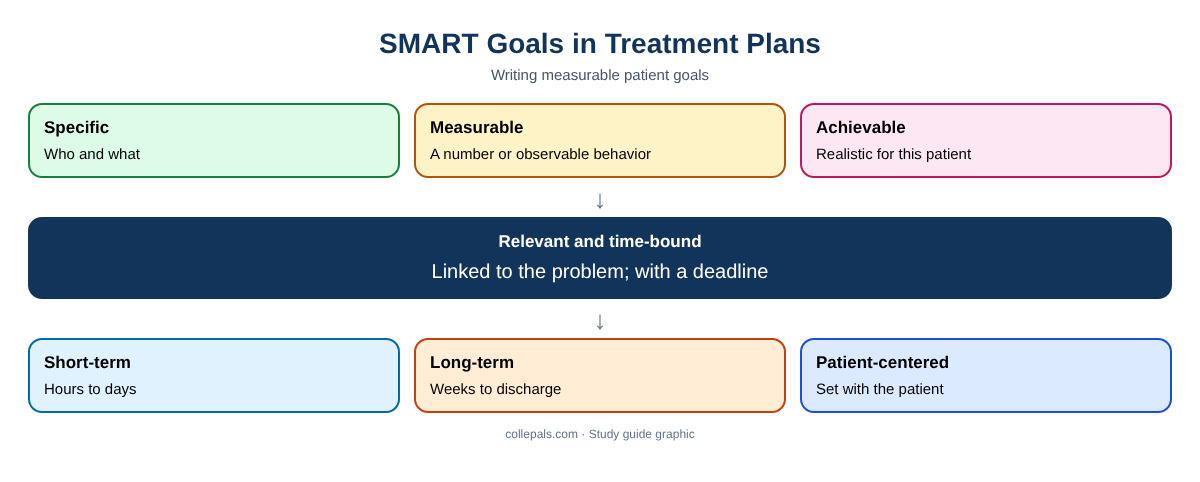
The SMART acronym, originally proposed for management objectives (Doran, 1981), is widely used in nursing goal writing.
| Letter | Meaning | Example element |
|---|---|---|
| S | Specific | Who and what: ‘Patient will walk’ |
| M | Measurable | ’30 meters with a walker’ |
| A | Achievable | Realistic for this patient’s condition |
| R | Relevant | Addresses impaired mobility |
| T | Time-bound | ‘by postoperative day 3’ |
Goal Formula
Formula
Patient + action verb + measurable criterion + condition (if any) + time frame. Example: ‘Patient will verbalize three signs of hypoglycemia before discharge.’
Examples
| Problem / diagnosis | Goal (SMART) | Interventions | Rationale | Evaluation |
|---|---|---|---|---|
| Acute pain | Patient will report pain ≤3/10 within 1 hour of analgesia today | Pain scale before and after interventions | Measurable and time-bound | Pain 2/10 at 1 h: met |
| Deficient knowledge (insulin) | Patient will demonstrate correct insulin pen technique before discharge | Demonstration and return demonstration | Observable behavior | Correct technique: met |
| Impaired mobility | Patient will walk 30 m with walker twice daily by day 3 | PT plan; scheduled ambulation | Specific distance and frequency | Walked 20 m: partly met |
Tips
- Use verbs you can observe: state, demonstrate, walk, report.
- Avoid “understand,” “know” or “feel better” without measures.
- Distinguish short-term (hours to days) from long-term (weeks or by discharge) goals.
- Set goals with the patient; see patient-centered treatment planning.
Frequently Asked Questions
What is the difference between a goal and an outcome?
Goals state what you aim to achieve; outcomes are the results you evaluate.
How many goals per problem?
Usually one or two.
Can goals be nurse-centered?
Goals should be patient-centered; nursing actions belong in interventions.
Get Help Writing SMART Goals at Collepals
Case study treatment plans take time to research and write. Collepals.com helps nursing and nurse practitioner students:
- Identify and prioritize problems from complex case data.
- Write SMART goals, interventions and evidence-based rationales.
- Find current guidelines and format references in APA 7.
- Study model treatment plans and get your drafts edited and proofread.
Browse our free model assignments or learn more about our nursing assignment writing service.
Use Collepals examples as study guides and follow your school’s academic integrity and AI policies.
More treatment plan guides
Collepals is an independent study resource. Follow your program’s care plan format and rubric and write your own work.
References
Doran, G. T. (1981). There’s a S.M.A.R.T. way to write management’s goals and objectives. Management Review, 70(11), 35–36.
Get a plagiarism-free answer to this question
Send us your instructions and we’ll match you with the best writer in your subject.
- 100% human-written, zero AI
- Turnitin report included
- Confidential — we never share your data
- Free revisions & refunds