Bipolar Disorder Case Study: Treatment Plan and Management
Need help with this assignment?Get an original answer from a qualified tutor — from $10/page.
Get it written →Bipolar disorder case studies often present a patient in an acute manic episode. This bipolar disorder case study explains assessment, a treatment plan and ongoing management, with a downloadable plan.
Quick answer
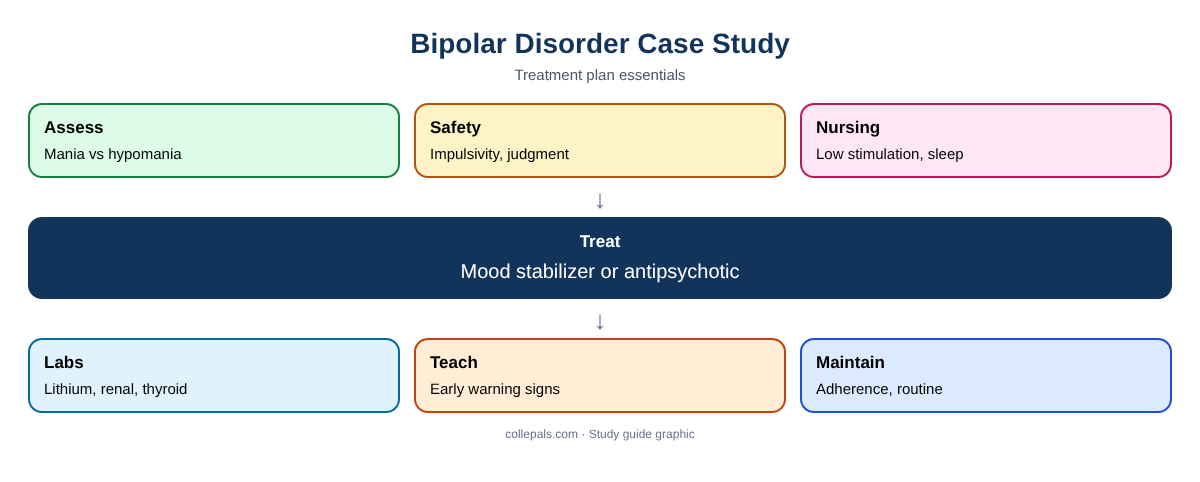
Distinguish mania from hypomania using DSM-5-TR duration and severity criteria, prioritize safety, reduce stimulation, protect sleep and nutrition, treat with first-line mood stabilizers or antipsychotics such as lithium, quetiapine or divalproex, avoid antidepressant monotherapy, monitor labs and teach early warning signs.
Patients in this article are fictional and used for study purposes. Treatments are illustrative; follow current guidelines, provider orders, facility protocols and your scope of practice. This content is educational, not medical advice.
Sample document: a bipolar disorder treatment plan (Word).
The Case (Fictional)
Case
J.T., 27, has slept 2–3 hours nightly for nine days, speaks rapidly, started several businesses and spent $8,000. Grandiose and irritable; poor insight. Family history of bipolar disorder. Drug screen negative.
Assessment
A manic episode requires at least one week of elevated, expansive or irritable mood with increased energy and at least three additional symptoms (four if mood is only irritable), causing marked impairment (American Psychiatric Association, 2022).
Clinical Management
- First-line options for acute mania include lithium, quetiapine, divalproex, asenapine, aripiprazole, paliperidone, risperidone and cariprazine (Yatham et al., 2018).
- Stop antidepressants during mania.
- Lithium: monitor levels, renal and thyroid function; teach toxicity signs (tremor, vomiting, diarrhea, confusion).
- Metabolic monitoring for antipsychotics.
Nursing Treatment Plan
| Problem / diagnosis | Goal (SMART) | Interventions | Rationale | Evaluation |
|---|---|---|---|---|
| Risk for injury r/t impulsivity and hyperactivity | No injury; reduced risky behavior during admission | Low-stimulation environment; supervise; limit setting; remove hazards | Reducing stimuli decreases agitation | No injury: met |
| Disturbed sleep pattern | Sleeps ≥5 h within 3 nights | Quiet room; consistent bedtime; medications as ordered | Sleep loss worsens mania | 5 h by night 3: met |
| Imbalanced nutrition: less than requirements | Eats finger foods ≥75% of meals | High-calorie portable foods; fluids | Hyperactive patients may not sit to eat | Met |
| Noncompliance risk / deficient knowledge | States early warning signs and medication plan before discharge | Psychoeducation; teach lithium toxicity signs and lab monitoring | Education supports adherence and early intervention | Teach-back correct |
Frequently Asked Questions
What is the difference between mania and hypomania?
Mania lasts at least a week (or any duration with hospitalization) and causes marked impairment; hypomania lasts at least four days without marked impairment.
Why are labs important with lithium?
Lithium has a narrow therapeutic range and affects kidney and thyroid function.
What is a key nursing priority in mania?
Safety, sleep and nutrition.
Get Help With Your Bipolar Disorder Case Study at Collepals
Case study treatment plans take time to research and write. Collepals.com helps nursing and nurse practitioner students:
- Identify and prioritize problems from complex case data.
- Write SMART goals, interventions and evidence-based rationales.
- Find current guidelines and format references in APA 7.
- Study model treatment plans and get your drafts edited and proofread.
Browse our free model assignments or learn more about our nursing assignment writing service.
Use Collepals examples as study guides and follow your school’s academic integrity and AI policies.
More treatment plan guides
Collepals is an independent study resource. Follow your program’s care plan format and rubric and write your own work.
References
American Psychiatric Association. (2022). Diagnostic and statistical manual of mental disorders (5th ed., text rev.). https://doi.org/10.1176/appi.books.9780890425787
Yatham, L. N., Kennedy, S. H., Parikh, S. V., Schaffer, A., Bond, D. J., Frey, B. N., Sharma, V., Goldstein, B. I., Rej, S., Beaulieu, S., Alda, M., MacQueen, G., Milev, R. V., Ravindran, A., O’Donovan, C., McIntosh, D., Lam, R. W., Vazquez, G., Kapczinski, F., … Berk, M. (2018). Canadian Network for Mood and Anxiety Treatments (CANMAT) and International Society for Bipolar Disorders (ISBD) 2018 guidelines for the management of patients with bipolar disorder. Bipolar Disorders, 20(2), 97–170. https://doi.org/10.1111/bdi.12609
Get a plagiarism-free answer to this question
Send us your instructions and we’ll match you with the best writer in your subject.
- 100% human-written, zero AI
- Turnitin report included
- Confidential — we never share your data
- Free revisions & refunds