Depression Case Study: Treatment Plan and Clinical Management
Need help with this assignment?Get an original answer from a qualified tutor — from $10/page.
Get it written →Depression is one of the most common case studies in nursing and PMHNP programs. This depression case study walks through assessment, a treatment plan and clinical management, with a downloadable treatment plan.
Quick answer
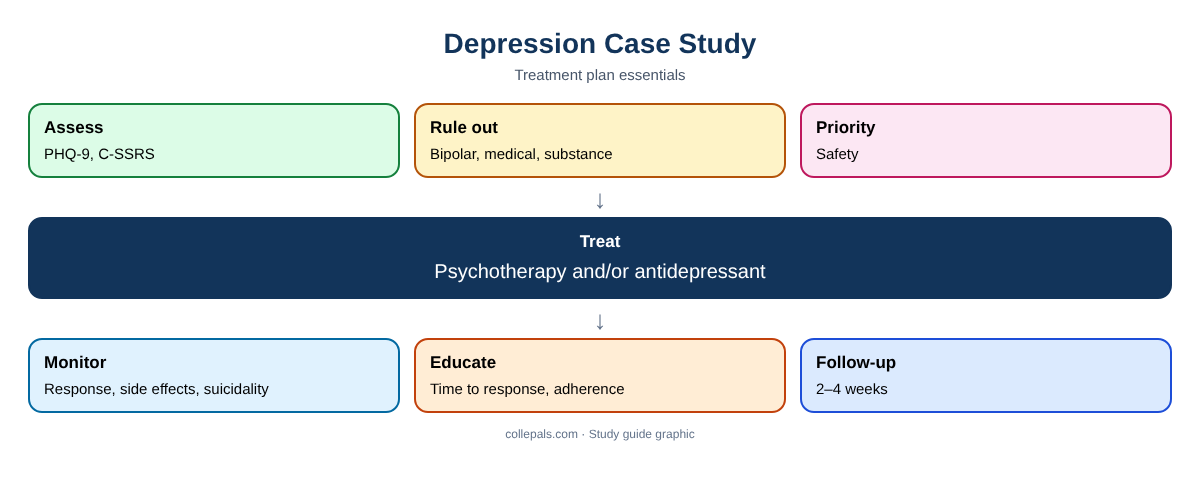
Assess depressive symptoms with the PHQ-9 and suicide risk with a structured tool, rule out bipolar disorder, substance and medical causes, prioritize safety, start evidence-based psychotherapy and/or antidepressant medication, monitor response, side effects and suicidality and follow up within two to four weeks.
Patients in this article are fictional and used for study purposes. Treatments are illustrative; follow current guidelines, provider orders, facility protocols and your scope of practice. This content is educational, not medical advice.
Sample document: a depression case treatment plan (Word).
The Case (Fictional)
Case
M.R., 34, reports three months of low mood after job loss, anhedonia, insomnia, 8-lb weight loss, guilt and passive death wishes without plan. PHQ-9: 19. No history of mania. TSH normal.
Assessment and Diagnosis
She meets DSM-5-TR criteria for major depressive disorder, with five or more symptoms over two weeks including depressed mood and anhedonia (American Psychiatric Association, 2022). The PHQ-9 quantifies severity (Kroenke et al., 2001), and the C-SSRS structures suicide risk assessment (Posner et al., 2011).
Clinical Management
- Psychotherapy (CBT, interpersonal therapy, behavioral activation) and/or an antidepressant such as an SSRI, SNRI, bupropion or mirtazapine (VA/DoD, 2022).
- Safety plan and crisis resources.
- Follow-up in 2–4 weeks; repeat PHQ-9.
- Teach expected time to response and side effects; antidepressants carry a boxed warning for suicidality in patients up to age 24.
Nursing Treatment Plan
| Problem / diagnosis | Goal (SMART) | Interventions | Rationale | Evaluation |
|---|---|---|---|---|
| Risk for suicide | No self-harm; collaborates on safety plan before discharge | C-SSRS each shift; remove means; safety plan; 988 Lifeline | Risk assessment and means restriction reduce harm | No self-harm; plan completed |
| Depressed mood / hopelessness | PHQ-9 reduced ≥50% in 8 weeks | Medication as ordered; monitor side effects; encourage CBT and behavioral activation | Combined psychotherapy and medication are guideline-supported (VA/DoD, 2022) | PHQ-9 19 → 11 at 6 weeks: partly met |
| Self-care deficit | Completes hygiene and eats ≥75% of meals daily within 1 week | Structured routine; positive reinforcement; nutrition monitoring | Routine and activation counter withdrawal | Met by day 5 |
Frequently Asked Questions
How soon do antidepressants work?
Some improvement may appear in 2–4 weeks; full response often takes longer.
Why rule out bipolar disorder?
Antidepressant monotherapy can destabilize bipolar disorder.
What is the top nursing priority?
Safety, particularly suicide risk.
Get Help With Your Depression Case Study at Collepals
Case study treatment plans take time to research and write. Collepals.com helps nursing and nurse practitioner students:
- Identify and prioritize problems from complex case data.
- Write SMART goals, interventions and evidence-based rationales.
- Find current guidelines and format references in APA 7.
- Study model treatment plans and get your drafts edited and proofread.
Browse our free model assignments or learn more about our nursing assignment writing service.
Use Collepals examples as study guides and follow your school’s academic integrity and AI policies.
More treatment plan guides
Collepals is an independent study resource. Follow your program’s care plan format and rubric and write your own work.
References
American Psychiatric Association. (2022). Diagnostic and statistical manual of mental disorders (5th ed., text rev.). https://doi.org/10.1176/appi.books.9780890425787
Kroenke, K., Spitzer, R. L., & Williams, J. B. W. (2001). The PHQ-9: Validity of a brief depression severity measure. Journal of General Internal Medicine, 16(9), 606–613. https://doi.org/10.1046/j.1525-1497.2001.016009606.x
Posner, K., Brown, G. K., Stanley, B., Brent, D. A., Yershova, K. V., Oquendo, M. A., Currier, G. W., Melvin, G. A., Greenhill, L., Shen, S., & Mann, J. J. (2011). The Columbia–Suicide Severity Rating Scale: Initial validity and internal consistency findings from three multisite studies with adolescents and adults. American Journal of Psychiatry, 168(12), 1266–1277. https://doi.org/10.1176/appi.ajp.2011.10111704
U.S. Department of Veterans Affairs & U.S. Department of Defense. (2022). VA/DoD clinical practice guideline for the management of major depressive disorder (Version 4.0). https://www.healthquality.va.gov/guidelines/MH/mdd/
Get a plagiarism-free answer to this question
Send us your instructions and we’ll match you with the best writer in your subject.
- 100% human-written, zero AI
- Turnitin report included
- Confidential — we never share your data
- Free revisions & refunds