PTSD Case Study: Treatment Plan and Evidence-Based Interventions
Need help with this assignment?Get an original answer from a qualified tutor — from $10/page.
Get it written →PTSD case studies require trauma-informed assessment, attention to safety and co-occurring conditions and evidence-based treatment. This PTSD case study presents a treatment plan and evidence-based interventions, with a downloadable plan.
Quick answer
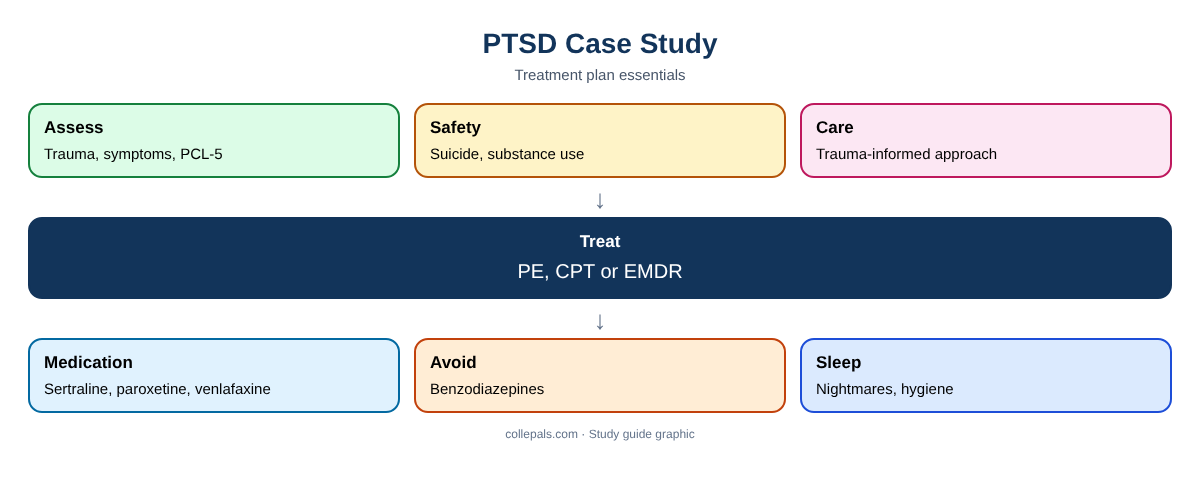
Confirm trauma exposure and symptoms across intrusion, avoidance, negative cognition and mood and arousal clusters lasting over one month, measure severity with the PCL-5, assess suicide and substance use, use trauma-informed care and recommend trauma-focused psychotherapy (PE, CPT or EMDR) as first-line treatment, with sertraline, paroxetine or venlafaxine as medication options and no benzodiazepines.
Patients in this article are fictional and used for study purposes. Treatments are illustrative; follow current guidelines, provider orders, facility protocols and your scope of practice. This content is educational, not medical advice.
Sample document: a PTSD treatment plan (Word).
The Case (Fictional)
Case
A.S., 38, a former paramedic, has nightmares and intrusive memories 14 months after a fatal crash, avoids highways, feels detached, startles easily and drinks 3–4 beers nightly to sleep. PCL-5: 52.
Assessment
Symptoms meet DSM-5-TR PTSD criteria (American Psychiatric Association, 2022). The PCL-5 measures severity and tracks change (Weathers et al., 2013).
Evidence-Based Treatment
- Trauma-focused psychotherapy, prolonged exposure, cognitive processing therapy or EMDR, is preferred over medication (VA/DoD, 2023).
- Medication options: sertraline, paroxetine or venlafaxine (VA/DoD, 2023).
- Benzodiazepines and cannabis are not recommended for PTSD (VA/DoD, 2023).
- Treat co-occurring alcohol use concurrently.
Nursing Treatment Plan
| Problem / diagnosis | Goal (SMART) | Interventions | Rationale | Evaluation |
|---|---|---|---|---|
| Post-trauma syndrome AEB nightmares, avoidance, hypervigilance; PCL-5 52 | PCL-5 reduced ≥10 points in 12 weeks | Trauma-informed care; referral for PE, CPT or EMDR; medication as ordered | Trauma-focused psychotherapy is preferred first-line (VA/DoD, 2023) | PCL-5 52 → 38: met |
| Risk for suicide | No self-harm; safety plan completed | C-SSRS; safety plan; crisis resources | Structured assessment reduces risk | Plan completed |
| Ineffective coping (alcohol to sleep) | Reduces drinking and uses 2 non-alcohol sleep strategies in 4 weeks | Screen alcohol use; sleep hygiene; refer for alcohol treatment | Co-occurring alcohol use worsens PTSD | Reduced to 2 drinks weekly: partly met |
Frequently Asked Questions
What is first-line treatment for PTSD?
Trauma-focused psychotherapies such as PE, CPT and EMDR.
Are benzodiazepines used for PTSD?
Guidelines recommend against them.
What is trauma-informed care?
Care that recognizes trauma’s impact, emphasizes safety, choice and trust and avoids re-traumatization.
Get Help With Your PTSD Case Study at Collepals
Case study treatment plans take time to research and write. Collepals.com helps nursing and nurse practitioner students:
- Identify and prioritize problems from complex case data.
- Write SMART goals, interventions and evidence-based rationales.
- Find current guidelines and format references in APA 7.
- Study model treatment plans and get your drafts edited and proofread.
Browse our free model assignments or learn more about our nursing assignment writing service.
Use Collepals examples as study guides and follow your school’s academic integrity and AI policies.
More treatment plan guides
Collepals is an independent study resource. Follow your program’s care plan format and rubric and write your own work.
References
American Psychiatric Association. (2022). Diagnostic and statistical manual of mental disorders (5th ed., text rev.). https://doi.org/10.1176/appi.books.9780890425787
U.S. Department of Veterans Affairs & U.S. Department of Defense. (2023). VA/DoD clinical practice guideline for the management of posttraumatic stress disorder and acute stress disorder (Version 4.0). https://www.healthquality.va.gov/guidelines/MH/ptsd/
Weathers, F. W., Litz, B. T., Keane, T. M., Palmieri, P. A., Marx, B. P., & Schnurr, P. P. (2013). The PTSD Checklist for DSM-5 (PCL-5). National Center for PTSD. https://www.ptsd.va.gov
Get a plagiarism-free answer to this question
Send us your instructions and we’ll match you with the best writer in your subject.
- 100% human-written, zero AI
- Turnitin report included
- Confidential — we never share your data
- Free revisions & refunds