Stroke Case Study: Treatment Plan and Nursing Management
Need help with this assignment?Get an original answer from a qualified tutor — from $10/page.
Get it written →Stroke case studies test rapid assessment, time-sensitive treatment and nursing care that prevents complications and supports recovery. This stroke case study walks through a treatment plan and nursing management, with a downloadable plan.
Quick answer
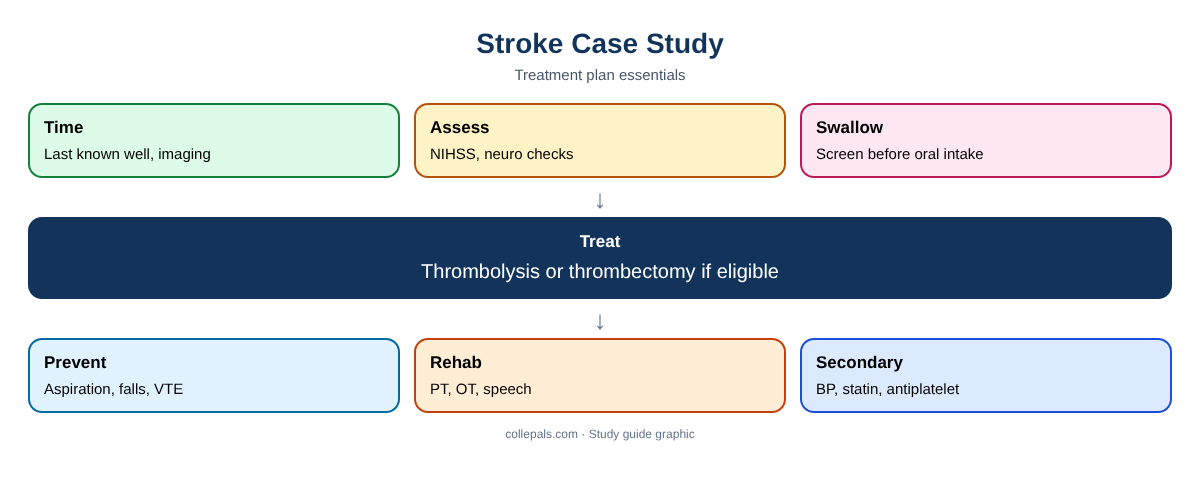
Recognize stroke signs fast, confirm last known well, support rapid imaging and reperfusion decisions, monitor neuro status and blood pressure, screen swallowing before any oral intake, prevent aspiration, falls and VTE, start early rehabilitation and teach secondary prevention and BE-FAST warning signs.
Patients in this article are fictional and used for study purposes. Treatments are illustrative; follow current guidelines, provider orders, facility protocols and your scope of practice. This content is educational, not medical advice.
Sample document: a stroke nursing treatment plan (Word).
The Case (Fictional)
Case
R.K., 68, with hypertension and atrial fibrillation (off anticoagulation), develops right-sided weakness and slurred speech; last known well 90 minutes before arrival. NIHSS 8. CT shows no hemorrhage.
Acute Management
- The 2026 AHA/ASA guideline keeps thrombolysis (tenecteplase or alteplase) within 4.5 hours for eligible patients, supports endovascular thrombectomy for selected patients up to 24 hours and sets a goal of brain imaging within about 25 minutes of arrival (American Heart Association, 2026).
- Frequent neuro checks and BP monitoring per protocol after thrombolysis.
- Swallow screen before food, fluids or oral medications (Powers et al., 2019).
- Secondary prevention: anticoagulation for atrial fibrillation when appropriate, statin, BP control.
Nursing Treatment Plan
| Problem / diagnosis | Goal (SMART) | Interventions | Rationale | Evaluation |
|---|---|---|---|---|
| Risk for aspiration r/t dysphagia | No aspiration; lungs clear throughout stay | NPO until bedside swallow screen; HOB ≥30°; SLP referral; modified diet as ordered | Dysphagia screening before oral intake reduces pneumonia risk (Powers et al., 2019) | Passed modified screen day 2; lungs clear: met |
| Risk for ineffective cerebral tissue perfusion | Stable or improving NIHSS; BP within ordered range | Neuro checks and NIHSS per protocol; BP monitoring; report changes immediately | Early detection of deterioration or hemorrhage guides urgent treatment | NIHSS 8 → 5: met |
| Impaired physical mobility (right hemiparesis) | Transfers bed to chair with 1 assist by day 5 | Early mobilization with PT/OT; positioning; fall precautions; VTE prophylaxis as ordered | Early rehab improves function; prevents complications | Transfers with 1 assist day 4: met |
| Deficient knowledge: stroke prevention | Patient and spouse state BE-FAST signs and medication plan | Teach-back on warning signs, antiplatelet, statin, BP control | Secondary prevention reduces recurrent stroke | Teach-back correct |
Need help with the plan format? See How to Write a Treatment Plan for a Nursing Case Study.
Frequently Asked Questions
What is the first nursing priority in suspected stroke?
Rapid recognition, noting last known well time and activating the stroke team.
Why screen swallowing before oral intake?
Dysphagia is common after stroke and raises aspiration pneumonia risk.
What is BE-FAST?
Balance, Eyes, Face, Arm, Speech, Time: warning signs to teach patients and families.
Get Help With Your Stroke Case Study at Collepals
Case study treatment plans take time to research and write. Collepals.com helps nursing and nurse practitioner students:
- Identify and prioritize problems from complex case data.
- Write SMART goals, interventions and evidence-based rationales.
- Find current guidelines and format references in APA 7.
- Study model treatment plans and get your drafts edited and proofread.
Browse our free model assignments or learn more about our nursing assignment writing service.
Use Collepals examples as study guides and follow your school’s academic integrity and AI policies.
More treatment plan guides
Collepals is an independent study resource. Follow your program’s care plan format and rubric and write your own work.
References
American Heart Association. (2026, January 26). New guideline expands stroke treatment for adults, offers first pediatric stroke guidance [News release]. EurekAlert! https://www.eurekalert.org/news-releases/1113946
Powers, W. J., Rabinstein, A. A., Ackerson, T., Adeoye, O. M., Bambakidis, N. C., Becker, K., Biller, J., Brown, M., Demaerschalk, B. M., Hoh, B., Jauch, E. C., Kidwell, C. S., Leslie-Mazwi, T. M., Ovbiagele, B., Scott, P. A., Sheth, K. N., Southerland, A. M., Summers, D. V., & Tirschwell, D. L. (2019). Guidelines for the early management of patients with acute ischemic stroke: 2019 update to the 2018 guidelines. Stroke, 50(12), e344–e418. https://doi.org/10.1161/STR.0000000000000211
Get a plagiarism-free answer to this question
Send us your instructions and we’ll match you with the best writer in your subject.
- 100% human-written, zero AI
- Turnitin report included
- Confidential — we never share your data
- Free revisions & refunds