Pneumonia Case Study: Treatment Plan and Clinical Management
Need help with this assignment?Get an original answer from a qualified tutor — from $10/page.
Get it written →Pneumonia case studies focus on severity assessment, prompt antibiotics, oxygenation and recognizing sepsis. This pneumonia case study presents a treatment plan and clinical management, with a downloadable plan.
Quick answer
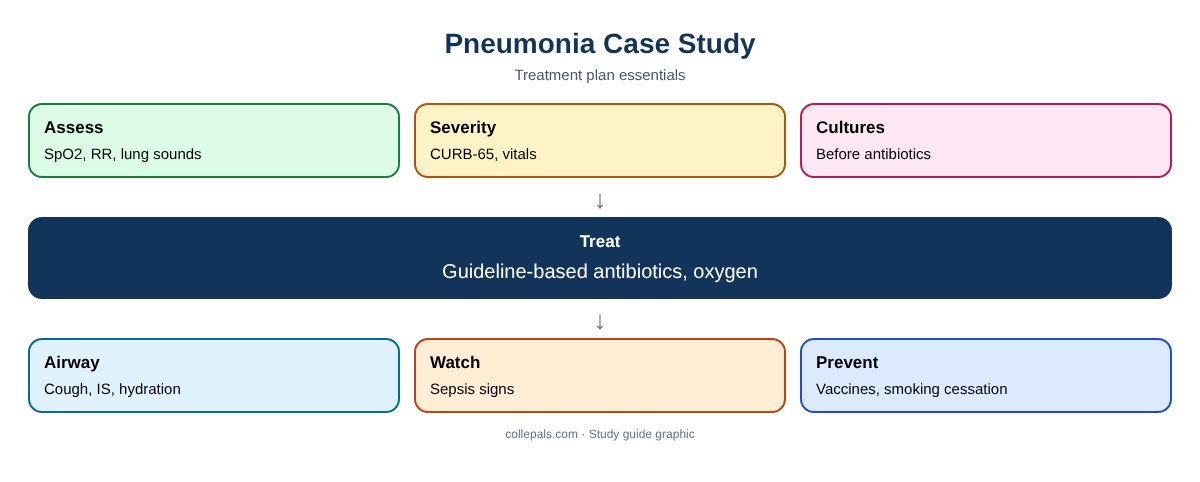
Assess respiratory status and severity with a tool such as CURB-65, obtain chest imaging and cultures as indicated, start guideline-based antibiotics promptly, titrate oxygen, monitor for sepsis and deterioration, promote airway clearance, hydration and mobility and teach vaccination and follow-up.
Patients in this article are fictional and used for study purposes. Treatments are illustrative; follow current guidelines, provider orders, facility protocols and your scope of practice. This content is educational, not medical advice.
Sample document: a pneumonia treatment plan (Word).
The Case (Fictional)
Case
E.W., 74, has 3 days of productive cough, fever 39.1 °C, RR 26, BP 118/70, SpO2 89% on room air, new confusion and BUN 24 mg/dL. Chest x-ray: right lower lobe consolidation.
Severity Assessment
CURB-65 scores one point each for confusion, urea above 7 mmol/L (BUN above 19 mg/dL), RR 30 or more, low BP (systolic below 90 or diastolic 60 or less) and age 65 or older; scores of 2 or more suggest hospital care (Lim et al., 2003). E.W. scores 3.
Clinical Management
- Inpatient non-severe CAP: beta-lactam plus macrolide, or a respiratory fluoroquinolone (Metlay et al., 2019).
- Blood and sputum cultures in severe CAP or with risk factors for MRSA or Pseudomonas (Metlay et al., 2019).
- Oxygen titration; sepsis screening; reassess at 48–72 hours.
- Vaccines (pneumococcal, influenza, COVID-19, RSV when eligible) before discharge planning.
Nursing Treatment Plan
| Problem / diagnosis | Goal (SMART) | Interventions | Rationale | Evaluation |
|---|---|---|---|---|
| Impaired gas exchange AEB SpO2 89%, RR 26 | SpO2 ≥92% on ≤2 L within 48 h | Oxygen titration as ordered; HOB up; pulse oximetry; incentive spirometry | Improves oxygenation and lung expansion | SpO2 94% on 2 L at 36 h: met |
| Ineffective airway clearance | Clears secretions; lungs improving in 72 h | Cough and deep breathing; mobilize; fluids unless restricted | Mobilizing secretions improves ventilation | Met |
| Risk for sepsis / infection progression | Timely antibiotics; MAP ≥65; no deterioration | Cultures before antibiotics as ordered; give antibiotics promptly; monitor vitals, lactate, mental status | Early recognition and treatment improve outcomes | Antibiotics within 1 h; stable |
| Risk for deficient fluid volume | Urine ≥0.5 mL/kg/h; moist mucosa | Monitor I&O; fluids as ordered | Fever and tachypnea increase losses | Met |
Frequently Asked Questions
What does CURB-65 measure?
Pneumonia severity to guide site of care.
Why are cultures drawn before antibiotics?
To identify the organism without delaying antibiotic administration.
What signs suggest sepsis?
Hypotension, rising lactate, altered mental status, tachycardia and decreased urine output.
Get Help With Your Pneumonia Case Study at Collepals
Case study treatment plans take time to research and write. Collepals.com helps nursing and nurse practitioner students:
- Identify and prioritize problems from complex case data.
- Write SMART goals, interventions and evidence-based rationales.
- Find current guidelines and format references in APA 7.
- Study model treatment plans and get your drafts edited and proofread.
Browse our free model assignments or learn more about our nursing assignment writing service.
Use Collepals examples as study guides and follow your school’s academic integrity and AI policies.
More treatment plan guides
Collepals is an independent study resource. Follow your program’s care plan format and rubric and write your own work.
References
Lim, W. S., van der Eerden, M. M., Laing, R., Boersma, W. G., Karalus, N., Town, G. I., Lewis, S. A., & Macfarlane, J. T. (2003). Defining community acquired pneumonia severity on presentation to hospital: An international derivation and validation study. Thorax, 58(5), 377–382. https://doi.org/10.1136/thorax.58.5.377
Metlay, J. P., Waterer, G. W., Long, A. C., Anzueto, A., Brozek, J., Crothers, K., Cooley, L. A., Dean, N. C., Fine, M. J., Flanders, S. A., Griffin, M. R., Metersky, M. L., Musher, D. M., Restrepo, M. I., & Whitney, C. G. (2019). Diagnosis and treatment of adults with community-acquired pneumonia: An official clinical practice guideline of the American Thoracic Society and Infectious Diseases Society of America. American Journal of Respiratory and Critical Care Medicine, 200(7), e45–e67. https://doi.org/10.1164/rccm.201908-1581ST
Get a plagiarism-free answer to this question
Send us your instructions and we’ll match you with the best writer in your subject.
- 100% human-written, zero AI
- Turnitin report included
- Confidential — we never share your data
- Free revisions & refunds