How to Prioritize Patient Problems When Developing a Treatment Plan
Need help with this assignment?Get an original answer from a qualified tutor — from $10/page.
Get it written →Case studies often contain more problems than you can address. Prioritizing shows clinical judgment and is a major NCLEX skill. This guide explains how to prioritize patient problems when developing a treatment plan, with a ranked example you can download.
Quick answer
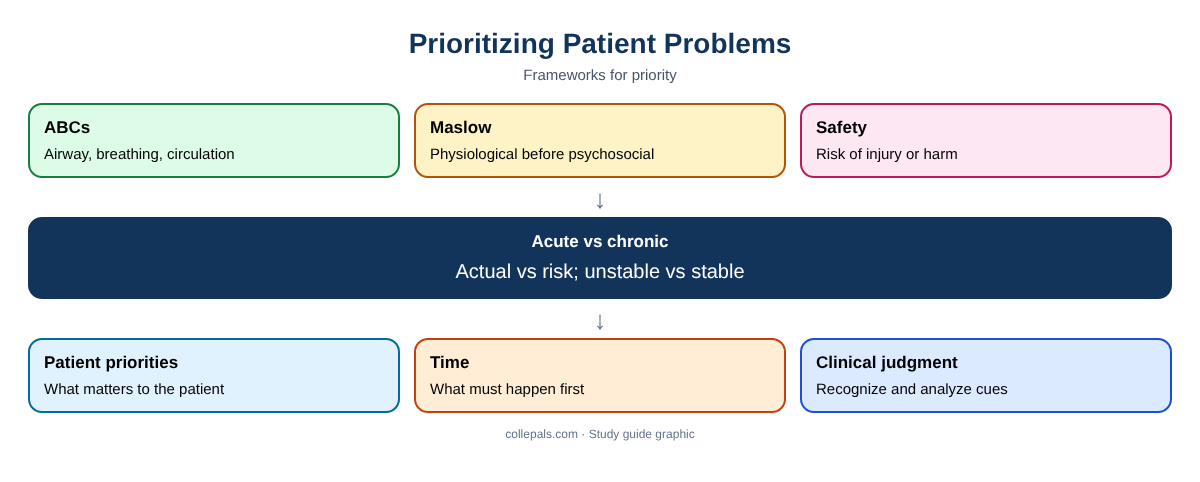
Prioritize life-threatening problems first using airway, breathing and circulation; then safety risks and other physiological needs before psychosocial and learning needs, following Maslow’s hierarchy. Place actual, unstable and acute problems ahead of potential, stable and chronic ones, while considering what matters most to the patient.
Sample document: a ranked problem list with rationale (Word).
Prioritization Frameworks
| Framework | How to use it |
|---|---|
| ABCs | Airway, then breathing, then circulation |
| Maslow’s hierarchy | Physiological needs before safety, belonging and esteem (Maslow, 1943) |
| Safety | Risk of falls, bleeding, self-harm |
| Acute vs. chronic | New or worsening problems first |
| Actual vs. risk | Actual problems usually before potential ones, unless the risk is severe |
Example Ranking (Fictional)
| Problem | Framework | Reason |
|---|---|---|
| 1. Ineffective airway clearance | Airway | Highest priority: airway threat |
| 2. Impaired gas exchange | Breathing | SpO2 88% |
| 3. Risk for bleeding (on anticoagulant) | Circulation / safety | Potential, serious |
| 4. Acute pain | Physiological comfort | Important but not life-threatening |
| 5. Anxiety | Psychosocial | Address after physiological stability |
| 6. Deficient knowledge | Learning | Before discharge |
Clinical Judgment
Prioritization is dynamic: reassess as the patient changes. A risk diagnosis such as suicide risk can outrank physical problems when danger is imminent; see depression case study.
Patient Priorities
Ask what matters most to the patient; a patient focused on pain may not engage in teaching until pain is controlled.
Frequently Asked Questions
Is pain always a low priority?
No; severe pain can be urgent and affects breathing and mobility, but airway and breathing threats come first.
Do risk diagnoses come last?
Not always; a serious risk, such as suicide or bleeding, can be top priority.
How many problems should I include?
Usually the top two to four.
Get Help Prioritizing Problems at Collepals
Case study treatment plans take time to research and write. Collepals.com helps nursing and nurse practitioner students:
- Identify and prioritize problems from complex case data.
- Write SMART goals, interventions and evidence-based rationales.
- Find current guidelines and format references in APA 7.
- Study model treatment plans and get your drafts edited and proofread.
Browse our free model assignments or learn more about our nursing assignment writing service.
Use Collepals examples as study guides and follow your school’s academic integrity and AI policies.
More treatment plan guides
Collepals is an independent study resource. Follow your program’s care plan format and rubric and write your own work.
References
Maslow, A. H. (1943). A theory of human motivation. Psychological Review, 50(4), 370–396. https://doi.org/10.1037/h0054346
Get a plagiarism-free answer to this question
Send us your instructions and we’ll match you with the best writer in your subject.
- 100% human-written, zero AI
- Turnitin report included
- Confidential — we never share your data
- Free revisions & refunds