How to Develop an Evidence-Based Treatment Plan From a Patient Case Study
Need help with this assignment?Get an original answer from a qualified tutor — from $10/page.
Get it written →An evidence-based treatment plan does more than list interventions: it shows that each choice is supported by current guidelines or research and adapted to the patient. This guide explains how to develop an evidence-based treatment plan from a patient case study, with a worked heart failure example you can download.
Quick answer
Identify the patient’s priority problems, frame a clinical question for each, search for current guidelines and systematic reviews, match evidence to the patient’s specific data and preferences, write interventions and rationales citing that evidence and define measurable outcomes to evaluate.
Patients in this article are fictional and used for study purposes. Treatments are illustrative; follow current guidelines, provider orders, facility protocols and your scope of practice. This content is educational, not medical advice.
Sample document: an evidence-based heart failure treatment plan (Word).
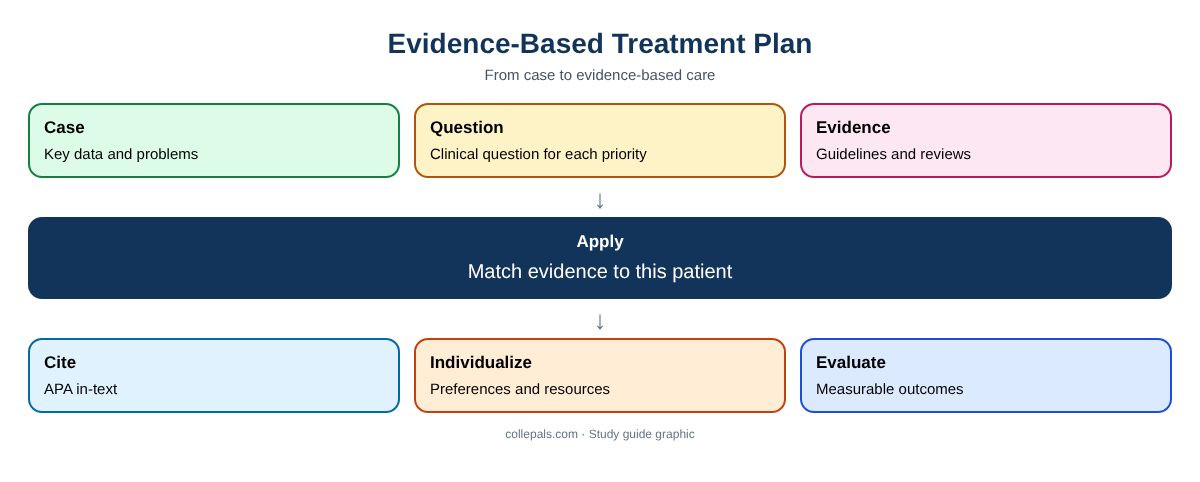
Step 1: Identify Priorities
Cluster cues and prioritize, see prioritizing problems.
Step 2: Ask Clinical Questions
For each priority, ask what the best evidence recommends, for example, “What self-care education reduces readmissions in heart failure?”
Step 3: Find High-Level Evidence
Start with clinical practice guidelines, then systematic reviews and recent studies (Melnyk & Fineout-Overholt, 2023).
Step 4: Apply to the Patient
Consider comorbidities, values, health literacy and resources. Evidence informs, but the patient’s situation decides; see patient-centered planning.
Step 5: Cite in Rationales
Each rationale should reference the evidence that supports it.
Worked Example (Fictional)
| Problem / diagnosis | Goal (SMART) | Interventions | Rationale | Evaluation |
|---|---|---|---|---|
| Excess fluid volume r/t reduced cardiac output | Weight −1 kg and decreased edema in 48 h | Daily weights, I&O, diuretic as ordered, sodium restriction | 2022 HF guideline supports diuretics for congestion and self-care education (AHA, 2022) | Weight −1.5 kg: met |
| Activity intolerance | Walks 30 m with SpO2 ≥92% by discharge | Progressive ambulation; monitor vitals before and after | Gradual activity improves tolerance while monitoring safety | Walked 30 m: met |
| Deficient knowledge | States 3 warning signs and daily weight plan before discharge | Teach-back education with written materials | Teach-back effective in 19 of 20 studies (Talevski et al., 2020) | Teach-back correct: met |
Frequently Asked Questions
What counts as evidence?
Clinical practice guidelines, systematic reviews, research studies and authoritative textbooks.
How current should sources be?
Usually within five years, unless a guideline or seminal source is older and still current.
Can I use the course textbook?
Yes, often combined with outside guidelines and research.
Get Help With Evidence-Based Plans at Collepals
Case study treatment plans take time to research and write. Collepals.com helps nursing and nurse practitioner students:
- Identify and prioritize problems from complex case data.
- Write SMART goals, interventions and evidence-based rationales.
- Find current guidelines and format references in APA 7.
- Study model treatment plans and get your drafts edited and proofread.
Browse our free model assignments or learn more about our nursing assignment writing service.
Use Collepals examples as study guides and follow your school’s academic integrity and AI policies.
More treatment plan guides
Collepals is an independent study resource. Follow your program’s care plan format and rubric and write your own work.
References
American Heart Association. (2022). 2022 AHA/ACC/HFSA guideline for the management of heart failure [Guideline highlights]. https://professional.heart.org/en/science-news/2022-guideline-for-the-management-of-heart-failure
Melnyk, B. M., & Fineout-Overholt, E. (2023). Evidence-based practice in nursing & healthcare: A guide to best practice (5th ed.). Wolters Kluwer.
Talevski, J., Wong Shee, A., Rasmussen, B., Kemp, G., & Beauchamp, A. (2020). Teach-back: A systematic review of implementation and impacts. PLOS ONE, 15(4), Article e0231350. https://doi.org/10.1371/journal.pone.0231350
Get a plagiarism-free answer to this question
Send us your instructions and we’ll match you with the best writer in your subject.
- 100% human-written, zero AI
- Turnitin report included
- Confidential — we never share your data
- Free revisions & refunds