How to Write Nursing Interventions With Rationales
Need help with this assignment?Get an original answer from a qualified tutor — from $10/page.
Get it written →Interventions are what you do for the patient; rationales explain why. Instructors grade both heavily, because rationales show clinical reasoning. This guide explains how to write nursing interventions with rationales, with examples and a downloadable sample.
Quick answer
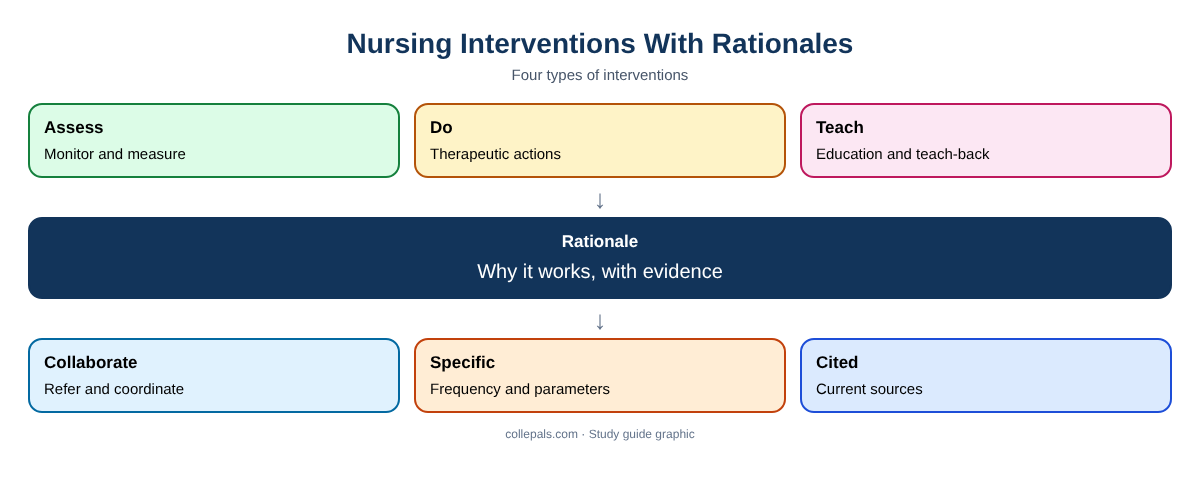
Write interventions that are specific (what, how often, what parameters), cover assessment, therapeutic actions, teaching and collaboration and directly address the problem’s cause. For each, write a rationale that explains the physiological or psychological reason it works, supported by a current source.
Patients in this article are fictional and used for study purposes. Treatments are illustrative; follow current guidelines, provider orders, facility protocols and your scope of practice. This content is educational, not medical advice.
Sample document: a sample intervention and rationale table for heart failure (Word).
Four Types of Interventions
| Type | Example |
|---|---|
| Assessment | Monitor SpO2 and respiratory rate every 2 hours |
| Therapeutic | Elevate head of bed 30–45 degrees |
| Teaching | Teach incentive spirometer use, 10 times per hour while awake |
| Collaborative | Consult respiratory therapy |
Writing Strong Rationales
- Explain the mechanism: “Elevating the head of the bed improves diaphragmatic excursion and lung expansion.”
- Link to the problem’s cause.
- Cite evidence when possible (Melnyk & Fineout-Overholt, 2023).
Example: Heart Failure (Fictional)
| Problem / diagnosis | Goal (SMART) | Interventions | Rationale | Evaluation |
|---|---|---|---|---|
| Excess fluid volume | Weight down 1 kg in 48 h | Assess: weigh daily, same scale, before breakfast | Daily weight is the most sensitive indicator of fluid change | Weight −1.2 kg: met |
| Do: give furosemide as ordered; monitor K+ | Loop diuretics remove fluid but cause potassium loss | K+ 4.0 | ||
| Teach: 2 g sodium diet; daily weights at home | Sodium restriction limits fluid retention; self-monitoring detects early change | Teach-back correct | ||
| Collaborate: dietitian consult | Specialist input supports adherence | Consult done |
Common Mistakes
- Vague interventions (“monitor patient”).
- Rationales that restate the intervention.
- Interventions outside nursing scope without “as ordered.”
- No teaching or collaboration.
See heart failure case study for the full plan.
Frequently Asked Questions
How many interventions per problem?
Usually three to five, including at least one teaching intervention.
Do rationales need citations?
Most academic assignments require them.
What does ‘as ordered’ mean?
It indicates an intervention requiring a provider order, such as medications.
Get Help With Interventions and Rationales at Collepals
Case study treatment plans take time to research and write. Collepals.com helps nursing and nurse practitioner students:
- Identify and prioritize problems from complex case data.
- Write SMART goals, interventions and evidence-based rationales.
- Find current guidelines and format references in APA 7.
- Study model treatment plans and get your drafts edited and proofread.
Browse our free model assignments or learn more about our nursing assignment writing service.
Use Collepals examples as study guides and follow your school’s academic integrity and AI policies.
More treatment plan guides
Collepals is an independent study resource. Follow your program’s care plan format and rubric and write your own work.
References
Melnyk, B. M., & Fineout-Overholt, E. (2023). Evidence-based practice in nursing & healthcare: A guide to best practice (5th ed.). Wolters Kluwer.
Get a plagiarism-free answer to this question
Send us your instructions and we’ll match you with the best writer in your subject.
- 100% human-written, zero AI
- Turnitin report included
- Confidential — we never share your data
- Free revisions & refunds