Treatment Plan Examples for Nursing Students
Need help with this assignment?Get an original answer from a qualified tutor — from $10/page.
Get it written →Examples make treatment plans easier to understand. These treatment plan examples for nursing students cover common conditions, each with a problem, SMART goal, interventions, rationale and evaluation. A downloadable document includes all examples.
Quick answer
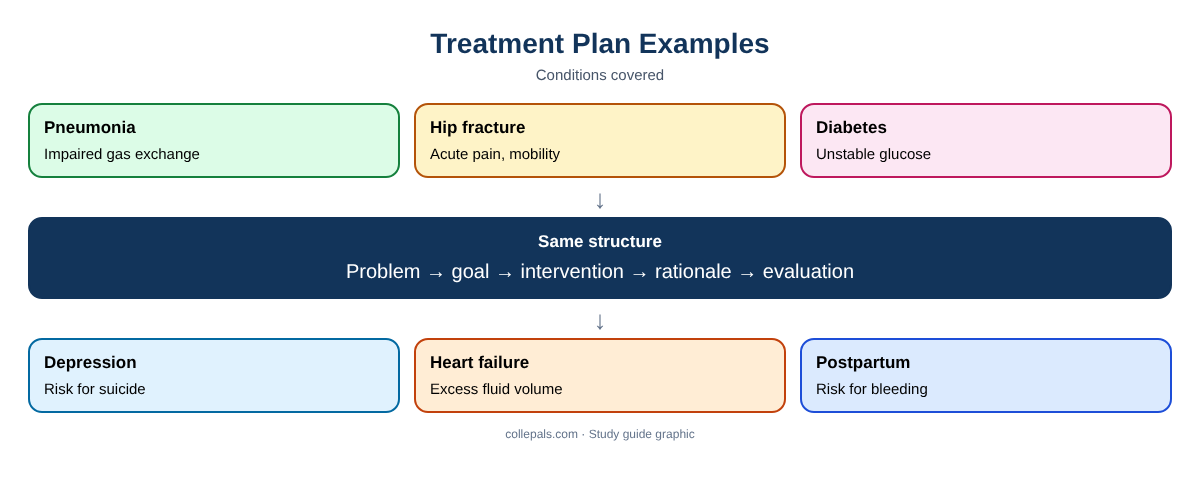
Each example follows the same structure: a prioritized problem supported by case data, a measurable goal, specific interventions, a rationale explaining why each intervention works and an evaluation statement.
Patients in this article are fictional and used for study purposes. Treatments are illustrative; follow current guidelines, provider orders, facility protocols and your scope of practice. This content is educational, not medical advice.
Sample document: a set of treatment plan examples for six conditions (Word).
Examples
| Problem / diagnosis | Goal (SMART) | Interventions | Rationale | Evaluation |
|---|---|---|---|---|
| Impaired gas exchange r/t alveolar inflammation AEB SpO2 89% RA, RR 26, crackles RLL | SpO2 ≥92% on ≤2 L O2 within 24 h | Monitor SpO2 and RR q2h; O2 as ordered; HOB 30–45°; IS 10×/h awake | Positioning and lung expansion improve ventilation; monitoring detects deterioration | SpO2 94% on 2 L at 24 h: met |
| Hip fracture repair: impaired physical mobility r/t pain and surgical restrictions | Walks 15 m with walker and 1 assist by POD 2 | PT collaboration; premedicate before activity; reinforce hip precautions; fall precautions | Early mobility prevents complications; analgesia enables participation | Walked 15 m: met |
| Type 2 diabetes: risk for unstable blood glucose | Glucose 140–180 mg/dL before meals within 48 h | Glucose AC/HS; insulin as ordered; coordinate meals; hypoglycemia teaching | Matching insulin to intake prevents highs and lows | Glucose 150–176: met |
| Depression: risk for suicide | Remains free of self-harm; identifies 2 coping strategies and crisis contacts before discharge | C-SSRS screening; environmental safety; collaborative safety plan | Structured assessment and safety planning reduce risk | Safety plan completed: met |
| Heart failure: excess fluid volume | Weight down 1 kg and fewer crackles in 48 h | Daily weights; I&O; diuretic as ordered; monitor K+; sodium teaching | Daily weight is the best indicator of fluid status | Weight −1.4 kg: met |
| Postpartum: risk for bleeding | Fundus firm, lochia moderate or less for 24 h | Fundal checks per protocol; massage if boggy; monitor vitals; encourage voiding | A full bladder displaces the uterus and increases bleeding | Fundus firm: met |
Conditions: pneumonia, hip fracture, diabetes, depression, heart failure and postpartum care (fictional patients).
What the Examples Have in Common
- Problems are specific to case cues.
- Goals include numbers and time frames.
- Interventions include frequency and parameters.
- Rationales explain mechanisms.
- Evaluations restate data and judge whether the goal was met.
For detailed case studies, see heart failure, diabetes and depression.
Frequently Asked Questions
Can I copy these examples?
Use them to learn structure; your plan must reflect your case data and your own words.
Why include evaluation in an example?
It shows how goals are measured and closes the nursing process.
Are these real patients?
No; all examples are fictional.
Get Help With Your Treatment Plans at Collepals
Case study treatment plans take time to research and write. Collepals.com helps nursing and nurse practitioner students:
- Identify and prioritize problems from complex case data.
- Write SMART goals, interventions and evidence-based rationales.
- Find current guidelines and format references in APA 7.
- Study model treatment plans and get your drafts edited and proofread.
Browse our free model assignments or learn more about our nursing assignment writing service.
Use Collepals examples as study guides and follow your school’s academic integrity and AI policies.
More treatment plan guides
Collepals is an independent study resource. Follow your program’s care plan format and rubric and write your own work.
References
Herdman, T. H., Kamitsuru, S., & Lopes, C. T. (Eds.). (2024). NANDA-I international nursing diagnoses: Definitions and classification, 2024–2026 (13th ed.). Thieme.
Get a plagiarism-free answer to this question
Send us your instructions and we’ll match you with the best writer in your subject.
- 100% human-written, zero AI
- Turnitin report included
- Confidential — we never share your data
- Free revisions & refunds