Psychiatric Case Study Treatment Plans: Complete Guide
Need help with this assignment?Get an original answer from a qualified tutor — from $10/page.
Get it written →Psychiatric treatment plans combine diagnosis, safety, medication management, psychotherapy and nursing care. Whether you are a nursing student on a mental health rotation or a PMHNP student, this complete guide explains how to write a psychiatric case study treatment plan, with a downloadable sample.
Quick answer
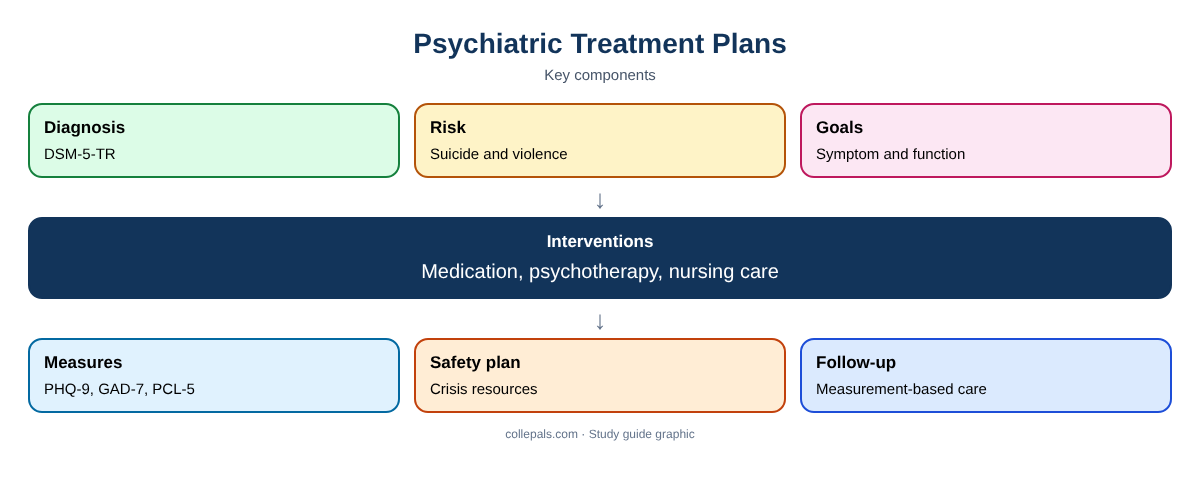
A psychiatric treatment plan identifies DSM-5-TR diagnoses, assesses suicide and violence risk, sets symptom and functional goals, combines evidence-based medication, psychotherapy and nursing interventions, uses validated rating scales to track progress and includes a safety plan, education and follow-up.
Patients in this article are fictional and used for study purposes. Treatments are illustrative; follow current guidelines, provider orders, facility protocols and your scope of practice. This content is educational, not medical advice.
Sample document: a sample psychiatric nursing treatment plan (Word).
Key Components
| Component | What to include |
|---|---|
| Diagnosis | DSM-5-TR diagnoses with specifiers (American Psychiatric Association, 2022) |
| Risk assessment | Suicide and violence, protective factors |
| Goals | Symptom reduction and functional recovery |
| Interventions | Medication, psychotherapy, nursing care |
| Measures | PHQ-9, GAD-7, PCL-5 and others |
| Safety and education | Safety plan, crisis resources, family involvement |
| Follow-up | Timing and what will be reassessed |
Measurement-Based Care
Repeating validated scales at each visit to guide treatment improves outcomes compared with usual care (Fortney et al., 2017).
Sample Nursing Plan (Fictional)
| Problem / diagnosis | Goal (SMART) | Interventions | Rationale | Evaluation |
|---|---|---|---|---|
| Risk for suicide | Remains free of self-harm; agrees to safety plan | C-SSRS; environmental safety; observation per order; collaborative safety plan with 988 Lifeline | Structured assessment and safety planning reduce risk (Posner et al., 2011) | Safety plan completed |
| Disturbed sleep pattern | Sleeps ≥6 h on 5 of 7 nights in 2 weeks | Sleep hygiene teaching; limit caffeine; monitor sleep log | Sleep regularity supports mood stability | Sleep log 6 h on 4 nights: partly met |
| Ineffective coping | Uses 2 coping skills daily within 1 week | Teach grounding and behavioral activation; encourage therapy attendance | Active coping reduces symptom burden | Uses walking and journaling: met |
Condition Guides
- Depression Case Study: Treatment Plan and Clinical Management
- Anxiety Case Study: Treatment Plan and Nursing Interventions
- Bipolar Disorder Case Study: Treatment Plan and Management
- PTSD Case Study: Treatment Plan and Evidence-Based Interventions
Frequently Asked Questions
Should every psychiatric plan include a safety plan?
Whenever suicide or violence risk is present, and risk should be assessed for every patient.
What scales should I use?
Choose validated tools matching the diagnosis, such as the PHQ-9 for depression.
Do nursing students include medications?
Nursing plans include administering, monitoring and teaching about ordered medications.
Get Help With Psychiatric Treatment Plans at Collepals
Case study treatment plans take time to research and write. Collepals.com helps nursing and nurse practitioner students:
- Identify and prioritize problems from complex case data.
- Write SMART goals, interventions and evidence-based rationales.
- Find current guidelines and format references in APA 7.
- Study model treatment plans and get your drafts edited and proofread.
Browse our free model assignments or learn more about our nursing assignment writing service.
Use Collepals examples as study guides and follow your school’s academic integrity and AI policies.
More treatment plan guides
Collepals is an independent study resource. Follow your program’s care plan format and rubric and write your own work.
References
American Psychiatric Association. (2022). Diagnostic and statistical manual of mental disorders (5th ed., text rev.). https://doi.org/10.1176/appi.books.9780890425787
Fortney, J. C., Unützer, J., Wrenn, G., Pyne, J. M., Smith, G. R., Schoenbaum, M., & Harbin, H. T. (2017). A tipping point for measurement-based care. Psychiatric Services, 68(2), 179–188. https://doi.org/10.1176/appi.ps.201500439
Posner, K., Brown, G. K., Stanley, B., Brent, D. A., Yershova, K. V., Oquendo, M. A., Currier, G. W., Melvin, G. A., Greenhill, L., Shen, S., & Mann, J. J. (2011). The Columbia–Suicide Severity Rating Scale: Initial validity and internal consistency findings from three multisite studies with adolescents and adults. American Journal of Psychiatry, 168(12), 1266–1277. https://doi.org/10.1176/appi.ajp.2011.10111704
Get a plagiarism-free answer to this question
Send us your instructions and we’ll match you with the best writer in your subject.
- 100% human-written, zero AI
- Turnitin report included
- Confidential — we never share your data
- Free revisions & refunds