Psychiatric Assessment and Mental Status Examination Guide
Need help with this assignment?Get an original answer from a qualified tutor — from $10/page.
Get it written →A psychiatric assessment assignment often asks you to complete and document a mental status examination (MSE) along with a psychiatric history and risk screening. This guide explains each MSE domain, how to document objectively and how to write up a psychiatric assessment, with a fictional example.
Quick answer
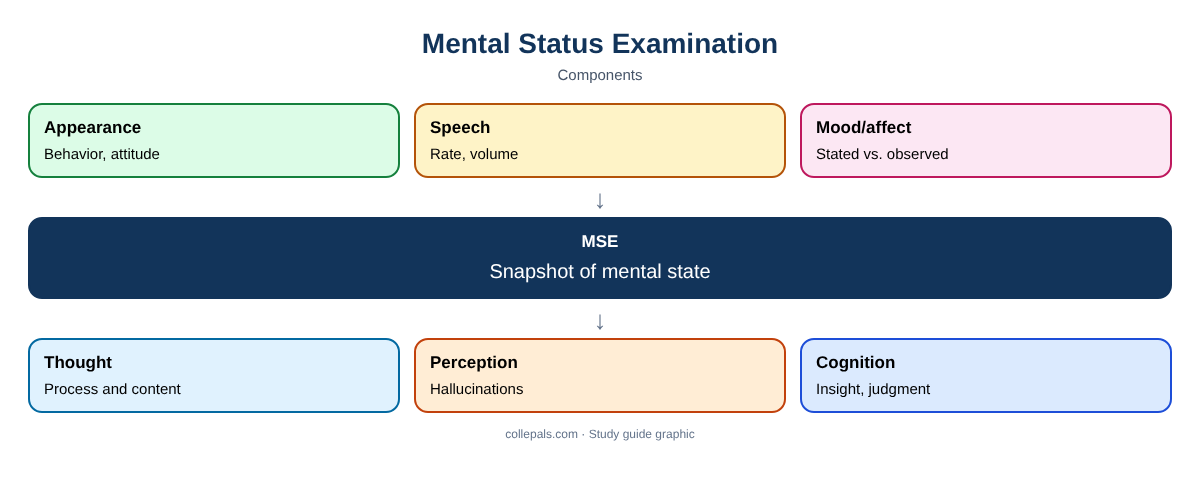
A psychiatric assessment combines a history (presenting problem, psychiatric, medical, substance use and social history) with a mental status examination covering appearance, behavior, speech, mood, affect, thought process, thought content, perception, cognition, insight and judgment, plus suicide and violence risk screening and validated rating scales. Document objective observations and quote the patient’s own words for mood.
Patients and examples on this page are fictional and written by Collepals for study purposes. Course codes, assignments and rubrics vary by school, so always follow your own syllabus. This content is educational, not clinical advice.
Sample document: a mental status examination documentation template with a fictional example (Word).
Psychiatric Assessment Components
- Identifying data and chief complaint in the patient’s words
- History of present illness
- Past psychiatric history, hospitalizations and medications
- Substance use
- Medical history and current medications
- Family and social history, trauma, supports, strengths
- Mental status examination
- Risk assessment: suicide (for example, C-SSRS; Posner et al., 2011) and violence
- Rating scales such as the PHQ-9 or GAD-7; cognitive screening such as the MoCA when indicated (Nasreddine et al., 2005)
Mental Status Examination Guide
| Domain | What to assess | Example documentation (fictional) |
|---|---|---|
| Appearance | Grooming, dress, hygiene, apparent age | Disheveled, wearing heavy coat in warm room |
| Behavior and attitude | Eye contact, psychomotor activity, cooperation | Poor eye contact; psychomotor slowing; cooperative |
| Speech | Rate, volume, rhythm, quantity | Slow, soft, monotone |
| Mood | Patient’s own words | “I feel empty.” |
| Affect | Observed range, congruence | Constricted, congruent with mood |
| Thought process | Organization of thinking | Linear and goal-directed |
| Thought content | Delusions, obsessions, suicidal or homicidal ideation | Passive suicidal ideation without plan; no homicidal ideation |
| Perception | Hallucinations, illusions | Denies hallucinations; not responding to internal stimuli |
| Cognition | Orientation, attention, memory | Oriented ×4; recalls 3/3 words |
| Insight and judgment | Understanding of illness; decision-making | Fair insight; fair judgment |
Documentation Tips
- Describe, don’t label: “speech rapid and difficult to interrupt” instead of “manic.”
- Quote the patient for mood and key statements.
- Always document suicidal and homicidal ideation, even when absent.
- Distinguish thought process (how) from thought content (what).
- Note strengths and protective factors.
Use your findings in Mental Health Nursing Care Plans: Assignment Guide or How to Write a Psychiatric Treatment Plan.
Frequently Asked Questions
What is the difference between mood and affect?
Mood is what the patient reports; affect is what you observe.
Is the MSE the same as the MMSE?
No. The MSE is a broad mental status assessment; the MMSE is a specific cognitive screening test.
Should I always ask about suicide?
Yes. Asking directly does not increase risk and is a core part of psychiatric assessment.
Get Help With Your Psychiatric Assessment Assignment
Psychiatric mental health nursing assignments demand clinical reasoning, therapeutic communication and careful APA writing. Collepals.com helps nursing students in psychiatric mental health courses:
- Plan discussion posts and thoughtful peer responses.
- Write case studies, care plans, concept maps and treatment plans.
- Structure reflections and mental status exam write-ups.
- Find current evidence, cite in APA 7 and get drafts edited and proofread.
Browse our free model assignments or learn more about our nursing assignment writing service.
Use Collepals examples as study guides and follow your school’s academic integrity and AI policies.
More psychiatric mental health nursing guides
Collepals is an independent study resource. Follow your program’s instructions and rubric and write your own work.
References
American Psychiatric Association. (2022). Diagnostic and statistical manual of mental disorders (5th ed., text rev.). https://doi.org/10.1176/appi.books.9780890425787
Kroenke, K., Spitzer, R. L., & Williams, J. B. W. (2001). The PHQ-9: Validity of a brief depression severity measure. Journal of General Internal Medicine, 16(9), 606–613. https://doi.org/10.1046/j.1525-1497.2001.016009606.x
Nasreddine, Z. S., Phillips, N. A., Bédirian, V., Charbonneau, S., Whitehead, V., Collin, I., Cummings, J. L., & Chertkow, H. (2005). The Montreal Cognitive Assessment, MoCA: A brief screening tool for mild cognitive impairment. Journal of the American Geriatrics Society, 53(4), 695–699. https://doi.org/10.1111/j.1532-5415.2005.53221.x
Posner, K., Brown, G. K., Stanley, B., Brent, D. A., Yershova, K. V., Oquendo, M. A., Currier, G. W., Melvin, G. A., Greenhill, L., Shen, S., & Mann, J. J. (2011). The Columbia–Suicide Severity Rating Scale: Initial validity and internal consistency findings from three multisite studies with adolescents and adults. American Journal of Psychiatry, 168(12), 1266–1277. https://doi.org/10.1176/appi.ajp.2011.10111704
Get a plagiarism-free answer to this question
Send us your instructions and we’ll match you with the best writer in your subject.
- 100% human-written, zero AI
- Turnitin report included
- Confidential — we never share your data
- Free revisions & refunds