How to Write a Mental Health Nursing Reflection
Need help with this assignment?Get an original answer from a qualified tutor — from $10/page.
Get it written →A psychiatric nursing reflection assignment asks you to examine your experiences, feelings and growth during a mental health rotation. Reflections are personal, but strong ones also apply theory, address stigma and set goals. This guide explains how to write a mental health nursing reflection with a sample.
Quick answer
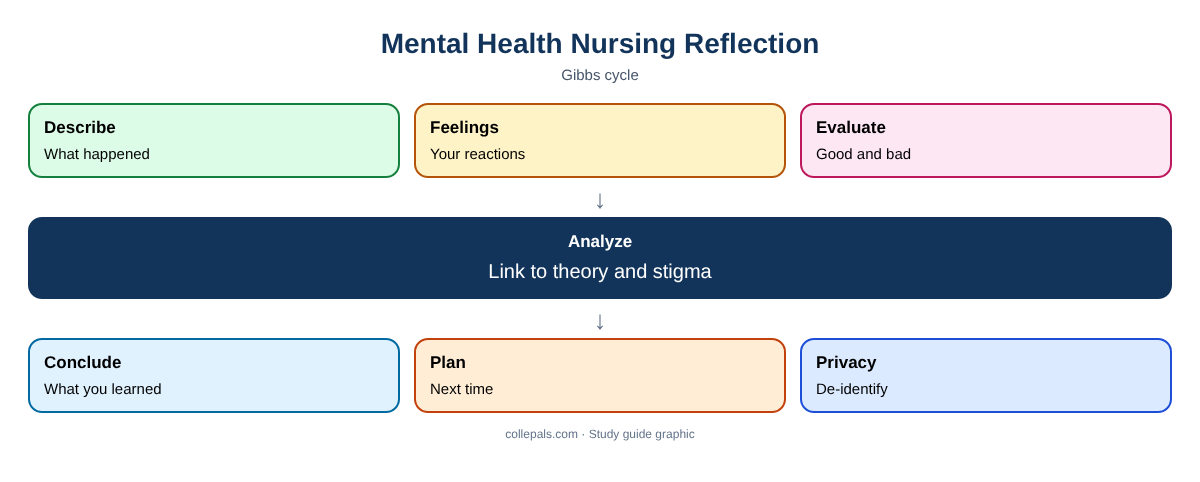
To write a mental health nursing reflection, choose a specific clinical moment, follow a reflective model such as Gibbs’ cycle, describe what happened and how you felt honestly, analyze it using course concepts and evidence, consider your own assumptions or stigma, state what you learned and set concrete goals for future practice while keeping patient details de-identified.
Patients and examples on this page are fictional and written by Collepals for study purposes. Course codes, assignments and rubrics vary by school, so always follow your own syllabus. This content is educational, not clinical advice.
Sample document: a sample mental health nursing reflection using Gibbs’ cycle (Word).
Using Gibbs’ Reflective Cycle
Gibbs (1988) offers six stages that work well for psychiatric clinical reflections:
| Stage | Example (fictional) |
|---|---|
| Description | On my first inpatient psychiatric clinical day, a patient with schizophrenia asked whether I could hear the voices too. |
| Feelings | I felt anxious and unsure whether to agree, argue or change the subject. |
| Evaluation | I stayed calm and did not argue, but I hesitated and nearly left the conversation. |
| Analysis | Textbook guidance is to acknowledge the patient’s experience without confirming the hallucination, then focus on reality and safety (Halter, 2026). |
| Conclusion | I could have said: “I don’t hear voices, but I can see they’re upsetting you. What are they saying?” |
| Action plan | Practice responses to hallucinations; always ask whether voices are command hallucinations. |
What Makes Mental Health Reflections Different
- Self-awareness: many students expect psychiatric units to be frightening; reflecting on that expectation is valuable.
- Therapeutic use of self: Peplau (1952) emphasized the nurse’s own behavior as a tool.
- Personal knowing: Carper (1978) identified personal knowledge as a pattern of knowing in nursing.
- Boundaries: reflect on how you kept professional boundaries.
Writing Tips
- Use first person and be honest.
- Spend more words on analysis than description.
- Cite course concepts or sources in the analysis stage.
- Never include names, room numbers or identifying details.
- If clinical experiences stir up personal feelings, talk with your instructor or campus counseling.
Related: How to Write NUR 101 Mental Health Nursing Discussion Posts and Psychiatric Assessment and Mental Status Examination Guide.
Frequently Asked Questions
Which reflective model should I use?
Use the model your course requires; Gibbs, Driscoll and Johns are common.
Can I write about feeling scared?
Yes. Honest reflection on fear or stigma, followed by analysis and growth, is what instructors want.
Do reflections need references?
Usually yes, at least in the analysis section.
Get Help With Your Mental Health Nursing Reflection
Psychiatric mental health nursing assignments demand clinical reasoning, therapeutic communication and careful APA writing. Collepals.com helps nursing students in psychiatric mental health courses:
- Plan discussion posts and thoughtful peer responses.
- Write case studies, care plans, concept maps and treatment plans.
- Structure reflections and mental status exam write-ups.
- Find current evidence, cite in APA 7 and get drafts edited and proofread.
Browse our free model assignments or learn more about our nursing assignment writing service.
Use Collepals examples as study guides and follow your school’s academic integrity and AI policies.
More psychiatric mental health nursing guides
Collepals is an independent study resource. Follow your program’s instructions and rubric and write your own work.
References
Carper, B. A. (1978). Fundamental patterns of knowing in nursing. Advances in Nursing Science, 1(1), 13–23. https://doi.org/10.1097/00012272-197810000-00004
Gibbs, G. (1988). Learning by doing: A guide to teaching and learning methods. Further Education Unit, Oxford Polytechnic.
Halter, M. J. (2026). Varcarolis’ foundations of psychiatric-mental health nursing: A clinical approach (10th ed.). Elsevier.
Peplau, H. E. (1952). Interpersonal relations in nursing. G. P. Putnam’s Sons.
Get a plagiarism-free answer to this question
Send us your instructions and we’ll match you with the best writer in your subject.
- 100% human-written, zero AI
- Turnitin report included
- Confidential — we never share your data
- Free revisions & refunds