NUR 101: Foundations of Psychiatric Mental Health Nursing — Complete Course Guide
Need help with this assignment?Get an original answer from a qualified tutor — from $10/page.
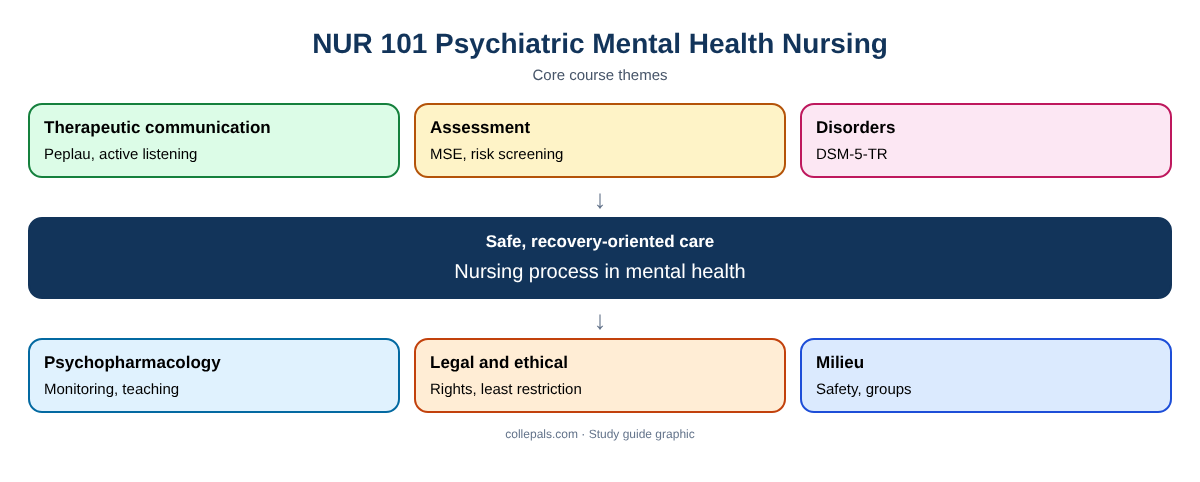
Get it written →NUR 101 psychiatric mental health nursing courses introduce the knowledge and skills nurses need to care for people with mental health conditions. Course codes differ by school, but most foundations courses cover the same core: therapeutic communication, mental health assessment, major psychiatric disorders, psychopharmacology, legal and ethical issues and safe, recovery-oriented care. This complete course guide explains what to expect, how to study and how to succeed in every assignment type.
Quick answer
NUR 101 Foundations of Psychiatric Mental Health Nursing typically covers therapeutic communication, the mental status exam and risk assessment, DSM-5-TR disorders, psychopharmacology, legal and ethical issues and the therapeutic milieu. Succeed by mastering therapeutic communication, learning assessment tools, linking symptoms to nursing diagnoses and interventions and completing discussion posts, care plans, case studies and reflections with current evidence and APA citations.
Patients and examples on this page are fictional and written by Collepals for study purposes. Course codes, assignments and rubrics vary by school, so always follow your own syllabus. This content is educational, not clinical advice.
Sample document: a NUR 101 course study planner and topic checklist (Word).
What NUR 101 Psychiatric Mental Health Nursing Covers
| Topic | What you will learn |
|---|---|
| Therapeutic communication | Peplau’s interpersonal relations, active listening, therapeutic vs. nontherapeutic techniques |
| Mental health assessment | Mental status exam, suicide and violence risk screening, rating scales |
| Psychiatric disorders | Depressive, anxiety, bipolar, trauma-related, psychotic, substance use and neurocognitive disorders (DSM-5-TR) |
| Psychopharmacology | Antidepressants, antipsychotics, mood stabilizers, anxiolytics; side effects and teaching |
| Legal and ethical issues | Voluntary vs. involuntary admission, patient rights, least restrictive environment, confidentiality |
| Therapeutic milieu | Safety, groups, de-escalation, recovery-oriented care |
| Special populations | Children, older adults, crisis and trauma survivors |
Psychiatric-mental health nursing practice is defined by the profession’s scope and standards, published jointly by the American Psychiatric Nurses Association, the International Society of Psychiatric-Mental Health Nurses and the American Nurses Association (2022). Many courses use Varcarolis’ Foundations of Psychiatric-Mental Health Nursing, now in its 10th edition (Halter, 2026); check your syllabus for your required text.
Key Concepts to Master Early
- Therapeutic relationship: Peplau (1952) described orientation, working and termination phases that still frame psychiatric nursing.
- Recovery orientation and person-first language: “a person with schizophrenia,” not “a schizophrenic.”
- Safety first: suicide and violence risk are assessed for every patient, using tools such as the C-SSRS (Posner et al., 2011).
- Diagnosis: DSM-5-TR criteria (American Psychiatric Association, 2022) alongside nursing diagnoses.
Typical Assignments
- How to Write NUR 101 Mental Health Nursing Discussion Posts
- How to Respond to Classmates in Psychiatric Mental Health Nursing
- Psychiatric Mental Health Nursing Case Study Writing Guide
- How to Write a Mental Health Nursing Reflection
- Mental Health Nursing Care Plans: Assignment Guide
- Psychiatric Nursing Concept Maps: How to Develop Them
- How to Write a Psychiatric Treatment Plan
- Psychiatric Assessment and Mental Status Examination Guide
Study Tips
- Practice therapeutic responses aloud with classmates.
- Make medication cards with class, key side effects and teaching points.
- Use NCLEX-style questions to apply, not memorize, content.
- Review the mental status exam before your first clinical day.
Assignment overview: NUR 101 Psychiatric Mental Health Nursing Assignments Guide.
Frequently Asked Questions
Is NUR 101 psychiatric mental health nursing hard?
It is different: success depends on communication skills and clinical judgment as much as memorization.
What textbook is used?
Many programs use Varcarolis’ Foundations of Psychiatric-Mental Health Nursing; follow your syllabus.
Will I have clinical rotations?
Most courses include inpatient, outpatient or community mental health clinicals or simulations.
Does this guide follow my school’s syllabus?
No. It describes typical content; always follow your own course materials.
Get Help With NUR 101 Psychiatric Mental Health Nursing
Psychiatric mental health nursing assignments demand clinical reasoning, therapeutic communication and careful APA writing. Collepals.com helps nursing students in psychiatric mental health courses:
- Plan discussion posts and thoughtful peer responses.
- Write case studies, care plans, concept maps and treatment plans.
- Structure reflections and mental status exam write-ups.
- Find current evidence, cite in APA 7 and get drafts edited and proofread.
Browse our free model assignments or learn more about our nursing assignment writing service.
Use Collepals examples as study guides and follow your school’s academic integrity and AI policies.
More psychiatric mental health nursing guides
Collepals is an independent study resource. Follow your program’s instructions and rubric and write your own work.
References
American Psychiatric Association. (2022). Diagnostic and statistical manual of mental disorders (5th ed., text rev.). https://doi.org/10.1176/appi.books.9780890425787
American Psychiatric Nurses Association, International Society of Psychiatric-Mental Health Nurses, & American Nurses Association. (2022). Psychiatric-mental health nursing: Scope and standards of practice (3rd ed.). Nursesbooks.org.
Halter, M. J. (2026). Varcarolis’ foundations of psychiatric-mental health nursing: A clinical approach (10th ed.). Elsevier.
Peplau, H. E. (1952). Interpersonal relations in nursing. G. P. Putnam’s Sons.
Posner, K., Brown, G. K., Stanley, B., Brent, D. A., Yershova, K. V., Oquendo, M. A., Currier, G. W., Melvin, G. A., Greenhill, L., Shen, S., & Mann, J. J. (2011). The Columbia–Suicide Severity Rating Scale: Initial validity and internal consistency findings from three multisite studies with adolescents and adults. American Journal of Psychiatry, 168(12), 1266–1277. https://doi.org/10.1176/appi.ajp.2011.10111704
Get a plagiarism-free answer to this question
Send us your instructions and we’ll match you with the best writer in your subject.
- 100% human-written, zero AI
- Turnitin report included
- Confidential — we never share your data
- Free revisions & refunds