How to Respond to Classmates in Psychiatric Mental Health Nursing
Need help with this assignment?Get an original answer from a qualified tutor — from $10/page.
Get it written →Good psychiatric nursing peer responses do more than agree. They add evidence, extend a classmate’s idea to practice and model the empathy and respect central to mental health nursing. This guide shows how to respond to classmates in psychiatric mental health nursing, with examples and sentence starters.
Quick answer
To respond to classmates in psychiatric mental health nursing, acknowledge a specific point they made, add new evidence or a different perspective with a citation, apply the idea to a clinical situation, ask a thoughtful question, use respectful person-first language and keep any personal or patient details confidential.
Patients and examples on this page are fictional and written by Collepals for study purposes. Course codes, assignments and rubrics vary by school, so always follow your own syllabus. This content is educational, not clinical advice.
Sample document: psychiatric nursing peer response examples and sentence starters (Word).
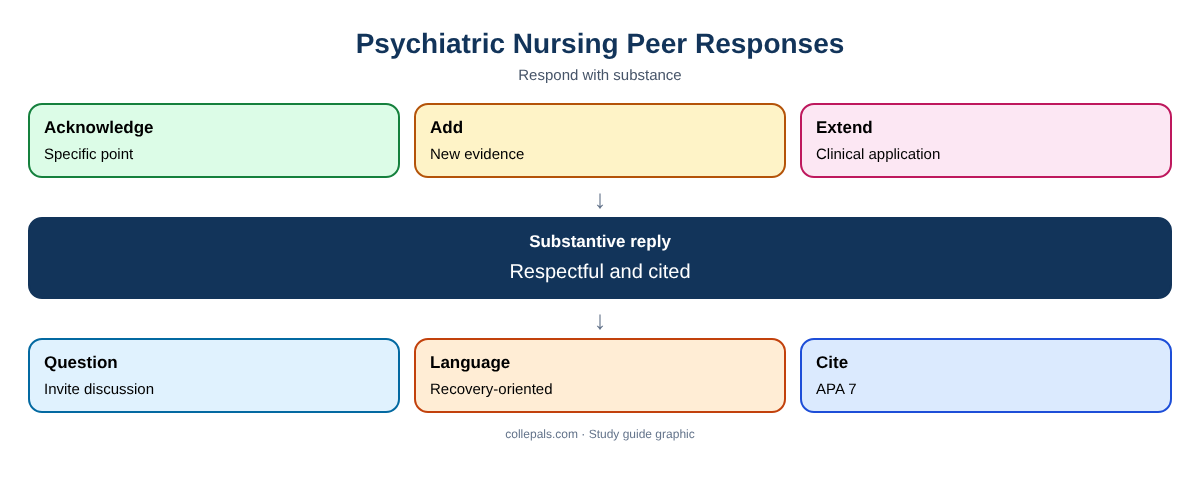
The Peer Response Formula
- Acknowledge: name a specific idea, not just “great post.”
- Add: new evidence, a guideline or another perspective.
- Apply: how it looks in practice.
- Ask: an open question to continue the discussion.
- Cite: APA 7.
Example Peer Responses (Fictional)
Response 1: Adding evidence
Maria, your point that asking directly about suicide does not increase risk is important. The Columbia Suicide Severity Rating Scale gives nurses structured questions that make that conversation easier and more consistent (Posner et al., 2011). On my unit, a brief safety plan follows any positive screen (Stanley & Brown, 2012). Have you seen safety plans completed with patients during your clinicals?
Response 2: Respectful disagreement
James, I agree that benzodiazepines can relieve acute anxiety quickly. I would add that guidelines generally favor SSRIs, SNRIs and CBT for long-term treatment of anxiety disorders because of the dependence and fall risks of benzodiazepines. How do you think nurses can support patients who are reluctant to change from a benzodiazepine?
Sentence Starters
- “Your point about ___ made me think about ___.”
- “Building on your idea, recent evidence shows ___.”
- “I saw this in clinical when ___.”
- “Another perspective to consider is ___.”
- “How might nurses apply this when ___?”
Sensitive Topics
Classmates may share personal mental health experiences. Respond with respect, avoid diagnosing peers and keep the focus on professional learning.
More: How to respond to a classmate’s discussion post in nursing and nursing discussion board response examples.
Frequently Asked Questions
How long should a peer response be?
Often 100–200 words with at least one citation; follow your rubric.
Is it okay to disagree?
Yes, respectfully and with evidence.
What if a classmate shares a personal struggle?
Respond with empathy, avoid advice that goes beyond your role and point to course or campus resources if appropriate.
Get Help With Psychiatric Nursing Peer Responses
Psychiatric mental health nursing assignments demand clinical reasoning, therapeutic communication and careful APA writing. Collepals.com helps nursing students in psychiatric mental health courses:
- Plan discussion posts and thoughtful peer responses.
- Write case studies, care plans, concept maps and treatment plans.
- Structure reflections and mental status exam write-ups.
- Find current evidence, cite in APA 7 and get drafts edited and proofread.
Browse our free model assignments or learn more about our nursing assignment writing service.
Use Collepals examples as study guides and follow your school’s academic integrity and AI policies.
More psychiatric mental health nursing guides
Collepals is an independent study resource. Follow your program’s instructions and rubric and write your own work.
References
Posner, K., Brown, G. K., Stanley, B., Brent, D. A., Yershova, K. V., Oquendo, M. A., Currier, G. W., Melvin, G. A., Greenhill, L., Shen, S., & Mann, J. J. (2011). The Columbia–Suicide Severity Rating Scale: Initial validity and internal consistency findings from three multisite studies with adolescents and adults. American Journal of Psychiatry, 168(12), 1266–1277. https://doi.org/10.1176/appi.ajp.2011.10111704
Stanley, B., & Brown, G. K. (2012). Safety planning intervention: A brief intervention to mitigate suicide risk. Cognitive and Behavioral Practice, 19(2), 256–264. https://doi.org/10.1016/j.cbpra.2011.01.001
Get a plagiarism-free answer to this question
Send us your instructions and we’ll match you with the best writer in your subject.
- 100% human-written, zero AI
- Turnitin report included
- Confidential — we never share your data
- Free revisions & refunds