How to Respond to a Classmate’s Discussion Post in Nursing School
Need help with this assignment?Get an original answer from a qualified tutor — from $10/page.
Get it written →Most nursing courses grade discussion boards in two parts: your initial post and your replies to classmates. Replies often carry a third or more of the discussion grade, yet many students lose points with short comments like “Great post!” This guide explains how to respond to a classmate’s discussion post in nursing school, step by step, with sentence starters, an example and a checklist you can use every week.
Quick answer
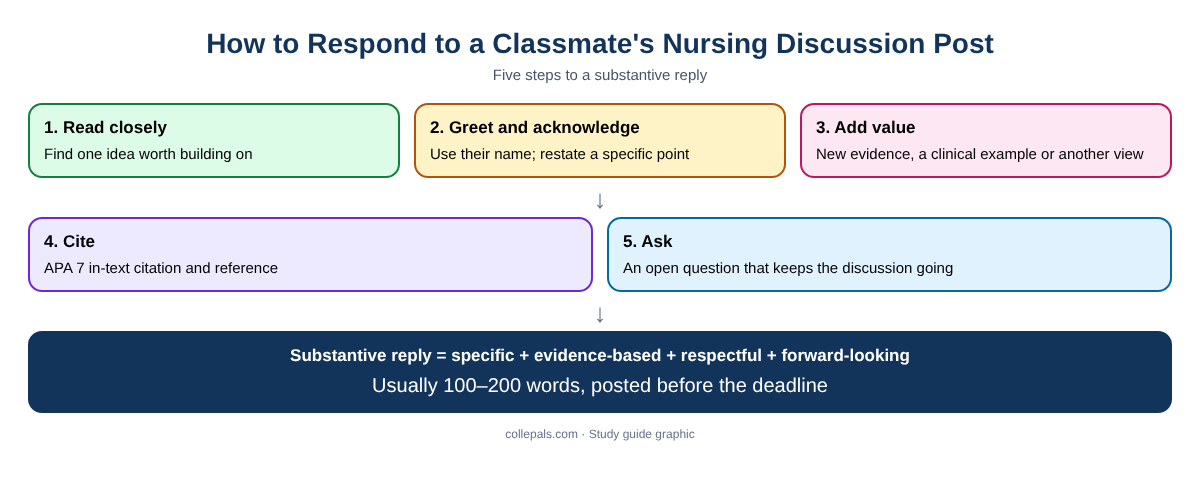
Read your classmate’s post closely, greet them by name and acknowledge one specific point. Then add something new, such as current evidence, a clinical example or a respectful alternative view, support it with an APA citation and end with an open question. Aim for 100–200 words unless your rubric says otherwise.
What Instructors Mean by a “Substantive” Response
Discussion rubrics usually require substantive replies. A substantive response does more than agree: it moves the conversation forward. In practice, that means your reply should be:
- Specific: it refers to an idea your classmate actually wrote.
- Evidence-based: it adds information supported by a scholarly source, guideline or professional standard.
- Applied: it connects the idea to nursing practice, patients or the classmate’s setting.
- Respectful and collegial: it reads like a conversation between professionals.
- Forward-looking: it invites further discussion with a question.
These elements mirror the communication and evidence-based practice competencies that nursing programs are expected to develop (American Association of Colleges of Nursing [AACN], 2021). Discussion replies are practice for the way nurses share knowledge with colleagues on a unit.
Step-by-Step: How to Respond to a Classmate’s Post
Step 1: Read the post closely
Read the whole post, not just the first paragraph, and note one idea you can build on: a strategy, a statistic, a patient example or a claim you see differently. Choose posts on topics you know something about, or that use a different approach from your own; that makes it easier to add value.
Step 2: Greet and acknowledge a specific point
Start with your classmate’s name and restate their idea briefly in your own words. This shows you read their work and sets up your contribution.
- “Hi Aisha, your point that bedside shift report improves patient involvement really stood out to me.”
- “Hello Daniel, I agree with your choice of Orem’s self-care theory for patients with heart failure.”
Step 3: Add value
This is the most important part of the reply. Choose one of these approaches:
- Extend with evidence: share a research finding or guideline that supports or deepens their point.
- Add a practice example: describe how the issue looks on your unit or in clinicals, without patient identifiers.
- Offer another perspective: raise a barrier, a risk, a different population or an alternative intervention.
- Connect to course content: link their idea to this week’s readings, a nursing theory or an ethical principle.
Step 4: Cite your source
Most nursing courses expect at least one scholarly reference in each reply. Paraphrase the finding, add an in-text citation such as (Talevski et al., 2020) and list the full APA reference at the end of your reply (American Psychological Association [APA], 2020). For detailed formatting, see our guide on writing nursing peer responses with APA references.
Step 5: End with a question
A good question keeps the discussion going and often earns participation points when your classmate answers. Ask something open-ended that relates to their experience or setting:
- “How does your unit handle this during night shift?”
- “What barriers do you think nurses would face in implementing this?”
- “Would this strategy work for patients with limited English proficiency?”
Example: Putting It All Together
Suppose your classmate wrote about using written discharge instructions for patients with heart failure. A strong reply might look like this:
Sample reply (about 150 words)
Hi Aisha, I appreciated your point that many patients with heart failure leave the hospital unsure of when to call their provider. I agree that written instructions help, and I think pairing them with teach-back could make them even more effective. In a systematic review of 20 studies, Talevski et al. (2020) found that teach-back was effective in 19, improving outcomes ranging from knowledge retention to hospital readmissions. On my clinical unit, I watched a nurse ask a patient to explain, in her own words, which weight gain should prompt a call. The patient realized she had misunderstood the instructions, and the nurse corrected them before discharge. Have you seen teach-back used on your unit, and do you think time constraints make it hard for nurses to use it consistently?
Talevski, J., Wong Shee, A., Rasmussen, B., Kemp, G., & Beauchamp, A. (2020). Teach-back: A systematic review of implementation and impacts. PLOS ONE, 15(4), Article e0231350. https://doi.org/10.1371/journal.pone.0231350
Notice the parts: a greeting and specific acknowledgment, new evidence with a citation, a practice example and a question. For more samples across different nursing topics, see our examples of nursing discussion board responses to classmates.
Useful Sentence Starters
| Purpose | Sentence starters |
|---|---|
| Acknowledge | “Your point about … stood out to me because …” / “I appreciated how you connected … to …” |
| Agree and extend | “Building on your idea, research by … found …” / “Another benefit of this approach is …” |
| Offer another view | “One challenge I have seen is …” / “I wonder whether this would work as well for …” |
| Share practice | “On my unit, we …” / “During clinicals, I observed …” |
| Ask | “How would you address …?” / “What has your experience been with …?” |
Common Mistakes to Avoid
- Empty agreement: “Great post, I agree!” adds nothing and rarely earns credit.
- Repeating your own post: respond to your classmate’s ideas, not your own.
- Missing references: check whether replies need citations; most nursing rubrics require them.
- Harsh criticism: disagree with ideas, not people, and support your view with evidence.
- Patient identifiers: never include names, dates, room numbers or other details that could identify a patient.
- Late replies: replies posted on the last day leave no time for discussion and may lose participation points.
Checklist Before You Click “Post”
- I used my classmate’s name and referred to a specific point.
- I added new information, an example or a different perspective.
- I included at least one current scholarly source in APA format (if required).
- I connected the idea to nursing practice.
- I ended with a question.
- My reply meets the required word count and is free of errors.
If your course requires two replies, see how to write responses to two classmates in a nursing discussion board.
Frequently Asked Questions
How long should a reply to a classmate be?
Most nursing courses ask for 100 to 200 words per reply, but some graduate courses require 150 to 250. Always follow your syllabus.
Can I disagree with a classmate?
Yes. Respectful disagreement supported by evidence often makes the best discussion. Acknowledge their point first, present your evidence and invite their response.
Do I need a reference in every reply?
Many nursing rubrics require at least one scholarly reference per reply. If your rubric is silent, including one is still a good way to make your reply substantive.
Can I use first person?
Yes. APA 7 permits first person, and discussion replies are conversational, especially when you share your own experience.
Need Help Responding to Classmates? Use Collepals
Weekly discussion boards add up fast, especially alongside clinicals, exams and work. Collepals.com helps nursing students write stronger discussion posts and replies. Our nursing-focused writers and tutors can:
- Show you how to turn a classmate’s post into a substantive, evidence-based reply.
- Help you find current scholarly sources and format APA 7 citations and references.
- Provide model initial posts and peer responses you can study for structure and tone.
- Edit and proofread your drafts before you post.
Browse our free nursing model assignments or learn about our nursing assignment writing service.
Use Collepals examples as study guides and follow your school’s academic integrity and AI policies when you post your own work.
Related guides
- How to Write Nursing Peer Responses With APA References
- How to Write Responses to Two Classmates in a Nursing Discussion Board
- How to Respond to Colleagues in Nursing Discussion Posts
- Examples of Nursing Discussion Board Responses to Classmates
- How to Write Discussion Posts, Responses and Assignments in Nursing School
References
American Association of Colleges of Nursing. (2021). The essentials: Core competencies for professional nursing education. https://www.aacnnursing.org/essentials
American Psychological Association. (2020). Publication manual of the American Psychological Association (7th ed.). https://doi.org/10.1037/0000165-000
Talevski, J., Wong Shee, A., Rasmussen, B., Kemp, G., & Beauchamp, A. (2020). Teach-back: A systematic review of implementation and impacts. PLOS ONE, 15(4), Article e0231350. https://doi.org/10.1371/journal.pone.0231350
Get a plagiarism-free answer to this question
Send us your instructions and we’ll match you with the best writer in your subject.
- 100% human-written, zero AI
- Turnitin report included
- Confidential — we never share your data
- Free revisions & refunds