How to Write Nursing Peer Responses With APA References
Need help with this assignment?Get an original answer from a qualified tutor — from $10/page.
Get it written →A peer response without evidence is just an opinion. That is why most nursing discussion rubrics require at least one scholarly reference in every reply to a classmate. This guide explains how to write a nursing peer discussion response with references: where to find sources quickly, how to cite them in APA 7 inside a short reply and how to format the reference list in a discussion board.
Quick answer
Find one current scholarly source (a peer-reviewed article or clinical guideline, usually from the last five years) that adds to your classmate’s point. Paraphrase a specific finding in your reply with an APA in-text citation, such as (Lasater et al., 2021), then list the full APA reference under a Reference heading at the end of your reply.
Why References Matter in Peer Responses
References show that your reply is grounded in evidence, not only personal opinion. Evidence-based practice is a core competency for professional nurses (American Association of Colleges of Nursing [AACN], 2021), and discussion boards are one of the main places instructors assess whether you can locate, interpret and apply evidence. A well-chosen source also makes your reply more useful to your classmate, because it gives them something new to read and consider.
Step 1: Choose the Right Kind of Source
Check your rubric first; it may specify “scholarly,” “peer-reviewed” or “published within the last five years.” Good choices include:
- Peer-reviewed journal articles, such as research studies, systematic reviews and meta-analyses, found through CINAHL, PubMed or your library’s database search.
- Clinical practice guidelines from professional organizations or government agencies, such as the Centers for Disease Control and Prevention or the Agency for Healthcare Research and Quality.
- Professional standards, such as the ANA Code of Ethics or your state’s nurse practice act, when the topic is ethics or scope of practice.
- Your course textbook, if your instructor allows it; some rubrics require at least one source beyond the assigned readings.
Avoid general websites, Wikipedia, blogs, unattributed health sites and homework-help sites. If you are unsure, ask whether the source has named authors, a publication date and a clear review process.
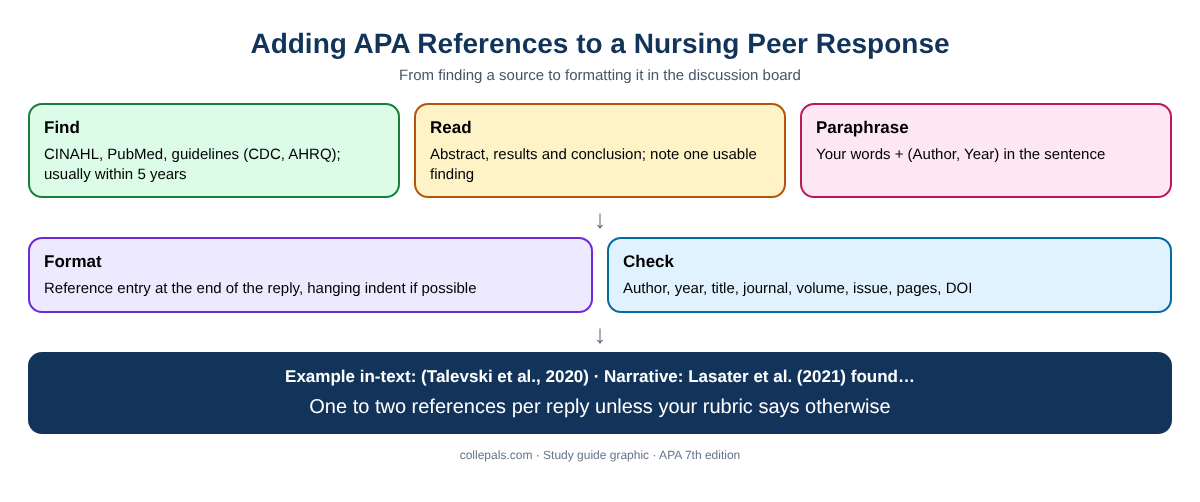
Step 2: Find a Source Fast
- Identify the key concept in your classmate’s post, such as “teach-back,” “nurse staffing” or “fall prevention.”
- Search CINAHL or PubMed with that term plus an outcome, such as “teach-back AND readmission.”
- Limit results to the last five years and to full-text, peer-reviewed articles.
- Read the abstract and conclusion first; systematic reviews are especially efficient because they summarize many studies.
- Note one specific finding you can use, with numbers if possible.
Step 3: Paraphrase and Cite in APA 7
In a short reply, paraphrasing is better than quoting. Put the finding in your own words and add an in-text citation (American Psychological Association [APA], 2020). APA 7 offers two formats:
| Format | Example |
|---|---|
| Parenthetical | Each additional patient added to a nurse’s workload was associated with higher odds of patient death (Lasater et al., 2021). |
| Narrative | Lasater et al. (2021) found that each additional patient per nurse was associated with higher odds of patient death. |
Author rules in APA 7: for one author, use the last name and year (Smith, 2023); for two authors, use both names with an ampersand in parentheses (Smith & Lee, 2023) or “and” in narrative citations; for three or more authors, use the first author and “et al.” from the first citation (Talevski et al., 2020). For an organization, use its name, and introduce an abbreviation the first time if you will use it again.
Step 4: Format the Reference in the Discussion Board
Place a heading such as Reference or References at the end of your reply and list each source in APA format. A journal article reference includes the author(s), year, article title in sentence case, journal name and volume in italics, issue in parentheses, page range or article number and the DOI as a link.
Example reference entry
Lasater, K. B., Aiken, L. H., Sloane, D. M., French, R., Martin, B. M., Alexander, M., & McHugh, M. D. (2021). Patient outcomes and cost savings associated with hospital safe nurse staffing legislation: An observational study. BMJ Open, 11(12), Article e052899. https://doi.org/10.1136/bmjopen-2021-052899
Discussion board tips: many boards strip formatting when you paste text, so check that italics survived and, if the editor allows, apply a hanging indent. If formatting is lost, keep the elements in the correct order; instructors understand the limitations of the platform. Writing in a word processor first and pasting into the board also helps you catch errors.
Example: A Complete Peer Response With References
Sample reply on safe staffing (about 170 words)
Hi Marcus, I agree with your point that high patient loads make it harder to catch early signs of deterioration. The evidence supports your concern. In a study of 87 Illinois hospitals, Lasater et al. (2021) found that each additional patient added to a nurse’s workload was associated with 16% higher odds of patient death, and they projected that meeting a four-patients-per-nurse standard on medical-surgical units could prevent more than 1,500 deaths a year among Medicare patients alone. Short staffing also affects patient teaching. When nurses are rushed, techniques like teach-back may be skipped, even though a systematic review found teach-back effective in 19 of 20 studies (Talevski et al., 2020). On my unit, discharge teaching is often the first thing compressed on a busy shift. Do you think mandated ratios or acuity-based staffing tools would work better in your hospital?
References
Lasater, K. B., Aiken, L. H., Sloane, D. M., French, R., Martin, B. M., Alexander, M., & McHugh, M. D. (2021). Patient outcomes and cost savings associated with hospital safe nurse staffing legislation: An observational study. BMJ Open, 11(12), Article e052899. https://doi.org/10.1136/bmjopen-2021-052899
Talevski, J., Wong Shee, A., Rasmussen, B., Kemp, G., & Beauchamp, A. (2020). Teach-back: A systematic review of implementation and impacts. PLOS ONE, 15(4), Article e0231350. https://doi.org/10.1371/journal.pone.0231350
Notice how each source supports a specific sentence and how the numbers make the reply more persuasive. For the overall structure of a reply, see how to respond to a classmate’s discussion post in nursing school.
Citing Your Classmate or the Course Textbook
- Your classmate’s post: you usually refer to it by name (“As you noted, Marcus…”) without a formal citation. If you use a source your classmate cited, read it yourself before citing it.
- Your textbook: cite it like any book, with author(s), year, title in italics, edition and publisher. Check whether your rubric requires a source beyond the textbook.
- Personal experience: describe it in first person; it does not need a citation, but it should not replace evidence.
Common Reference Mistakes in Peer Responses
- Listing a reference that is never cited in the reply.
- Citing an old source when the rubric requires current evidence.
- Using a source you only read about in a classmate’s post.
- Copying sentences from the abstract instead of paraphrasing.
- Missing the year, DOI or journal volume in the reference.
- Using “et al.” incorrectly for two-author sources.
Frequently Asked Questions
How many references should a nursing peer response have?
Usually one, sometimes two. Follow your rubric; graduate courses may require two scholarly sources per reply.
Can I reuse a source from my initial post?
Sometimes, but a new source usually adds more value. Some instructors require replies to introduce a source not already used in the thread.
Do discussion replies need a reference list?
Yes, if you cite anything. Place it at the end of the reply, even if it contains only one entry.
What if I can’t find a source from the last five years?
Look for a recent systematic review or guideline on the topic, broaden your search terms, or ask your librarian. Classic theory sources may be older; check whether your instructor allows them.
Get Help With Evidence-Based Peer Responses at Collepals
Weekly discussion boards add up fast, especially alongside clinicals, exams and work. Collepals.com helps nursing students write stronger discussion posts and replies. Our nursing-focused writers and tutors can:
- Show you how to turn a classmate’s post into a substantive, evidence-based reply.
- Help you find current scholarly sources and format APA 7 citations and references.
- Provide model initial posts and peer responses you can study for structure and tone.
- Edit and proofread your drafts before you post.
Browse our free nursing model assignments or learn about our nursing assignment writing service.
Use Collepals examples as study guides and follow your school’s academic integrity and AI policies when you post your own work.
Related guides
- How to Respond to a Classmate’s Discussion Post in Nursing School
- How to Write Responses to Two Classmates in a Nursing Discussion Board
- How to Respond to Colleagues in Nursing Discussion Posts
- Examples of Nursing Discussion Board Responses to Classmates
- How to Write Discussion Posts, Responses and Assignments in Nursing School
References
American Association of Colleges of Nursing. (2021). The essentials: Core competencies for professional nursing education. https://www.aacnnursing.org/essentials
American Psychological Association. (2020). Publication manual of the American Psychological Association (7th ed.). https://doi.org/10.1037/0000165-000
Lasater, K. B., Aiken, L. H., Sloane, D. M., French, R., Martin, B. M., Alexander, M., & McHugh, M. D. (2021). Patient outcomes and cost savings associated with hospital safe nurse staffing legislation: An observational study. BMJ Open, 11(12), Article e052899. https://doi.org/10.1136/bmjopen-2021-052899
Talevski, J., Wong Shee, A., Rasmussen, B., Kemp, G., & Beauchamp, A. (2020). Teach-back: A systematic review of implementation and impacts. PLOS ONE, 15(4), Article e0231350. https://doi.org/10.1371/journal.pone.0231350
Get a plagiarism-free answer to this question
Send us your instructions and we’ll match you with the best writer in your subject.
- 100% human-written, zero AI
- Turnitin report included
- Confidential — we never share your data
- Free revisions & refunds