How to Write Responses to Two Classmates in a Nursing Discussion Board
Need help with this assignment?Get an original answer from a qualified tutor — from $10/page.
Get it written →“Respond to at least two classmates” is one of the most common instructions in online nursing courses. Writing two replies sounds simple, but many students end up posting two nearly identical comments, or rushing both on the due date. This guide explains how to plan and write a nursing discussion board response to two classmates so that each reply is distinct, substantive and on time.
Quick answer
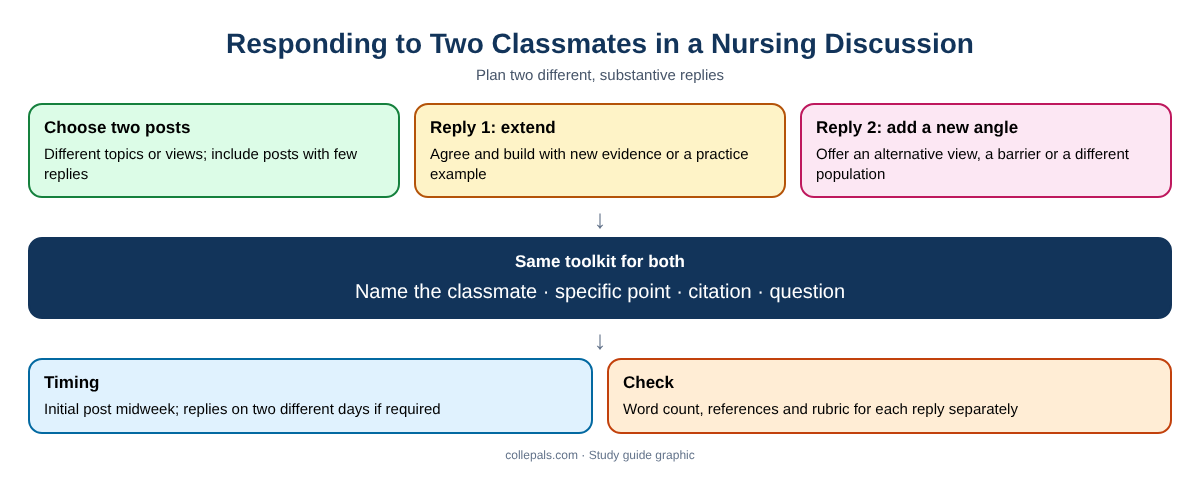
Choose two posts that differ in topic or viewpoint. In the first reply, agree and extend your classmate’s idea with new evidence or a practice example. In the second, add a new angle, such as a barrier, a different population or an alternative intervention. Each reply should name the classmate, refer to a specific point, include a citation if required and end with a question.
Read the Instructions Carefully
Before writing, check exactly what your course requires. Typical requirements include:
- Number of replies: “at least two” means two is the minimum; extra replies can strengthen participation.
- Length: often 100–200 words per reply, sometimes more in graduate courses.
- References: many rubrics require one scholarly source in each reply.
- Timing: some courses require replies on different days, or after a classmate’s post has been up for a set time.
- Who to reply to: some prompts specify classmates who chose a different theory, case or topic from yours.
If the prompt says to respond to “classmates who focused on a different theory,” for example, two replies to classmates who chose the same theory as you will not meet the requirement.
Step 1: Choose Two Posts Strategically
Pick posts where you can genuinely add something. Good choices include:
- A post on a topic you know from clinical experience or your own research.
- A post with a different view or approach from yours, which allows a richer discussion.
- A post that has received few or no replies; instructors notice when students engage with everyone.
Choosing posts that differ from each other also makes it easier to write two distinct replies.
Step 2: Give Each Reply a Different Purpose
A simple way to avoid repetition is to assign each reply a role:
| Reply 1: Extend | Reply 2: Add a new angle | |
|---|---|---|
| Goal | Agree with and deepen your classmate’s idea | Broaden the discussion with another perspective |
| Typical content | Supporting research, a practice example, an implementation tip | A barrier, a risk, a different patient population, an alternative intervention, an ethical or equity issue |
| Sample opening | “Building on your point about …” | “You raised an important strategy; one challenge I have seen is …” |
Both replies still use the same core structure: name the classmate, acknowledge a specific point, add value with evidence and ask a question. For the full method, see how to respond to a classmate’s discussion post in nursing school.
Example: Two Replies in the Same Discussion
Imagine a discussion prompt asking, “What nursing intervention would you use to prevent falls on an inpatient unit?” Two classmates posted different answers.
Reply 1 (extend): to Priya, who recommended patient and family education
Hi Priya, I agree that education should be central to fall prevention, and your idea of including family members is especially practical because they are often at the bedside when patients try to get up. The evidence supports you: in a systematic review and meta-analysis of hospital fall prevention interventions, education for patients and staff was the only single intervention that significantly reduced falls (Morris et al., 2022). One way to make education stick is to use a bedside poster that lists each patient’s specific risks and plan, so staff and families see the same information every shift. Have you seen families included in fall prevention teaching on your unit?
Morris, M. E., Webster, K., Jones, C., Hill, A.-M., Haines, T., McPhail, S., Kiegaldie, D., Slade, S., Jazayeri, D., Heng, H., Shorr, R., Carey, L., Barker, A., & Cameron, I. (2022). Interventions to reduce falls in hospitals: A systematic review and meta-analysis. Age and Ageing, 51(5), Article afac077. https://doi.org/10.1093/ageing/afac077
Reply 2 (new angle): to Kevin, who recommended bed alarms
Hi Kevin, you made a good point that bed alarms can alert staff before a patient walks unassisted, especially at night. I wonder, though, whether alarms alone are enough. The same meta-analysis found that assistive devices such as bed and chair alarms did not significantly reduce falls (Morris et al., 2022), and frequent false alarms can contribute to alarm fatigue. Programs that tailor prevention to each patient may be more effective; the Fall TIPS program, which builds individualized plans with patients, was associated with a 19% reduction in falls and avoided more than $14,000 in costs per 1,000 patient days (Dykes et al., 2023). Do you think alarms would work better combined with a tailored plan, for example for patients with confusion?
Dykes, P. C., Curtin-Bowen, M., Lipsitz, S., Franz, C., Adelman, J., Adkison, L., Bogaisky, M., Carroll, D., Carter, E., Herlihy, L., Lindros, M. E., Ryan, V., Scanlan, M., Walsh, M.-A., Wien, M., & Bates, D. W. (2023). Cost of inpatient falls and cost-benefit analysis of implementation of an evidence-based fall prevention program. JAMA Health Forum, 4(1), Article e225125. https://doi.org/10.1001/jamahealthforum.2022.5125
Morris, M. E., Webster, K., Jones, C., Hill, A.-M., Haines, T., McPhail, S., Kiegaldie, D., Slade, S., Jazayeri, D., Heng, H., Shorr, R., Carey, L., Barker, A., & Cameron, I. (2022). Interventions to reduce falls in hospitals: A systematic review and meta-analysis. Age and Ageing, 51(5), Article afac077. https://doi.org/10.1093/ageing/afac077
The first reply supports and builds; the second respectfully challenges and redirects. Together, they show that you understand the topic from more than one angle. For guidance on formatting the citations, see how to write nursing peer responses with APA references.
Step 3: Plan Your Timing
| Day (sample week) | Task |
|---|---|
| Monday–Tuesday | Read the prompt and readings; draft your initial post. |
| Wednesday | Post your initial response by the midweek deadline. |
| Thursday | Read classmates’ posts; choose two; find one source for each; write and post reply 1. |
| Saturday | Post reply 2; answer anyone who replied to you, including the instructor. |
| Sunday | Check that all requirements are met before the discussion closes. |
Posting on different days usually improves participation scores and gives classmates time to respond to you.
Checklist for Two Replies
- I replied to two different classmates who meet any criteria in the prompt.
- Each reply has a different focus and is not copied or lightly reworded from the other.
- Each reply refers to a specific point by the classmate’s name.
- Each reply meets the word count and includes its own reference if required.
- Each reply ends with a question.
- I checked back to answer replies to my own post.
Common Mistakes When Responding to Two Classmates
- Writing one reply and pasting a similar version to the second classmate.
- Posting both replies minutes before the deadline.
- Replying only to close friends or to the first two posts on the board.
- Using the same source in both replies when the rubric asks for new evidence.
- Forgetting that a reply to the instructor may be required in addition to the two classmate replies.
Frequently Asked Questions
Can I reply to the same classmate twice?
A second reply in an ongoing conversation is fine, but it usually does not count toward the two required classmates. Reply to two different people.
Should both replies have references?
If your rubric requires a reference per reply, yes. Using a different source in each reply also shows broader reading.
What if no one has posted yet?
Post your initial response first, then return later in the week. If the board stays quiet, let your instructor know.
Does a reply to my instructor count as one of the two?
Usually not. Most courses count instructor replies separately; check your syllabus.
Need Help With Your Two Classmate Responses? Use Collepals
Weekly discussion boards add up fast, especially alongside clinicals, exams and work. Collepals.com helps nursing students write stronger discussion posts and replies. Our nursing-focused writers and tutors can:
- Show you how to turn a classmate’s post into a substantive, evidence-based reply.
- Help you find current scholarly sources and format APA 7 citations and references.
- Provide model initial posts and peer responses you can study for structure and tone.
- Edit and proofread your drafts before you post.
Browse our free nursing model assignments or learn about our nursing assignment writing service.
Use Collepals examples as study guides and follow your school’s academic integrity and AI policies when you post your own work.
Related guides
- How to Respond to a Classmate’s Discussion Post in Nursing School
- How to Write Nursing Peer Responses With APA References
- How to Respond to Colleagues in Nursing Discussion Posts
- Examples of Nursing Discussion Board Responses to Classmates
- How to Write Discussion Posts, Responses and Assignments in Nursing School
References
Dykes, P. C., Curtin-Bowen, M., Lipsitz, S., Franz, C., Adelman, J., Adkison, L., Bogaisky, M., Carroll, D., Carter, E., Herlihy, L., Lindros, M. E., Ryan, V., Scanlan, M., Walsh, M.-A., Wien, M., & Bates, D. W. (2023). Cost of inpatient falls and cost-benefit analysis of implementation of an evidence-based fall prevention program. JAMA Health Forum, 4(1), Article e225125. https://doi.org/10.1001/jamahealthforum.2022.5125
Morris, M. E., Webster, K., Jones, C., Hill, A.-M., Haines, T., McPhail, S., Kiegaldie, D., Slade, S., Jazayeri, D., Heng, H., Shorr, R., Carey, L., Barker, A., & Cameron, I. (2022). Interventions to reduce falls in hospitals: A systematic review and meta-analysis. Age and Ageing, 51(5), Article afac077. https://doi.org/10.1093/ageing/afac077
Get a plagiarism-free answer to this question
Send us your instructions and we’ll match you with the best writer in your subject.
- 100% human-written, zero AI
- Turnitin report included
- Confidential — we never share your data
- Free revisions & refunds