How to Respond to Colleagues in Nursing Discussion Posts
Need help with this assignment?Get an original answer from a qualified tutor — from $10/page.
Get it written →In RN-to-BSN, MSN and DNP programs, your classmates are often practicing nurses, and many instructors ask you to respond to them as “colleagues” or “peers.” A colleague response is held to a higher standard than a typical classmate reply: it should sound like a professional conversation between nurses who bring experience, evidence and leadership thinking to a problem. This guide explains how to respond to colleagues in nursing discussion posts, including tone, structure, disagreeing respectfully and protecting privacy.
Quick answer
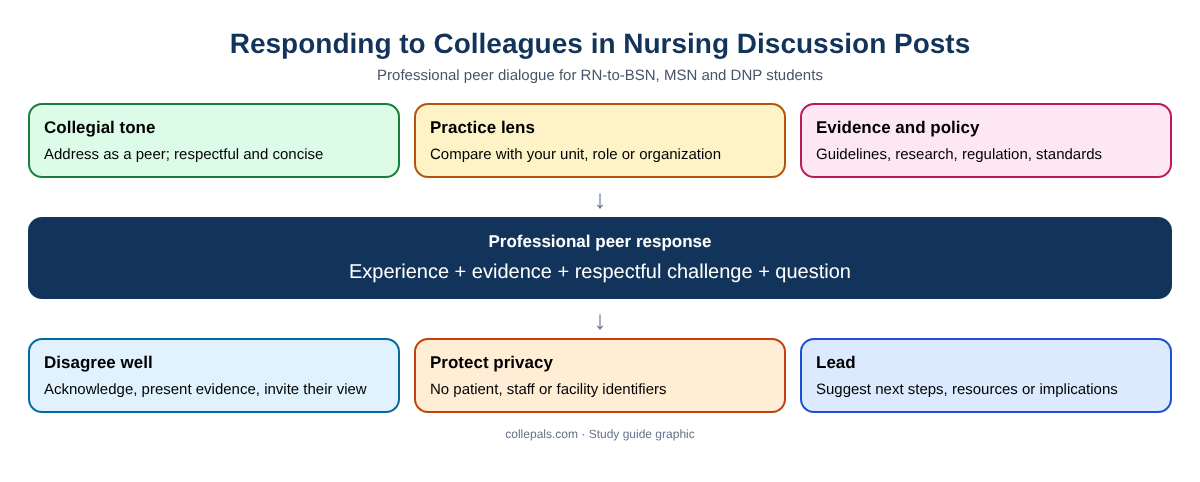
Address your colleague as a professional peer, acknowledge a specific point, compare it with your own practice setting or role and add current evidence, a guideline or a policy perspective. Where appropriate, challenge respectfully, consider implications for leadership, quality or equity and end with a question that invites your colleague to share more of their expertise.
How a Colleague Response Differs From a Classmate Reply
Prelicensure students often reply with what they observed in clinicals. Experienced nurses are expected to go further. A colleague response typically:
- Draws on professional experience from your unit, specialty or organization.
- Integrates evidence and policy, including research, guidelines, regulations and professional standards.
- Thinks at a systems level, considering quality, safety, cost, staffing, leadership and health equity.
- Engages critically, questioning assumptions and offering alternatives rather than simply agreeing.
These expectations reflect graduate and post-licensure competencies such as interprofessional partnership, systems-based practice and professionalism (American Association of Colleges of Nursing [AACN], 2021).
Step 1: Use a Collegial, Professional Tone
Write as you would to a respected coworker in a professional email: warm, concise and confident. Use your colleague’s name, avoid slang and excessive exclamation points and keep the focus on ideas. Phrases such as “I appreciated your perspective on…” or “Your experience in the ICU adds an important dimension…” set a collegial tone.
Step 2: Compare Practice Settings
One of the most valuable things you can offer a colleague is a different practice perspective. Compare how their idea would work in your setting:
- “In my outpatient clinic, we approach this differently because …”
- “Our hospital implemented a similar policy last year; one lesson we learned was …”
- “As a charge nurse, I see this most often during …”
Keep examples general and de-identified. Never share patient names, dates, specific events that could identify a patient, or confidential information about coworkers or your employer.
Step 3: Add Evidence, Guidelines or Policy
Strengthen your response with a current, credible source. At the graduate level, consider systematic reviews, clinical practice guidelines, legislation and quality data in addition to individual studies. For example, if a colleague discusses behavioral health in primary care, you might cite a Cochrane review showing that collaborative care improved depression and anxiety outcomes compared with usual care (Archer et al., 2012). If the topic is staffing, you might cite evidence linking patient-to-nurse ratios with mortality (Lasater et al., 2021). Format citations in APA 7 (American Psychological Association [APA], 2020); see our guide on nursing peer responses with APA references.
Step 4: Disagree Respectfully
Professional disagreement is a strength in a discussion, not a problem. Use a three-part approach:
- Acknowledge the value of your colleague’s view: “You make a strong case that mandated ratios protect patients.”
- Present your evidence or experience: “However, in rural hospitals like mine, strict ratios can be difficult to meet when the nursing workforce is limited.”
- Invite their view: “How do you think rural facilities could meet safe staffing goals?”
Avoid absolute language (“that’s wrong”) and personal comments. Disagree with the idea and support your position with evidence.
Step 5: Think Like a Leader
Colleague responses earn the most credit when they consider implications beyond the bedside. Ask yourself:
- How would this be implemented? Who are the stakeholders and what are the barriers?
- What are the costs, and how would outcomes be measured?
- Does the idea affect health equity, for example for patients with limited English proficiency or low income?
- What policy, regulation or accreditation standard applies?
Example: A Colleague Response in a Graduate Course
Sample colleague response (about 180 words)
Hi Renee, I appreciated your perspective on integrating behavioral health into primary care, especially your observation that patients in your clinic often decline outside mental health referrals. My organization faced the same problem until we added a behavioral health clinician to two primary care sites, and same-day introductions noticeably improved follow-through. The evidence supports this approach: a Cochrane review of 79 randomized trials found that collaborative care improved depression and anxiety outcomes compared with usual care (Archer et al., 2012). One challenge we encountered was sustainability. Behavioral health visits were not always reimbursed at the same level as medical visits, so leadership had to make a business case based on reduced emergency department use. I would be interested to hear how your clinic would fund an integrated model. Do you think your leadership team would support a pilot at one site first?
Archer, J., Bower, P., Gilbody, S., Lovell, K., Richards, D., Gask, L., Dickens, C., & Coventry, P. (2012). Collaborative care for depression and anxiety problems. Cochrane Database of Systematic Reviews, (10), Article CD006525. https://doi.org/10.1002/14651858.CD006525.pub2
This response acknowledges the colleague’s point, adds organizational experience, cites high-level evidence, raises a leadership and financing issue and ends with a question. For more samples, see our examples of nursing discussion board responses to classmates.
Do’s and Don’ts
| Do | Don’t |
|---|---|
| Use your colleague’s name and a professional greeting | Use slang, all caps or excessive emojis |
| Share de-identified experience from your role | Include patient, staff or facility identifiers |
| Cite current evidence and standards | Rely only on personal opinion |
| Disagree with ideas, using evidence | Criticize the person or their workplace |
| Consider systems, leadership and equity | Stay only at the level of individual tasks |
| End with an open question | End with “Great post!” |
Frequently Asked Questions
What if my colleague has much more experience than I do?
You can still add value through evidence, a different setting or thoughtful questions. Acknowledge their expertise and ask them to share how they have handled challenges.
Can I mention my employer by name?
It is safer to describe your setting generally (“a 300-bed community hospital”) and avoid sharing internal or confidential information.
How formal should a colleague response be?
Professional but conversational. First person is appropriate, and citations should follow APA 7.
Is it okay to respond to a colleague’s response to me?
Yes. Continuing a thread shows engagement, though it may not count toward the required number of peer replies.
Respond to Colleagues With Confidence: Get Help From Collepals
Weekly discussion boards add up fast, especially alongside clinicals, exams and work. Collepals.com helps nursing students write stronger discussion posts and replies. Our nursing-focused writers and tutors can:
- Show you how to turn a classmate’s post into a substantive, evidence-based reply.
- Help you find current scholarly sources and format APA 7 citations and references.
- Provide model initial posts and peer responses you can study for structure and tone.
- Edit and proofread your drafts before you post.
Browse our free nursing model assignments or learn about our nursing assignment writing service.
Use Collepals examples as study guides and follow your school’s academic integrity and AI policies when you post your own work.
Related guides
- How to Respond to a Classmate’s Discussion Post in Nursing School
- How to Write Nursing Peer Responses With APA References
- How to Write Responses to Two Classmates in a Nursing Discussion Board
- Examples of Nursing Discussion Board Responses to Classmates
- How to Write Discussion Posts, Responses and Assignments in Nursing School
References
American Association of Colleges of Nursing. (2021). The essentials: Core competencies for professional nursing education. https://www.aacnnursing.org/essentials
American Psychological Association. (2020). Publication manual of the American Psychological Association (7th ed.). https://doi.org/10.1037/0000165-000
Archer, J., Bower, P., Gilbody, S., Lovell, K., Richards, D., Gask, L., Dickens, C., & Coventry, P. (2012). Collaborative care for depression and anxiety problems. Cochrane Database of Systematic Reviews, (10), Article CD006525. https://doi.org/10.1002/14651858.CD006525.pub2
Lasater, K. B., Aiken, L. H., Sloane, D. M., French, R., Martin, B. M., Alexander, M., & McHugh, M. D. (2021). Patient outcomes and cost savings associated with hospital safe nurse staffing legislation: An observational study. BMJ Open, 11(12), Article e052899. https://doi.org/10.1136/bmjopen-2021-052899
Get a plagiarism-free answer to this question
Send us your instructions and we’ll match you with the best writer in your subject.
- 100% human-written, zero AI
- Turnitin report included
- Confidential — we never share your data
- Free revisions & refunds