Examples of Nursing Discussion Board Responses to Classmates
Need help with this assignment?Get an original answer from a qualified tutor — from $10/page.
Get it written →Sometimes the fastest way to learn how to write a strong discussion reply is to see several. This guide offers examples of nursing discussion board responses to classmates on common nursing topics, each with real, current evidence in APA format and a short note on why it works. Use them to understand structure, tone and depth, then write your own replies in your own words.
Classmate names and posts are fictional, and clinical experiences in the examples are illustrative. The research findings and references are real. Never copy an example into your course; instructors use plagiarism and AI detection tools, and your reply must respond to your actual classmate’s post.
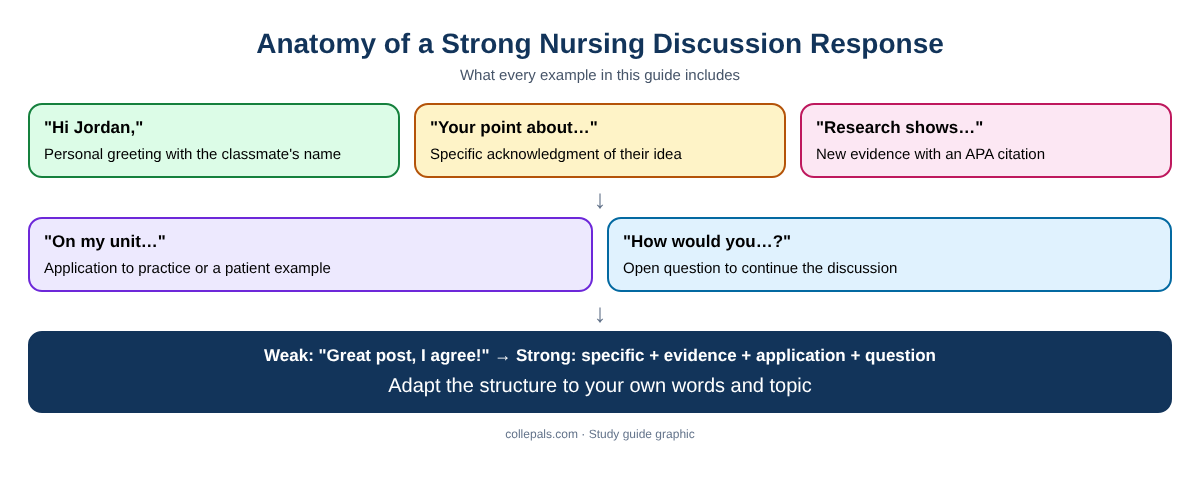
What Every Strong Response Includes
- A greeting with the classmate’s name.
- A specific acknowledgment of their idea.
- New evidence, an example or another perspective, with an APA citation.
- An application to nursing practice.
- An open question.
For a step-by-step method, see how to respond to a classmate’s discussion post in nursing school.
Weak vs. Strong: A Quick Rewrite
| Weak response | Why it loses points |
|---|---|
| “Hi Jordan, great post! I totally agree that patient education is important. Nurses should always educate their patients. Thanks for sharing!” | No specific point, no new information, no evidence, no application and no question. It could be posted under any discussion. |
Example 1 below shows how the same reply becomes substantive.
Examples of Nursing Discussion Board Responses
Example 1: Patient education and teach-back
Classmate’s post: Jordan recommended giving patients printed discharge instructions in plain language.
Response
Hi Jordan, your point about plain-language instructions is so important, since many patients feel overwhelmed at discharge. I would add teach-back as a way to confirm that patients actually understood the instructions. A systematic review found that teach-back was effective in 19 of 20 studies, with benefits ranging from better knowledge retention to fewer readmissions (Talevski et al., 2020). During clinicals, I saw a nurse ask a patient to explain how he would take his new anticoagulant; he had mixed up the dose times, and she corrected it before he left. How could nurses make time for teach-back on a busy discharge day?
Reference
Talevski, J., Wong Shee, A., Rasmussen, B., Kemp, G., & Beauchamp, A. (2020). Teach-back: A systematic review of implementation and impacts. PLOS ONE, 15(4), Article e0231350. https://doi.org/10.1371/journal.pone.0231350
Why it works: It acknowledges a specific idea, adds a complementary strategy with evidence and a de-identified clinical example and ends with a practical question.
Example 2: Safe staffing
Classmate’s post: Maya argued that nurse-to-patient ratios should be mandated in every state.
Response
Hi Maya, you made a persuasive case for mandated ratios. The evidence on workload is strong: in a study of 87 Illinois hospitals, each additional patient per nurse was associated with 16% higher odds of patient death and 5% higher odds of a longer stay (Lasater et al., 2021). I wonder, though, how smaller rural hospitals would meet fixed ratios with limited nursing workforces. Some states use staffing committees that let nurses set unit-based plans instead. Do you think a hybrid approach, with minimum ratios plus committee flexibility, could work?
Reference
Lasater, K. B., Aiken, L. H., Sloane, D. M., French, R., Martin, B. M., Alexander, M., & McHugh, M. D. (2021). Patient outcomes and cost savings associated with hospital safe nurse staffing legislation: An observational study. BMJ Open, 11(12), Article e052899. https://doi.org/10.1136/bmjopen-2021-052899
Why it works: It agrees with evidence and specific numbers, then respectfully raises an implementation barrier and an alternative, inviting debate.
Example 3: Fall prevention
Classmate’s post: Chris suggested hourly rounding as the main fall prevention strategy.
Response
Hi Chris, hourly rounding is a great foundation, especially when it includes offering toileting assistance. I would add patient and family education to the plan. A meta-analysis of hospital fall prevention studies found that education was the only single intervention that significantly reduced falls, while alarms and similar devices did not (Morris et al., 2022). Programs that combine education with individualized plans, such as Fall TIPS, were associated with a 19% reduction in falls (Dykes et al., 2023). On your unit, are fall plans tailored to each patient or standardized?
References
Dykes, P. C., Curtin-Bowen, M., Lipsitz, S., Franz, C., Adelman, J., Adkison, L., Bogaisky, M., Carroll, D., Carter, E., Herlihy, L., Lindros, M. E., Ryan, V., Scanlan, M., Walsh, M.-A., Wien, M., & Bates, D. W. (2023). Cost of inpatient falls and cost-benefit analysis of implementation of an evidence-based fall prevention program. JAMA Health Forum, 4(1), Article e225125. https://doi.org/10.1001/jamahealthforum.2022.5125
Morris, M. E., Webster, K., Jones, C., Hill, A.-M., Haines, T., McPhail, S., Kiegaldie, D., Slade, S., Jazayeri, D., Heng, H., Shorr, R., Carey, L., Barker, A., & Cameron, I. (2022). Interventions to reduce falls in hospitals: A systematic review and meta-analysis. Age and Ageing, 51(5), Article afac077. https://doi.org/10.1093/ageing/afac077
Why it works: It builds on the classmate’s idea with two strong sources and a question about practice.
Example 4: Diabetes self-management and cost
Classmate’s post: Lena discussed medication nonadherence among patients with type 2 diabetes.
Response
Hi Lena, I appreciated your point that cost is often the hidden reason behind nonadherence. Diabetes is extremely expensive for both patients and the system; the American Diabetes Association estimated its total U.S. economic cost at $412.9 billion in 2022 (Parker et al., 2024). Policy can help: after Medicare capped insulin cost sharing at $35 a month in 2023, an early evaluation estimated about 50,000 more low-cost insulin fills per month among Medicare enrollees (Myerson et al., 2023). Nurses can screen for cost barriers and connect patients with assistance programs. Does your clinic routinely ask patients whether they can afford their medications?
References
Myerson, R., Qato, D. M., Goldman, D. P., & Romley, J. A. (2023). Insulin fills by Medicare enrollees and out-of-pocket caps under the Inflation Reduction Act. JAMA. Advance online publication. https://doi.org/10.1001/jama.2023.12951
Parker, E. D., Lin, J., Mahoney, T., Ume, N., Yang, G., Gabbay, R. A., ElSayed, N. A., & Bannuru, R. R. (2024). Economic costs of diabetes in the U.S. in 2022. Diabetes Care, 47(1), 26–43. https://doi.org/10.2337/dci23-0085
Why it works: It links the classmate’s clinical observation to cost and health policy data and suggests a nursing action.
Example 5: Maternal health: pre-eclampsia
Classmate’s post: Tasha explained why nurses monitor blood pressure closely in patients with pre-eclampsia.
Response
Hi Tasha, your explanation of blood pressure monitoring was clear and practical. I would add that pre-eclampsia is not only about blood pressure; it is a multisystem disorder that can affect the kidneys, liver, brain and placenta. International guidelines define it as new hypertension with proteinuria or signs of organ or placental dysfunction (Magee et al., 2022). That is why nurses also monitor reflexes, urine output, headaches, visual changes and fetal well-being. Which assessment do you think new nurses are most likely to overlook?
Reference
Magee, L. A., Brown, M. A., Hall, D. R., Gupte, S., Hennessy, A., Karumanchi, S. A., Kenny, L. C., McCarthy, F., Myers, J., Poon, L. C., Rana, S., Saito, S., Staff, A. C., Tsigas, E., & von Dadelszen, P. (2022). The 2021 International Society for the Study of Hypertension in Pregnancy classification, diagnosis & management recommendations for international practice. Pregnancy Hypertension, 27, 148–169. https://doi.org/10.1016/j.preghy.2021.09.008
Why it works: It respectfully broadens the classmate’s focus with guideline-level evidence and connects it to specific nursing assessments.
Example 6: Simulation in nursing education
Classmate’s post: Sam wrote that simulation can’t replace real clinical experience.
Response
Hi Sam, I understand your concern; nothing feels quite like caring for a real patient. Research suggests, however, that high-quality simulation can replace part of clinical time without hurting outcomes. In the NCSBN National Simulation Study, students who had up to half of their clinical hours replaced with simulation had comparable clinical competency, knowledge and NCLEX pass rates (Hayden et al., 2014). The key seems to be trained faculty and strong debriefing. Have you found debriefing helpful after your simulations?
Reference
Hayden, J. K., Smiley, R. A., Alexander, M., Kardong-Edgren, S., & Jeffries, P. R. (2014). The NCSBN National Simulation Study: A longitudinal, randomized, controlled study replacing clinical hours with simulation in prelicensure nursing education. Journal of Nursing Regulation, 5(2, Suppl.), S3–S40.
Why it works: It respectfully challenges a common belief with landmark evidence while validating the classmate’s feelings.
Example 7: Integrated, team-based care
Classmate’s post: Ahmed described how fragmented care led to duplicated tests for a patient.
Response
Hi Ahmed, your example shows how fragmented care frustrates patients and wastes resources. Integrated, team-based models aim to fix this. At Intermountain Healthcare, patients in integrated team-based primary care practices had fewer emergency department visits and hospital admissions than those in traditional practices (Reiss-Brennan et al., 2016). Nurses often act as the care coordinators who make these models work. What role do you think RNs should play in coordinating care across settings?
Reference
Reiss-Brennan, B., Brunisholz, K. D., Dredge, C., Briot, P., Grazier, K., Wilcox, A., Savitz, L., & James, B. (2016). Association of integrated team-based care with health care quality, utilization, and cost. JAMA, 316(8), 826–834. https://doi.org/10.1001/jama.2016.11232
Why it works: It connects the classmate’s story to system-level evidence and highlights the nurse’s role.
Example: Responding to Your Instructor
Instructor asked: “How would you measure whether teach-back is working on your unit?”
Thank you for the question, Professor Lee. I would measure it in three ways: by auditing a sample of discharges each month to see how often teach-back is documented, by tracking 30-day readmissions for patients with heart failure, since that is a population where self-care knowledge matters, and by reviewing patient experience scores on the questions about understanding discharge instructions. Talevski et al. (2020) noted that few studies describe how teach-back is put into practice, so tracking how often it is actually used, not just outcomes, would show whether staff training is working.
Answer every part of the instructor’s question, show your reasoning and connect it back to evidence.
How to Adapt These Examples
- Start from your classmate’s actual post. Identify one specific idea to build on.
- Find your own source. Search CINAHL or PubMed for a current study related to that idea; see how to write nursing peer responses with APA references.
- Use your own experience. A de-identified clinical or work example makes your reply authentic.
- Vary your approach. If you must respond to two classmates, extend one idea and add a new angle to the other; see responses to two classmates.
- Adjust tone for your level. Graduate students should add leadership, policy and systems thinking; see how to respond to colleagues in nursing discussion posts.
Frequently Asked Questions
Can I copy these examples?
No. They are study examples. Your reply must respond to your classmate’s real post in your own words, and copying violates academic integrity policies.
How long are these examples?
About 90 to 130 words each, plus references, which fits most course requirements of 100 to 200 words. Lengthen yours if your rubric requires more.
Are the references real?
Yes. Each reference is a real peer-reviewed article; still, read any source yourself before citing it.
Want Help With Your Own Discussion Responses? Visit Collepals
Weekly discussion boards add up fast, especially alongside clinicals, exams and work. Collepals.com helps nursing students write stronger discussion posts and replies. Our nursing-focused writers and tutors can:
- Show you how to turn a classmate’s post into a substantive, evidence-based reply.
- Help you find current scholarly sources and format APA 7 citations and references.
- Provide model initial posts and peer responses you can study for structure and tone.
- Edit and proofread your drafts before you post.
Browse our free nursing model assignments or learn about our nursing assignment writing service.
Use Collepals examples as study guides and follow your school’s academic integrity and AI policies when you post your own work.
Related guides
- How to Respond to a Classmate’s Discussion Post in Nursing School
- How to Write Nursing Peer Responses With APA References
- How to Write Responses to Two Classmates in a Nursing Discussion Board
- How to Respond to Colleagues in Nursing Discussion Posts
- How to Write Discussion Posts, Responses and Assignments in Nursing School
Get a plagiarism-free answer to this question
Send us your instructions and we’ll match you with the best writer in your subject.
- 100% human-written, zero AI
- Turnitin report included
- Confidential — we never share your data
- Free revisions & refunds