Psychiatric Mental Health Nursing Case Study Writing Guide
Need help with this assignment?Get an original answer from a qualified tutor — from $10/page.
Get it written →A psychiatric nursing case study asks you to analyze a patient’s presentation, assessment, diagnosis and care using clinical reasoning and evidence. This writing guide gives the standard structure, a fictional mini case and tips for strong analysis.
Quick answer
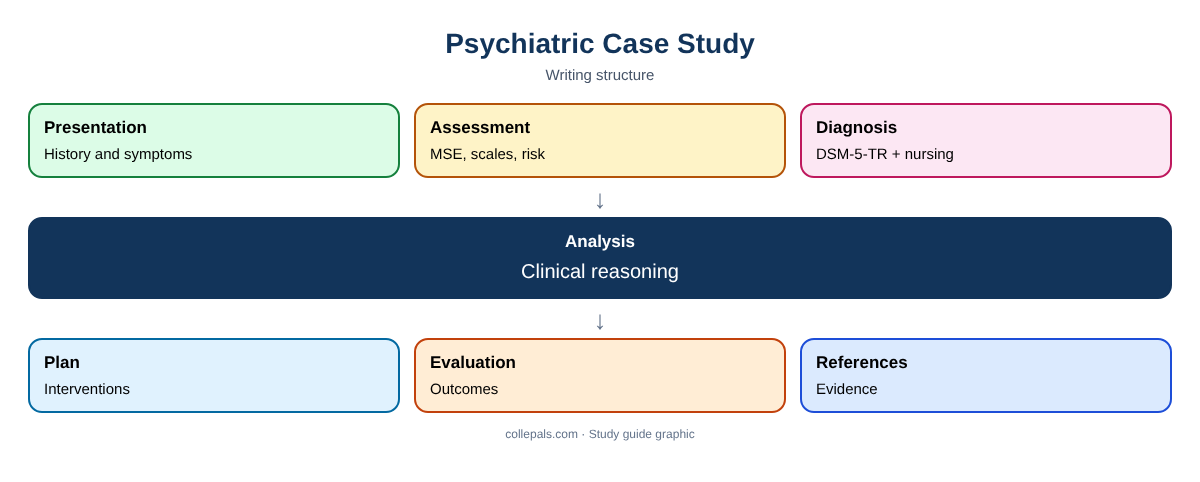
To write a psychiatric nursing case study, introduce the fictional or de-identified patient, summarize history, present assessment findings including the mental status exam, rating scales and risk screening, identify DSM-5-TR and nursing diagnoses, describe treatment and nursing interventions with rationales, evaluate outcomes and discuss evidence, ethics and recovery, citing sources in APA 7.
Patients and examples on this page are fictional and written by Collepals for study purposes. Course codes, assignments and rubrics vary by school, so always follow your own syllabus. This content is educational, not clinical advice.
Sample document: a psychiatric nursing case study writing template with a fictional example (Word).
Psychiatric Nursing Case Study Structure
| Section | Include |
|---|---|
| Introduction | Patient (fictional initials), age, setting, reason for admission |
| History | Psychiatric, medical, substance use, social and family history |
| Assessment | Mental status exam, rating scales (PHQ-9, GAD-7), suicide/violence risk, labs |
| Diagnosis | DSM-5-TR diagnosis and prioritized nursing diagnoses |
| Treatment | Medications, therapies, milieu, legal status |
| Nursing care | Goals, interventions with rationales |
| Evaluation | Outcomes and revisions |
| Discussion | Evidence, stigma, ethics, discharge and recovery |
| References | APA 7 |
Mini Case (Fictional)
T.H., 45
Admitted voluntarily after two weeks of insomnia, hopelessness and passive suicidal ideation following divorce. Speech slow; affect constricted; denies hallucinations; oriented ×4; insight fair. PHQ-9: 21. C-SSRS: passive ideation without plan.
Analysis example: T.H.’s symptoms meet criteria for major depressive disorder (American Psychiatric Association, 2022). The priority nursing diagnosis is risk for suicide, supported by hopelessness, recent loss and passive ideation. Interventions include structured risk assessment each shift, a collaborative safety plan (Stanley & Brown, 2012), environmental safety and medication monitoring.
Tips for Strong Analysis
- Use data to justify every diagnosis.
- Prioritize safety, then physiological needs, then psychosocial needs.
- Explain why interventions work, with citations.
- Discuss stigma, culture and recovery, not only symptoms.
- De-identify all real patient information.
Condition examples: depression case study, anxiety case study, bipolar disorder case study and PTSD case study.
Frequently Asked Questions
Should I use a real patient?
Only if your instructor allows it, and always de-identified; many assignments use instructor-provided cases.
How long is a psychiatric case study?
Commonly 4–8 pages; follow your rubric.
Do I need DSM-5-TR criteria?
Yes, cite them when explaining the medical diagnosis.
Get Help With Your Psychiatric Nursing Case Study
Psychiatric mental health nursing assignments demand clinical reasoning, therapeutic communication and careful APA writing. Collepals.com helps nursing students in psychiatric mental health courses:
- Plan discussion posts and thoughtful peer responses.
- Write case studies, care plans, concept maps and treatment plans.
- Structure reflections and mental status exam write-ups.
- Find current evidence, cite in APA 7 and get drafts edited and proofread.
Browse our free model assignments or learn more about our nursing assignment writing service.
Use Collepals examples as study guides and follow your school’s academic integrity and AI policies.
More psychiatric mental health nursing guides
Collepals is an independent study resource. Follow your program’s instructions and rubric and write your own work.
References
American Psychiatric Association. (2022). Diagnostic and statistical manual of mental disorders (5th ed., text rev.). https://doi.org/10.1176/appi.books.9780890425787
Kroenke, K., Spitzer, R. L., & Williams, J. B. W. (2001). The PHQ-9: Validity of a brief depression severity measure. Journal of General Internal Medicine, 16(9), 606–613. https://doi.org/10.1046/j.1525-1497.2001.016009606.x
Posner, K., Brown, G. K., Stanley, B., Brent, D. A., Yershova, K. V., Oquendo, M. A., Currier, G. W., Melvin, G. A., Greenhill, L., Shen, S., & Mann, J. J. (2011). The Columbia–Suicide Severity Rating Scale: Initial validity and internal consistency findings from three multisite studies with adolescents and adults. American Journal of Psychiatry, 168(12), 1266–1277. https://doi.org/10.1176/appi.ajp.2011.10111704
Stanley, B., & Brown, G. K. (2012). Safety planning intervention: A brief intervention to mitigate suicide risk. Cognitive and Behavioral Practice, 19(2), 256–264. https://doi.org/10.1016/j.cbpra.2011.01.001
Get a plagiarism-free answer to this question
Send us your instructions and we’ll match you with the best writer in your subject.
- 100% human-written, zero AI
- Turnitin report included
- Confidential — we never share your data
- Free revisions & refunds