Psychiatric Nursing Concept Maps: How to Develop Them
Need help with this assignment?Get an original answer from a qualified tutor — from $10/page.
Get it written →A psychiatric nursing concept map turns patient data into a visual web of problems, medications and interventions. It helps you see how symptoms, risks and treatments connect. This guide explains how to develop a psychiatric concept map step by step, with a fictional example and a template.
Quick answer
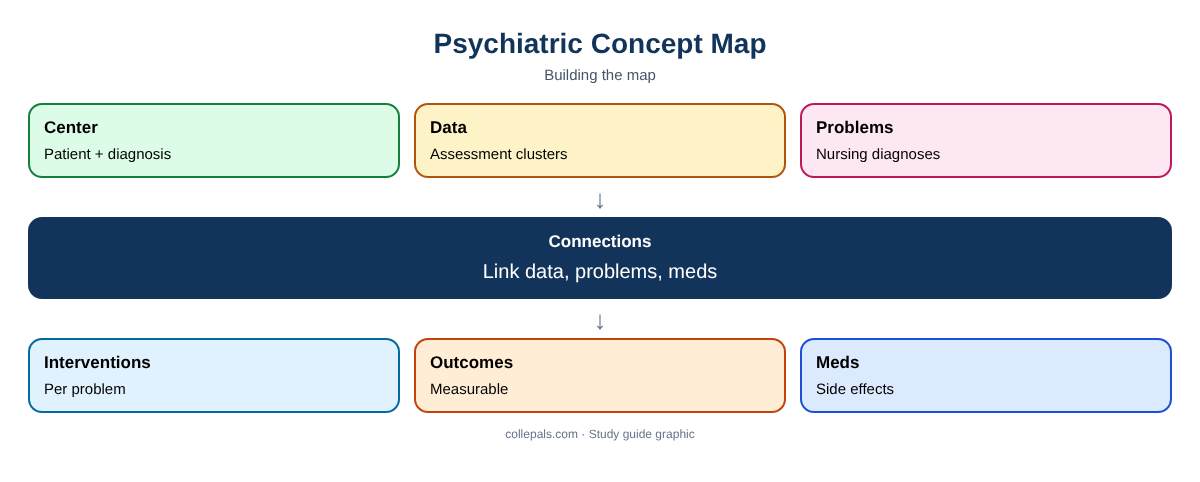
To develop a psychiatric nursing concept map, place the patient and primary diagnosis at the center, cluster assessment data (mental status exam, risk screening, labs, medications, psychosocial factors), identify and prioritize nursing diagnoses from each cluster, draw links between related problems, add goals and interventions for each diagnosis and include medication side effects and teaching.
Patients and examples on this page are fictional and written by Collepals for study purposes. Course codes, assignments and rubrics vary by school, so always follow your own syllabus. This content is educational, not clinical advice.
Sample document: a psychiatric nursing concept map template with a fictional example (Word).
How to Develop a Psychiatric Concept Map
- Center: patient (fictional initials), age, DSM-5-TR diagnosis, legal status.
- Data clusters: MSE findings, suicide/violence risk, sleep and nutrition, labs, medications, support system.
- Nursing diagnoses: name one per cluster and prioritize.
- Links: draw lines showing relationships (for example, insomnia worsens mania).
- Goals and interventions: add under each diagnosis with rationales.
- Medications: class, purpose, side effects to monitor, labs and teaching.
Fictional Example: Bipolar I, Current Episode Manic
| Map node | Content |
|---|---|
| Center | D.M., 26, bipolar I disorder, manic; involuntary hold |
| Cluster: behavior | Pressured speech, grandiosity, impulsive spending, irritability |
| Cluster: physiological | Sleeping 2 hours/night; weight loss; dehydration risk |
| Cluster: medications | Lithium: monitor levels, kidney and thyroid function, toxicity signs; antipsychotic: metabolic monitoring |
| Diagnoses | Risk for injury; disturbed sleep pattern; imbalanced nutrition; risk for other-directed violence |
| Key link | Sleep loss → worsening mania → injury risk |
| Interventions | Low-stimulation room; finger foods; consistent limits; sleep routine; lithium teaching |
Tips
- Use color for diagnoses, interventions and medications.
- Keep it on one page.
- Make sure every intervention links to a diagnosis.
- Label your legend.
Turn your map into a plan: Mental Health Nursing Care Plans: Assignment Guide. Bipolar care details: bipolar disorder case study.
Frequently Asked Questions
What software can I use?
Word, PowerPoint, Google Drawings or free diagram tools; hand-drawn maps are often accepted too.
How is a concept map different from a care plan?
A map shows relationships visually; a care plan details goals, interventions and evaluation in a table.
Should medications be on the map?
Yes, with side effects and nursing considerations.
Get Help Developing Your Psychiatric Concept Map
Psychiatric mental health nursing assignments demand clinical reasoning, therapeutic communication and careful APA writing. Collepals.com helps nursing students in psychiatric mental health courses:
- Plan discussion posts and thoughtful peer responses.
- Write case studies, care plans, concept maps and treatment plans.
- Structure reflections and mental status exam write-ups.
- Find current evidence, cite in APA 7 and get drafts edited and proofread.
Browse our free model assignments or learn more about our nursing assignment writing service.
Use Collepals examples as study guides and follow your school’s academic integrity and AI policies.
More psychiatric mental health nursing guides
Collepals is an independent study resource. Follow your program’s instructions and rubric and write your own work.
References
American Psychiatric Association. (2022). Diagnostic and statistical manual of mental disorders (5th ed., text rev.). https://doi.org/10.1176/appi.books.9780890425787
Halter, M. J. (2026). Varcarolis’ foundations of psychiatric-mental health nursing: A clinical approach (10th ed.). Elsevier.
Get a plagiarism-free answer to this question
Send us your instructions and we’ll match you with the best writer in your subject.
- 100% human-written, zero AI
- Turnitin report included
- Confidential — we never share your data
- Free revisions & refunds