How to Write a Psychiatric Treatment Plan
Need help with this assignment?Get an original answer from a qualified tutor — from $10/page.
Get it written →A psychiatric treatment plan organizes the care a person with a mental health condition will receive, from safety to medication to therapy and follow-up. This guide explains how to write a psychiatric treatment plan for a nursing or PMHNP assignment, step by step, with a template.
Quick answer
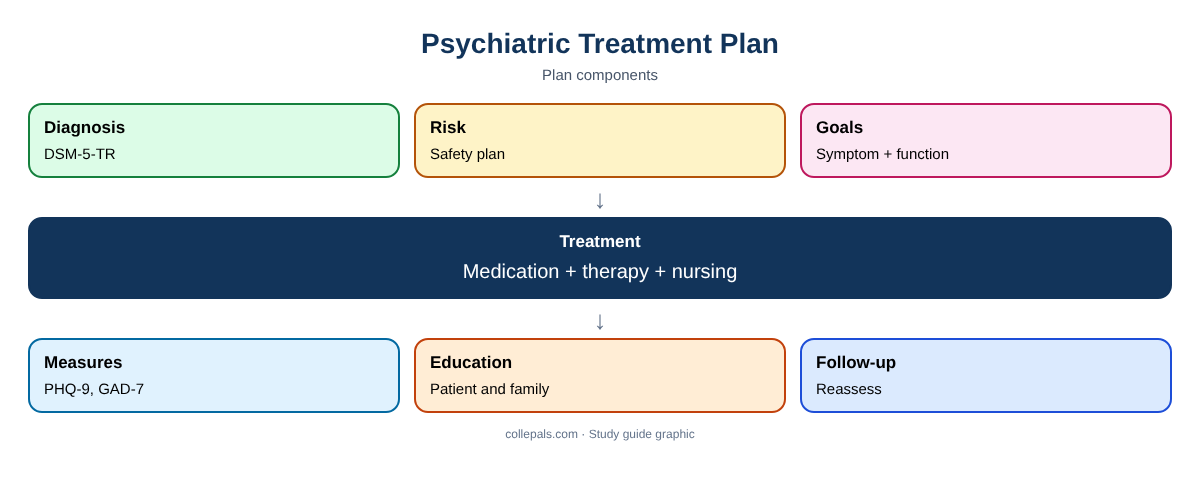
To write a psychiatric treatment plan, summarize the assessment, state DSM-5-TR diagnoses, identify problems with measurable symptom and functional goals, list evidence-based interventions across medication, psychotherapy, nursing care and education, include a safety plan when risk is present, choose validated measures such as the PHQ-9 to track progress and specify follow-up and criteria for revising the plan.
Patients and examples on this page are fictional and written by Collepals for study purposes. Course codes, assignments and rubrics vary by school, so always follow your own syllabus. This content is educational, not clinical advice.
Sample document: a psychiatric treatment plan template (Word).
Psychiatric Treatment Plan Components
| Component | Include |
|---|---|
| Identifying data and reason for care | Age, setting, presenting problem in the patient’s words |
| Assessment summary | MSE, rating scales, risk, substance use, medical issues, strengths |
| Diagnoses | DSM-5-TR diagnoses with specifiers |
| Problems and goals | Symptom and functional goals with measures and timeframes |
| Interventions | Medication, psychotherapy, nursing care, psychoeducation, family involvement |
| Safety plan | Warning signs, coping, contacts, crisis line (988), means safety |
| Measures | PHQ-9, GAD-7 or other validated scales repeated at intervals |
| Follow-up and discharge | Appointments, referrals, criteria for revision |
How to Write a Psychiatric Treatment Plan: Steps
- Summarize assessment findings in two or three sentences.
- List diagnoses using DSM-5-TR criteria (American Psychiatric Association, 2022).
- Write goals in the patient’s words when possible, such as “I want to sleep through the night.”
- Match interventions to goals and cite guidelines.
- Add a safety plan if suicide or violence risk is present (Stanley & Brown, 2012).
- Choose measures: repeating validated scales to guide treatment improves outcomes (Fortney et al., 2017).
- Set follow-up timing and revision criteria.
Sample goal and measure (fictional)
Problem: depressed mood. Goal: PHQ-9 reduced by at least 50% within 8 weeks and return to part-time work. Interventions: SSRI as prescribed with side-effect monitoring; weekly CBT; behavioral activation schedule. Measure: PHQ-9 every 2 weeks (Kroenke et al., 2001).
For full worked examples, see our psychiatric case study treatment plans complete guide and depression case study treatment plan.
Frequently Asked Questions
What is the difference between a treatment plan and a nursing care plan?
A treatment plan covers the whole team’s approach (diagnosis, medication, therapy); a nursing care plan focuses on nursing diagnoses and interventions.
Should the patient be involved?
Yes. Shared goals improve engagement and recovery.
How often is a treatment plan updated?
At set intervals and whenever the patient’s condition or risk changes.
Get Help Writing Your Psychiatric Treatment Plan
Psychiatric mental health nursing assignments demand clinical reasoning, therapeutic communication and careful APA writing. Collepals.com helps nursing students in psychiatric mental health courses:
- Plan discussion posts and thoughtful peer responses.
- Write case studies, care plans, concept maps and treatment plans.
- Structure reflections and mental status exam write-ups.
- Find current evidence, cite in APA 7 and get drafts edited and proofread.
Browse our free model assignments or learn more about our nursing assignment writing service.
Use Collepals examples as study guides and follow your school’s academic integrity and AI policies.
More psychiatric mental health nursing guides
- NUR 101: Foundations of Psychiatric Mental Health Nursing — Complete Course Guide
- Mental Health Nursing Care Plans: Assignment Guide
- Psychiatric Mental Health Nursing Case Study Writing Guide
- Psychiatric Assessment and Mental Status Examination Guide
- Psychiatric Nursing Concept Maps: How to Develop Them
Collepals is an independent study resource. Follow your program’s instructions and rubric and write your own work.
References
American Psychiatric Association. (2022). Diagnostic and statistical manual of mental disorders (5th ed., text rev.). https://doi.org/10.1176/appi.books.9780890425787
Fortney, J. C., Unützer, J., Wrenn, G., Pyne, J. M., Smith, G. R., Schoenbaum, M., & Harbin, H. T. (2017). A tipping point for measurement-based care. Psychiatric Services, 68(2), 179–188. https://doi.org/10.1176/appi.ps.201500439
Kroenke, K., Spitzer, R. L., & Williams, J. B. W. (2001). The PHQ-9: Validity of a brief depression severity measure. Journal of General Internal Medicine, 16(9), 606–613. https://doi.org/10.1046/j.1525-1497.2001.016009606.x
Stanley, B., & Brown, G. K. (2012). Safety planning intervention: A brief intervention to mitigate suicide risk. Cognitive and Behavioral Practice, 19(2), 256–264. https://doi.org/10.1016/j.cbpra.2011.01.001
Get a plagiarism-free answer to this question
Send us your instructions and we’ll match you with the best writer in your subject.
- 100% human-written, zero AI
- Turnitin report included
- Confidential — we never share your data
- Free revisions & refunds