How to Write a Treatment Plan for a Nursing Case Study
Need help with this assignment?Get an original answer from a qualified tutor — from $10/page.
Get it written →Writing a treatment plan for a nursing case study becomes manageable when you follow a consistent process. This guide explains how to write a treatment plan for a nursing case study, step by step, with a worked example and a downloadable sample.
Quick answer
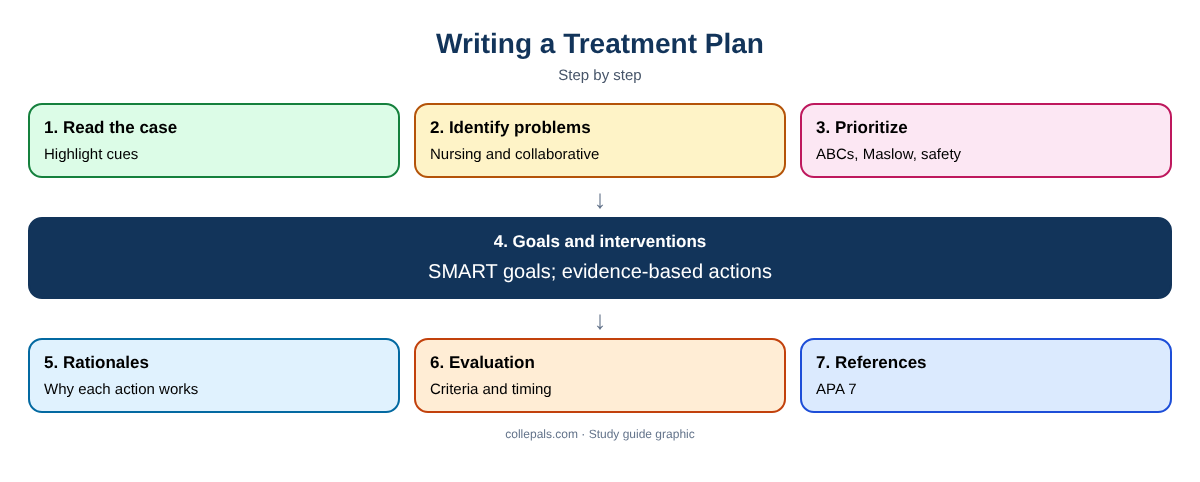
Read the case and highlight abnormal cues, cluster related cues into problems, prioritize them, write a SMART goal for each, select evidence-based interventions, explain the rationale for each, define how you will evaluate outcomes and support your plan with APA citations.
Patients in this article are fictional and used for study purposes. Treatments are illustrative; follow current guidelines, provider orders, facility protocols and your scope of practice. This content is educational, not medical advice.
Sample document: a sample postoperative treatment plan (Word).
Step 1: Read the Case Closely
Highlight vital signs, labs, symptoms, history, medications and psychosocial factors. Mark abnormal findings.
Step 2: Identify Problems
Cluster cues into nursing problems, such as “acute pain” or “risk for infection,” using NANDA-I labels when required (Herdman et al., 2024), and identify collaborative problems that need provider orders.
Step 3: Prioritize
Use airway, breathing and circulation, Maslow’s hierarchy and safety. See how to prioritize patient problems.
Step 4: Write SMART Goals
See SMART goals guide.
Step 5: Choose Interventions and Rationales
See interventions with rationales.
Step 6: Plan Evaluation
State how you will know whether each goal was met. See evaluating outcomes.
Step 7: Cite Evidence
Support rationales with current guidelines and textbooks in APA 7 (American Psychological Association, 2020).
Worked Example (Fictional Postoperative Patient)
| Problem / diagnosis | Goal (SMART) | Interventions | Rationale | Evaluation |
|---|---|---|---|---|
| Acute pain r/t surgical incision AEB pain 8/10, guarding | Pain ≤3/10 at rest within 1 h of intervention | Assess pain with scale q4h and 30–60 min after analgesia; give analgesic as ordered; splint incision; position | Regular assessment guides treatment; splinting reduces strain | Pain 3/10 at 1 h: met |
| Risk for infection r/t surgical incision | Incision free of redness and drainage through discharge | Hand hygiene; assess incision each shift; aseptic dressing care; monitor temperature and WBC | Early detection and asepsis prevent surgical site infection | No signs of infection: met |
Frequently Asked Questions
How long should a nursing treatment plan be?
Long enough to address priority problems completely; many assignments require two to three problems.
Can I use the same interventions for every patient?
No; interventions should reflect the patient’s specific data.
Should I include medications?
Include administering and monitoring ordered medications, with nursing considerations.
Need Help Writing a Treatment Plan? Use Collepals
Case study treatment plans take time to research and write. Collepals.com helps nursing and nurse practitioner students:
- Identify and prioritize problems from complex case data.
- Write SMART goals, interventions and evidence-based rationales.
- Find current guidelines and format references in APA 7.
- Study model treatment plans and get your drafts edited and proofread.
Browse our free model assignments or learn more about our nursing assignment writing service.
Use Collepals examples as study guides and follow your school’s academic integrity and AI policies.
More treatment plan guides
- Case Study Treatment Plans: A Complete Guide for Nursing Students
- How to Develop Patient Goals and SMART Objectives in Treatment Plans
- How to Write Nursing Interventions With Rationales
- How to Prioritize Patient Problems When Developing a Treatment Plan
- How to Evaluate Treatment Plan Outcomes in a Nursing Case Study
Collepals is an independent study resource. Follow your program’s care plan format and rubric and write your own work.
References
American Psychological Association. (2020). Publication manual of the American Psychological Association (7th ed.). https://doi.org/10.1037/0000165-000
Herdman, T. H., Kamitsuru, S., & Lopes, C. T. (Eds.). (2024). NANDA-I international nursing diagnoses: Definitions and classification, 2024–2026 (13th ed.). Thieme.
Get a plagiarism-free answer to this question
Send us your instructions and we’ll match you with the best writer in your subject.
- 100% human-written, zero AI
- Turnitin report included
- Confidential — we never share your data
- Free revisions & refunds