NRNP 6635 Psychiatric Case Presentation: Complete Guide
Need help with this assignment?Get an original answer from a qualified tutor — from $10/page.
Get it written →Some versions of NRNP 6635 ask students to present a comprehensive psychiatric evaluation as a recorded case presentation, often with slides, instead of or in addition to a written document. A good presentation tells the patient’s story efficiently and highlights your diagnostic reasoning. This complete guide explains how to plan, structure and deliver an NRNP 6635 psychiatric case presentation.
Quick answer
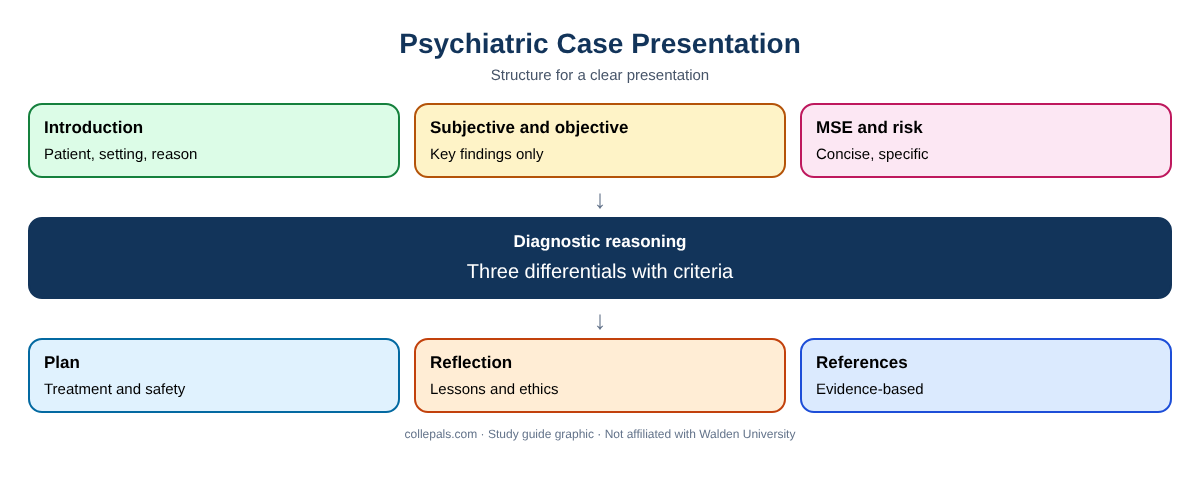
Structure the presentation as introduction, subjective findings, objective findings and MSE, risk assessment, three differential diagnoses with DSM-5-TR comparison, plan if required, reflection and references. Keep slides concise, speak to the key findings rather than reading text, protect patient privacy and stay within the time limit.
Slide-by-Slide Structure
| Slide or section | Content |
|---|---|
| Title | Case title, your name, course, date |
| Patient introduction | Age, gender, setting, chief complaint in quotes (no identifiers) |
| Subjective | HPI highlights and pertinent histories |
| Objective | Vital signs, labs, rating scale scores |
| Mental status examination | Key findings in each domain |
| Risk assessment | Suicide and violence risk, protective factors |
| Differential diagnoses | Three ranked diagnoses with DSM-5-TR support |
| Plan (if required) | Pharmacologic, psychotherapy, safety, follow-up |
| Reflection | What you would do differently, ethics, SDOH, health promotion |
| References | APA 7 |
Presentation Tips
- Tell a story. Present the case chronologically so your audience follows the reasoning.
- Prioritize. Present pertinent positives and negatives, not every detail.
- Use slides as prompts. Keep bullets short and explain them aloud; put detail in speaker notes.
- Show reasoning. A criteria comparison table for the differentials is powerful on a slide; see comparing DSM-5-TR criteria.
- Look professional. If you appear on video, dress professionally, use a quiet room and good lighting.
- Practice and time yourself. Rehearse to stay within the required length.
Sample Opening Script
Sample introduction (fictional)
Today I will present a 24-year-old man seen in an outpatient clinic, referred by his mother for withdrawal and unusual beliefs over the past eight months. His chief complaint is, ‘People at work are putting messages in my computer to control me.’ I will review his history, mental status findings and risk assessment, then compare three differential diagnoses: schizophrenia, schizophreniform disorder and substance-induced psychotic disorder.
For this type of case, see the schizophrenia and psychotic disorders case study.
Privacy and Professionalism
Never use real patient names, photos or identifying details. If you draw on clinical experience, change identifying details and follow HIPAA and your program’s policies. See legal and ethical considerations in psychiatric nursing evaluations.
Common Mistakes
- Reading dense slides word for word.
- Running over the time limit.
- Omitting risk assessment or the reflection.
- Presenting differentials without criteria.
Frequently Asked Questions
How long should an NRNP 6635 case presentation be?
Follow your assignment instructions; recorded case presentations often have a strict time limit of several minutes.
Do I need slides?
Many instructors require them. Follow the assignment directions and any required template.
Should I include references on slides?
Yes. Cite sources on relevant slides and include a final references slide in APA 7.
Get Help Preparing Your Case Presentation at Collepals
Comprehensive psychiatric evaluations take time, and NRNP 6635 often requires a new one every few weeks. Collepals.com supports PMHNP students with:
- Guidance on organizing your case into the comprehensive psychiatric evaluation template.
- Help comparing DSM-5-TR criteria and building three well-supported differential diagnoses.
- Current, evidence-based references formatted in APA 7.
- Model evaluations, case presentations and reflections you can study, plus editing and proofreading of your drafts.
Browse our free model assignments or learn more about our nursing assignment writing service.
Use Collepals examples as study guides and follow your university’s academic integrity and AI policies when you submit your own work.
More NRNP 6635 study guides
- NRNP 6635 Comprehensive Psychiatric Evaluation: Complete Guide
- NRNP 6635 Comprehensive Psychiatric Evaluation Template
- How to Write a Comprehensive Psychiatric Evaluation for PMHNP Students
- How to Compare DSM-5-TR Criteria in Psychiatric Case Studies
- How to Write a Psychiatric Evaluation Reflection
- NRNP 6635 Schizophrenia and Psychotic Disorders Case Study
Collepals is an independent study resource and is not affiliated with or endorsed by Walden University. Course requirements, templates and rubrics change; always follow your current syllabus and course template. This article is educational and is not clinical advice for any individual patient.
References
American Psychiatric Association. (2016). The American Psychiatric Association practice guidelines for the psychiatric evaluation of adults (3rd ed.). https://doi.org/10.1176/appi.books.9780890426760
American Psychiatric Association. (2022). Diagnostic and statistical manual of mental disorders (5th ed., text rev.). https://doi.org/10.1176/appi.books.9780890425787
Get a plagiarism-free answer to this question
Send us your instructions and we’ll match you with the best writer in your subject.
- 100% human-written, zero AI
- Turnitin report included
- Confidential — we never share your data
- Free revisions & refunds