How to Write a Mental Status Examination for a Psychiatric Patient
Need help with this assignment?Get an original answer from a qualified tutor — from $10/page.
Get it written →The mental status examination (MSE) is the psychiatric equivalent of the physical exam: a structured description of what you observe during the interview. In NRNP 6635 evaluations, a vague MSE (“patient appears depressed”) costs points, while a specific one supports your diagnosis. This guide explains how to write a mental status examination for a psychiatric patient, domain by domain, with an example.
Quick answer
Document each MSE domain with specific observations: appearance, behavior and psychomotor activity, speech, mood (in the patient’s words), affect, thought process, thought content (including suicidal and homicidal ideation and delusions), perception, cognition, insight and judgment. Use descriptive terms and examples, and make sure the MSE is consistent with your diagnoses.
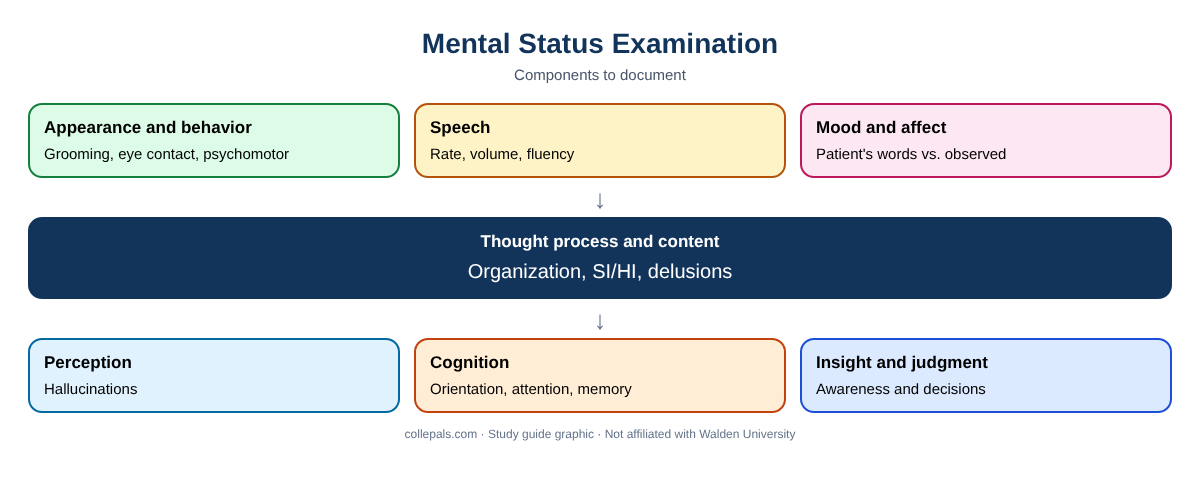
The MSE Domains
| Domain | What to describe | Useful terms |
|---|---|---|
| Appearance | Age appearance, dress, grooming, hygiene, notable features | Well-groomed, disheveled, malodorous, appears older than stated age |
| Behavior and psychomotor activity | Cooperation, eye contact, movements | Cooperative, guarded, agitated, psychomotor retardation, tremor, tics |
| Speech | Rate, rhythm, volume, articulation, spontaneity | Pressured, slow, soft, monotone, latency of response |
| Mood | Patient’s own description, in quotes | “Down,” “anxious,” “on top of the world” |
| Affect | Observed emotional expression: range, intensity, stability, congruence | Euthymic, constricted, blunted, flat, labile, incongruent |
| Thought process | How thoughts are organized | Linear, goal-directed, circumstantial, tangential, flight of ideas, loose associations |
| Thought content | What the patient thinks about | Suicidal or homicidal ideation, delusions, obsessions, preoccupations |
| Perception | Sensory disturbances | Auditory or visual hallucinations, illusions, responding to internal stimuli |
| Cognition | Level of consciousness, orientation, attention, memory, abstraction | Alert, oriented x4, serial sevens, three-word recall |
| Insight | Awareness of illness and need for treatment | Good, fair, poor, absent |
| Judgment | Decision-making ability | Good, fair, poor, impaired |
These domains follow standard psychiatric texts (Boland et al., 2022) and the APA (2016) evaluation guideline.
Example MSE
Sample MSE (fictional patient with depressive symptoms)
Appearance: 34-year-old woman appearing stated age, casually dressed, hair unwashed, fair hygiene. Behavior: cooperative, limited eye contact, psychomotor slowing. Speech: soft, slow rate, decreased spontaneity. Mood: “empty.” Affect: constricted, tearful at times, congruent with mood. Thought process: linear and goal-directed. Thought content: preoccupied with guilt about job loss; endorses passive death wishes (“sometimes I wish I wouldn’t wake up”); denies active suicidal intent or plan, homicidal ideation, delusions. Perception: denies auditory or visual hallucinations; not responding to internal stimuli. Cognition: alert, oriented to person, place, time and situation; attention mildly reduced (serial sevens with two errors); recent and remote memory grossly intact. Insight: fair; recognizes she is depressed. Judgment: fair; agreed to safety plan and follow-up.
Notice how each domain uses specific observations, and how thought content documents suicidal ideation with clear distinctions between passive wishes, intent and plan. A structured tool such as the C-SSRS helps you assess suicidal ideation and behavior systematically (Posner et al., 2011).
Tips for a Strong MSE
- Distinguish mood from affect. Mood is what the patient says; affect is what you observe.
- Be specific. “Pressured speech, difficult to interrupt” is better than “abnormal speech.”
- Document negatives that matter, such as “denies hallucinations; not responding to internal stimuli.”
- Keep it consistent. If your primary diagnosis is mania, your MSE should reflect findings such as pressured speech or flight of ideas when observed.
- Use a formal cognitive screen when cognitive impairment is suspected; see neurocognitive disorders case study.
Common MSE Mistakes
- Writing “WNL” for every domain.
- Diagnosing in the MSE (“patient is bipolar”).
- Confusing thought process (organization) with thought content (themes).
- Omitting suicidal and homicidal ideation.
- Including information the case did not show.
Frequently Asked Questions
What is the difference between mood and affect?
Mood is the patient’s subjective emotional state in their words; affect is the clinician’s observation of emotional expression.
Is the MSE subjective or objective?
It is objective, recording the clinician’s observations during the interview.
Should every MSE include suicide assessment?
Yes. Document suicidal and homicidal ideation, intent and plan in thought content for every patient.
Get Help Writing a Detailed MSE at Collepals
Comprehensive psychiatric evaluations take time, and NRNP 6635 often requires a new one every few weeks. Collepals.com supports PMHNP students with:
- Guidance on organizing your case into the comprehensive psychiatric evaluation template.
- Help comparing DSM-5-TR criteria and building three well-supported differential diagnoses.
- Current, evidence-based references formatted in APA 7.
- Model evaluations, case presentations and reflections you can study, plus editing and proofreading of your drafts.
Browse our free model assignments or learn more about our nursing assignment writing service.
Use Collepals examples as study guides and follow your university’s academic integrity and AI policies when you submit your own work.
More NRNP 6635 study guides
- NRNP 6635 Comprehensive Psychiatric Evaluation: Complete Guide
- NRNP 6635 Comprehensive Psychiatric Evaluation Template
- How to Write a Comprehensive Psychiatric Evaluation for PMHNP Students
- NRNP 6635 Psychiatric Evaluation: Subjective and Objective Assessment
- How to Develop Three Differential Diagnoses in Psychiatric Evaluations
Collepals is an independent study resource and is not affiliated with or endorsed by Walden University. Course requirements, templates and rubrics change; always follow your current syllabus and course template. This article is educational and is not clinical advice for any individual patient.
References
American Psychiatric Association. (2016). The American Psychiatric Association practice guidelines for the psychiatric evaluation of adults (3rd ed.). https://doi.org/10.1176/appi.books.9780890426760
Boland, R., Verduin, M. L., & Ruiz, P. (Eds.). (2022). Kaplan & Sadock’s synopsis of psychiatry (12th ed.). Wolters Kluwer.
Posner, K., Brown, G. K., Stanley, B., Brent, D. A., Yershova, K. V., Oquendo, M. A., Currier, G. W., Melvin, G. A., Greenhill, L., Shen, S., & Mann, J. J. (2011). The Columbia–Suicide Severity Rating Scale: Initial validity and internal consistency findings from three multisite studies with adolescents and adults. American Journal of Psychiatry, 168(12), 1266–1277. https://doi.org/10.1176/appi.ajp.2011.10111704
Get a plagiarism-free answer to this question
Send us your instructions and we’ll match you with the best writer in your subject.
- 100% human-written, zero AI
- Turnitin report included
- Confidential — we never share your data
- Free revisions & refunds