NRNP 6635 Comprehensive Psychiatric Evaluation Template
Need help with this assignment?Get an original answer from a qualified tutor — from $10/page.
Get it written →A clear template makes every NRNP 6635 comprehensive psychiatric evaluation faster to write and easier to grade. This page provides a section-by-section NRNP 6635 comprehensive psychiatric evaluation template with prompts for what to include, an example of how to fill it in and a downloadable Word version you can use for practice. Always compare it with the official template your course provides, which takes priority.
Quick answer
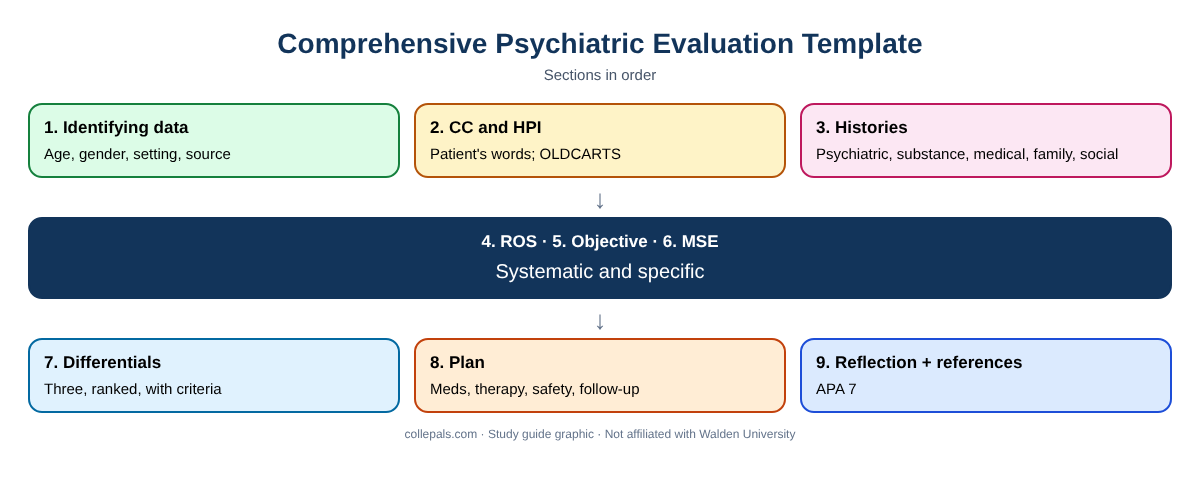
Organize the evaluation into identifying data; chief complaint; history of present illness; past psychiatric history; substance use history; family psychiatric and substance use history; psychosocial history; medical history and medications; review of systems; objective data; mental status examination; diagnostic impressions with three differentials; plan if required; reflection; and references.
Download the practice template (.docx)
Section-by-Section Template
| Section | Prompts to address |
|---|---|
| Identifying data | Age, gender, setting (outpatient, inpatient, telehealth), source of information and reliability; use initials or a pseudonym |
| Chief complaint (CC) | The reason for the visit in the patient’s own words, in quotation marks |
| History of present illness (HPI) | Onset, duration, course, severity, triggers, associated symptoms, impact on function, prior treatment for this episode, current screening scores |
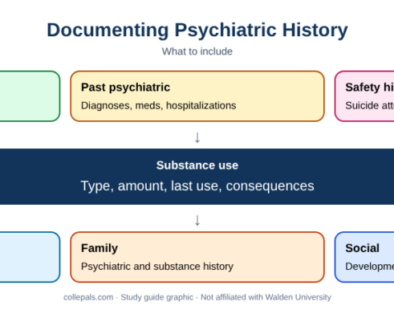
| Past psychiatric history | Previous diagnoses, medications and response, psychotherapy, hospitalizations, suicide attempts, self-harm, violence |
| Substance use history | Alcohol, tobacco, cannabis, other substances: amount, frequency, last use, consequences, treatment |
| Family psychiatric and substance use history | First- and second-degree relatives with mental illness, suicide or substance use |
| Psychosocial history | Development, education, employment, relationships, living situation, finances, legal history, trauma, culture, spirituality, support |
| Medical history | Conditions, surgeries, current medications, allergies, reproductive history if relevant |
| Review of systems (ROS) | Pertinent positives and negatives by system, including symptoms that could suggest medical causes |
| Objective | Vital signs, physical findings, laboratory and imaging results, rating scale scores |
| Mental status examination | Appearance, behavior, speech, mood, affect, thought process, thought content, perception, cognition, insight, judgment |
| Diagnostic impressions | Three differentials, ranked, each compared with DSM-5-TR criteria using pertinent positives and negatives |
| Plan (if required) | Medications, psychotherapy, labs, safety plan, referrals, follow-up |
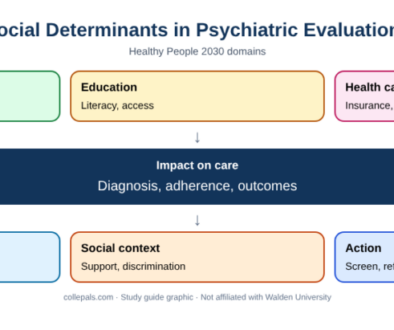
| Reflection | What you would do differently, legal and ethical issues, social determinants, health promotion and prevention |
| References | Current, evidence-based sources in APA 7 |
Example: Filling in the First Sections
Sample entries (fictional patient)
Chief complaint: “I can’t sleep and I feel like I’m failing at everything.” [Patient’s words]
HPI: 34-year-old female referred by primary care for evaluation of depressed mood for 3 months. Onset after job loss; symptoms include low mood most days, anhedonia, insomnia with early waking, poor appetite with 8-lb weight loss, fatigue and poor concentration. Denies prior manic symptoms. PHQ-9 score 18.
Notice that the HPI is specific, chronological and includes duration, symptoms, function and a screening score. For more on these sections, see subjective and objective assessment and how to document psychiatric history and presenting symptoms.
Tips for Using the Template
- Keep every heading, writing “Not reported in the case” when information is unavailable.
- Use objective, nonjudgmental language.
- Include pertinent negatives, such as “denies prior manic or hypomanic episodes,” because they support your differentials.
- Do not include real patient identifiers if you use clinical experiences.
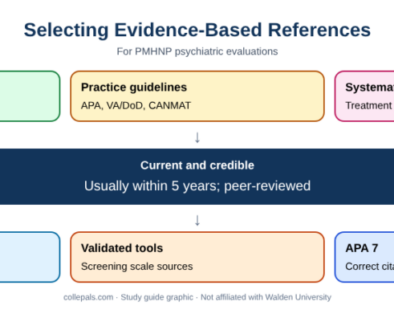
- Follow the APA practice guideline elements for a complete evaluation, including risk assessment and a quantitative symptom measure (American Psychiatric Association, 2016).
Once your data are organized, use how to develop three differential diagnoses to complete the assessment.
Frequently Asked Questions
Is this the official Walden template?
No. It is a practice template based on standard psychiatric evaluation structure. Use the official template from your course, which may differ in order or headings.
Should I use full sentences or bullet points?
Follow your rubric. Many students use concise sentences for the HPI and MSE and bullets for histories and ROS.
What if the case does not give vital signs or labs?
State that they were not provided and, if appropriate, recommend which labs you would order and why.
Need Help Completing Your Template? Use Collepals
Comprehensive psychiatric evaluations take time, and NRNP 6635 often requires a new one every few weeks. Collepals.com supports PMHNP students with:
- Guidance on organizing your case into the comprehensive psychiatric evaluation template.
- Help comparing DSM-5-TR criteria and building three well-supported differential diagnoses.
- Current, evidence-based references formatted in APA 7.
- Model evaluations, case presentations and reflections you can study, plus editing and proofreading of your drafts.
Browse our free model assignments or learn more about our nursing assignment writing service.
Use Collepals examples as study guides and follow your university’s academic integrity and AI policies when you submit your own work.
More NRNP 6635 study guides
- NRNP 6635 Comprehensive Psychiatric Evaluation: Complete Guide
- How to Write a Comprehensive Psychiatric Evaluation for PMHNP Students
- NRNP 6635 Psychiatric Evaluation: Subjective and Objective Assessment
- How to Write a Mental Status Examination for a Psychiatric Patient
- How to Develop Three Differential Diagnoses in Psychiatric Evaluations
- How to Document Psychiatric History and Presenting Symptoms
Collepals is an independent study resource and is not affiliated with or endorsed by Walden University. Course requirements, templates and rubrics change; always follow your current syllabus and course template. This article is educational and is not clinical advice for any individual patient.
References
American Psychiatric Association. (2016). The American Psychiatric Association practice guidelines for the psychiatric evaluation of adults (3rd ed.). https://doi.org/10.1176/appi.books.9780890426760
American Psychiatric Association. (2022). Diagnostic and statistical manual of mental disorders (5th ed., text rev.). https://doi.org/10.1176/appi.books.9780890425787
Get a plagiarism-free answer to this question
Send us your instructions and we’ll match you with the best writer in your subject.
- 100% human-written, zero AI
- Turnitin report included
- Confidential — we never share your data
- Free revisions & refunds