How to Write a Comprehensive Psychiatric Evaluation for PMHNP Students
Need help with this assignment?Get an original answer from a qualified tutor — from $10/page.
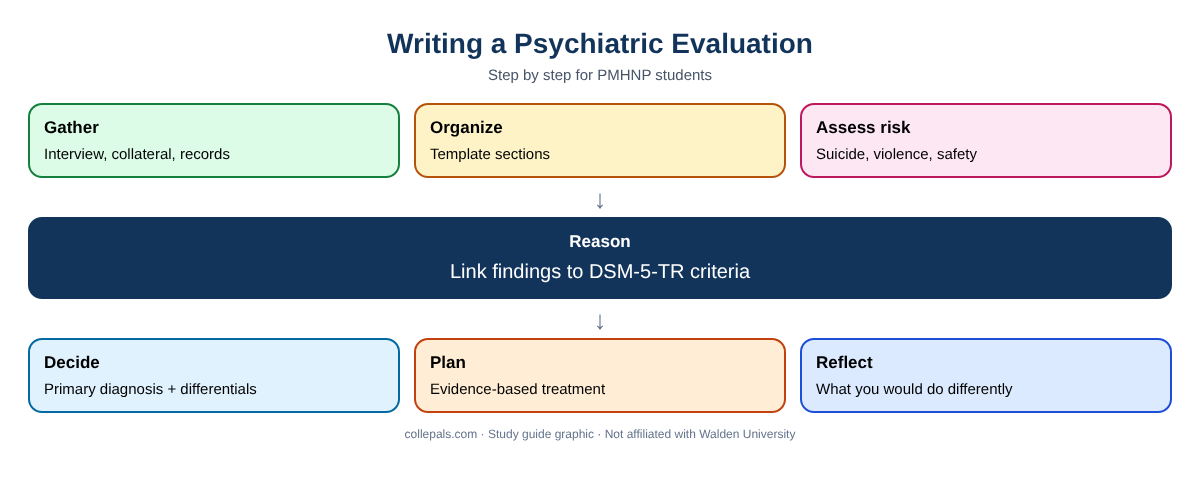
Get it written →Writing a comprehensive psychiatric evaluation is one of the first major skills PMHNP students master, and it is the core assignment in courses such as NRNP 6635. A strong evaluation is organized, specific and built on clear diagnostic reasoning. This guide explains how to write a comprehensive psychiatric evaluation step by step, from gathering data to reflecting on your work.
Quick answer
Gather data from the interview, collateral sources and records; organize it into the evaluation template; assess suicide and violence risk; link findings to DSM-5-TR criteria; identify a primary diagnosis and two other differentials; develop an evidence-based plan if required; and reflect on what you would do differently. Write concisely, objectively and with citations.
Step 1: Gather Complete Data
Watch or review the case carefully, taking notes on the patient’s words, behaviors and history. Use all available sources: patient interview, family or collateral reports, prior records, screening tools and labs. The American Psychiatric Association (2016) recommends that a psychiatric evaluation include the reason for evaluation, current symptoms, psychiatric, substance use, medical, family and social history, a mental status examination, a risk assessment and a quantitative measure of symptoms where appropriate.
Step 2: Organize the Data Into the Template
Place each finding in the correct section. Subjective information goes in the history sections; observed and measured findings go in the objective section and MSE. See our comprehensive psychiatric evaluation template and guide to subjective and objective assessment.
Step 3: Assess Risk
Every evaluation must address suicide and violence risk. Document ideation, intent, plan, means, past attempts, risk factors and protective factors. A structured tool such as the Columbia–Suicide Severity Rating Scale (C-SSRS) supports systematic assessment (Posner et al., 2011).
Step 4: Write a Specific MSE
Describe what you observed in each domain, from appearance to judgment, with concrete examples. See how to write a mental status examination.
Step 5: Reason Through the Diagnosis
List the key findings, generate possible diagnoses and compare each with DSM-5-TR criteria (American Psychiatric Association, 2022), including duration, impairment and exclusions such as substance use or medical conditions. Rank your three differentials and explain why the primary diagnosis fits best. See three differential diagnoses and comparing DSM-5-TR criteria.
Step 6: Plan (If Required)
Recommend evidence-based pharmacologic and psychotherapeutic treatment, safety measures, labs and follow-up. See how to develop a psychiatric treatment plan using DSM-5-TR.
Step 7: Reflect
Discuss what you would do differently, legal and ethical considerations, social determinants of health and health promotion. See how to write a psychiatric evaluation reflection.
Writing Style Tips
- Use professional, objective language: “Patient reports,” “Patient denies,” “observed.”
- Avoid judgmental terms, such as “noncompliant” or “drug seeker.”
- Be concise: clinical documentation rewards precision over length.
- Support clinical reasoning with current, scholarly references in APA 7.
- Proofread for consistency, such as matching ages, dates and medications across sections.
Common Mistakes
- Listing three differentials without comparing them to criteria.
- Ignoring substance-induced or medical causes.
- Copying the case transcript instead of summarizing.
- Omitting risk assessment.
- Generic MSE phrases with no observed details.
Frequently Asked Questions
How long should a comprehensive psychiatric evaluation be?
It varies by template, but most student evaluations are several pages. Completeness and clarity matter more than length.
Should I write in first person?
Clinical documentation is usually written in the third person about the patient; reflections are written in the first person.
What is the most important section?
Diagnostic reasoning is often weighted most heavily, but it depends on complete, accurate data in earlier sections.
Write Stronger Psychiatric Evaluations With Collepals
Comprehensive psychiatric evaluations take time, and NRNP 6635 often requires a new one every few weeks. Collepals.com supports PMHNP students with:
- Guidance on organizing your case into the comprehensive psychiatric evaluation template.
- Help comparing DSM-5-TR criteria and building three well-supported differential diagnoses.
- Current, evidence-based references formatted in APA 7.
- Model evaluations, case presentations and reflections you can study, plus editing and proofreading of your drafts.
Browse our free model assignments or learn more about our nursing assignment writing service.
Use Collepals examples as study guides and follow your university’s academic integrity and AI policies when you submit your own work.
More NRNP 6635 study guides
- NRNP 6635 Comprehensive Psychiatric Evaluation: Complete Guide
- NRNP 6635 Comprehensive Psychiatric Evaluation Template
- NRNP 6635 Psychiatric Evaluation: Subjective and Objective Assessment
- How to Write a Mental Status Examination for a Psychiatric Patient
- How to Develop Three Differential Diagnoses in Psychiatric Evaluations
- How to Write a Psychiatric Evaluation Reflection
- How to Develop a Psychiatric Treatment Plan Using DSM-5-TR
Collepals is an independent study resource and is not affiliated with or endorsed by Walden University. Course requirements, templates and rubrics change; always follow your current syllabus and course template. This article is educational and is not clinical advice for any individual patient.
References
American Psychiatric Association. (2016). The American Psychiatric Association practice guidelines for the psychiatric evaluation of adults (3rd ed.). https://doi.org/10.1176/appi.books.9780890426760
American Psychiatric Association. (2022). Diagnostic and statistical manual of mental disorders (5th ed., text rev.). https://doi.org/10.1176/appi.books.9780890425787
Posner, K., Brown, G. K., Stanley, B., Brent, D. A., Yershova, K. V., Oquendo, M. A., Currier, G. W., Melvin, G. A., Greenhill, L., Shen, S., & Mann, J. J. (2011). The Columbia–Suicide Severity Rating Scale: Initial validity and internal consistency findings from three multisite studies with adolescents and adults. American Journal of Psychiatry, 168(12), 1266–1277. https://doi.org/10.1176/appi.ajp.2011.10111704
Get a plagiarism-free answer to this question
Send us your instructions and we’ll match you with the best writer in your subject.
- 100% human-written, zero AI
- Turnitin report included
- Confidential — we never share your data
- Free revisions & refunds