NRNP 6635 Psychiatric Evaluation: Subjective and Objective Assessment
Need help with this assignment?Get an original answer from a qualified tutor — from $10/page.
Get it written →Many points in an NRNP 6635 psychiatric evaluation are lost in the first sections, where students mix subjective and objective information or leave out key details. This guide explains what belongs in the subjective and objective assessment of a psychiatric evaluation, with examples and screening tools.
Quick answer
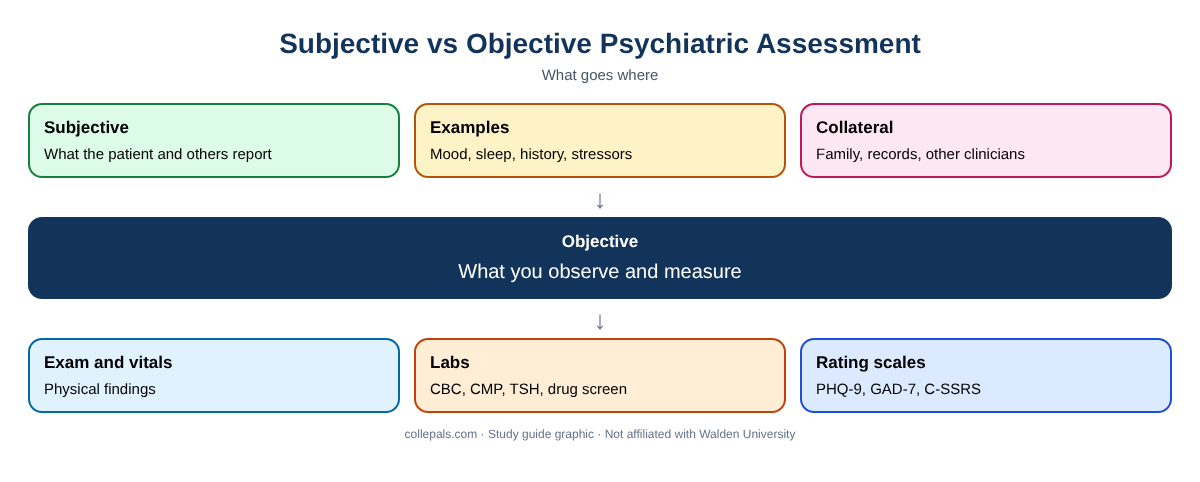
Subjective data are what the patient and others report: chief complaint, history of present illness, past psychiatric, substance use, medical, family and social histories and review of systems. Objective data are what you observe and measure: vital signs, physical findings, laboratory results, rating scale scores and the mental status examination.
Subjective Assessment
Chief complaint
Record the reason for the visit in the patient’s own words, such as “My thoughts are racing and I haven’t slept in days.”
History of present illness
Describe onset, duration, course, severity, precipitating factors, associated symptoms, impact on functioning and treatments tried. A chronological narrative helps your reader understand the episode.
Past psychiatric, substance use, medical, family and social histories
These histories provide context and risk factors. For details on each, see how to document psychiatric history and presenting symptoms.
Review of systems
Document pertinent positives and negatives, focusing on systems relevant to psychiatric symptoms: for example, heat intolerance and palpitations (thyroid), headaches or neurological symptoms, sleep and appetite changes and pain.
Objective Assessment
| Element | Examples | Why it matters |
|---|---|---|
| Vital signs | BP, heart rate, temperature, weight, BMI | Baseline for medications; signs of withdrawal or medical illness |
| Physical findings | Tremor, track marks, signs of self-harm, neurological findings | Clues to substance use, medical causes or risk |
| Laboratory tests | CBC, comprehensive metabolic panel, TSH, urine drug screen, lipids, A1C, pregnancy test when relevant | Rule out medical causes; baseline for treatment |
| Rating scales | PHQ-9, GAD-7, MDQ, PCL-5, C-SSRS, MoCA | Quantify symptoms and track change |
| Mental status examination | Observed appearance, behavior, speech, affect, thought, cognition | Clinician’s direct observation |
The PHQ-9 (Kroenke et al., 2001) and GAD-7 (Spitzer et al., 2006) are widely used, validated measures of depression and anxiety severity, and the APA (2016) recommends a quantitative measure of symptoms as part of the initial evaluation.
Examples of Correct Placement
| Finding | Subjective or objective? |
|---|---|
| Patient says she sleeps 3 hours a night | Subjective |
| Husband reports she spent $8,000 in a week | Subjective (collateral) |
| Pressured speech observed during interview | Objective (MSE) |
| TSH 0.1 mIU/L | Objective (labs) |
| PHQ-9 score of 19 | Objective (rating scale), based on patient report |
When Information Is Missing
Case videos rarely provide everything. Write “not reported” or “not assessed” rather than inventing data, and state what you would assess or order next. This shows clinical judgment.
Frequently Asked Questions
Is the MSE subjective or objective?
The MSE is objective because it records the clinician’s observations, although it includes the patient’s description of mood in quotes.
Are rating scale scores objective?
They are usually placed in the objective section because they are quantified, even though many are self-reported.
What labs should I recommend?
Choose labs based on the presentation and planned treatment, such as TSH for mood symptoms or a urine drug screen when substance use is possible.
Get Help With Subjective and Objective Assessments at Collepals
Comprehensive psychiatric evaluations take time, and NRNP 6635 often requires a new one every few weeks. Collepals.com supports PMHNP students with:
- Guidance on organizing your case into the comprehensive psychiatric evaluation template.
- Help comparing DSM-5-TR criteria and building three well-supported differential diagnoses.
- Current, evidence-based references formatted in APA 7.
- Model evaluations, case presentations and reflections you can study, plus editing and proofreading of your drafts.
Browse our free model assignments or learn more about our nursing assignment writing service.
Use Collepals examples as study guides and follow your university’s academic integrity and AI policies when you submit your own work.
More NRNP 6635 study guides
- NRNP 6635 Comprehensive Psychiatric Evaluation: Complete Guide
- NRNP 6635 Comprehensive Psychiatric Evaluation Template
- How to Write a Comprehensive Psychiatric Evaluation for PMHNP Students
- How to Write a Mental Status Examination for a Psychiatric Patient
- How to Document Psychiatric History and Presenting Symptoms
Collepals is an independent study resource and is not affiliated with or endorsed by Walden University. Course requirements, templates and rubrics change; always follow your current syllabus and course template. This article is educational and is not clinical advice for any individual patient.
References
American Psychiatric Association. (2016). The American Psychiatric Association practice guidelines for the psychiatric evaluation of adults (3rd ed.). https://doi.org/10.1176/appi.books.9780890426760
Kroenke, K., Spitzer, R. L., & Williams, J. B. W. (2001). The PHQ-9: Validity of a brief depression severity measure. Journal of General Internal Medicine, 16(9), 606–613. https://doi.org/10.1046/j.1525-1497.2001.016009606.x
Spitzer, R. L., Kroenke, K., Williams, J. B. W., & Löwe, B. (2006). A brief measure for assessing generalized anxiety disorder: The GAD-7. Archives of Internal Medicine, 166(10), 1092–1097. https://doi.org/10.1001/archinte.166.10.1092
Get a plagiarism-free answer to this question
Send us your instructions and we’ll match you with the best writer in your subject.
- 100% human-written, zero AI
- Turnitin report included
- Confidential — we never share your data
- Free revisions & refunds