How to Write a Psychiatric Evaluation Reflection
Need help with this assignment?Get an original answer from a qualified tutor — from $10/page.
Get it written →The reflection is often the last section of an NRNP 6635 comprehensive psychiatric evaluation, and it is easy to rush. Yet rubrics commonly reward a thoughtful reflection that addresses what you would do differently, legal and ethical issues, social determinants of health and health promotion. This guide explains how to write a psychiatric evaluation reflection with structure, depth and evidence.
Quick answer
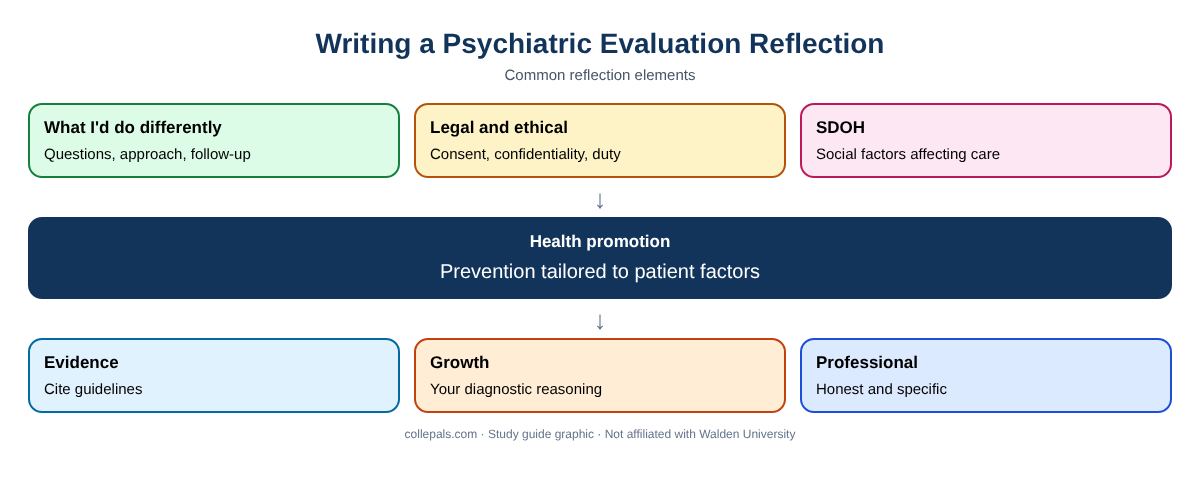
Reflect specifically on what you would do differently with the patient, legal and ethical considerations, social determinants of health that affect care and health promotion and disease prevention tailored to the patient’s age, culture and risk factors. Use first person, cite evidence and keep the focus on clinical learning.
What to Include
1. What you would do differently
Identify specific gaps in the interview or evaluation, such as missing collateral information, questions you did not ask, screening tools you would add or a different approach to rapport. Explain why each change would improve diagnostic accuracy or care.
2. Legal and ethical considerations
Discuss issues such as informed consent, confidentiality, capacity, duty to warn or protect, mandatory reporting, involuntary treatment or care of minors, and the ethical principles involved. See legal and ethical considerations in psychiatric nursing evaluations.
3. Social determinants of health
Identify social factors, such as income, housing, insurance, transportation, education, discrimination or social support, that affect the patient’s illness and access to care, and explain how you would address them. See social determinants of health in psychiatric patient evaluations.
4. Health promotion and disease prevention
Recommend prevention appropriate to the patient’s age, sex, culture, ethnicity, religion and risk factors, such as screening, vaccinations, physical activity, sleep, substance use counseling and metabolic monitoring for patients on antipsychotics.
Example Reflection
Sample reflection (fictional patient with depressive symptoms)
If I conducted this interview again, I would ask more specifically about past periods of elevated mood and decreased need for sleep, and I would seek the patient’s permission to speak with her husband, because collateral information is essential to rule out bipolar II disorder before starting an antidepressant. Ethically, her passive death wishes required me to balance her autonomy with beneficence by completing a structured suicide risk assessment and collaborative safety plan. Her recent job loss and loss of insurance are social determinants that could limit access to psychotherapy and medications, so I would connect her with a sliding-scale clinic and low-cost generic options. For health promotion, I would encourage regular physical activity and sleep hygiene, screen for alcohol use and recommend age-appropriate preventive care, such as cervical cancer screening, tailored to her values and resources.
Using a Reflection Model
A structured model such as Gibbs’ (1988) reflective cycle (description, feelings, evaluation, analysis, conclusion and action plan) helps you move beyond describing the case to learning from it.
Tips
- Be specific to the case; generic reflections lose points.
- Use first person for reflection, even though the evaluation itself is in third person.
- Support recommendations with guidelines or research.
- Address every element your template lists.
Frequently Asked Questions
How long should the reflection be?
Usually one to two substantial paragraphs or a short section; follow your template.
Can I use first person in the reflection?
Yes. Reflection is personal and APA 7 permits first person.
Do I need citations in the reflection?
Including evidence for ethical principles, SDOH and prevention recommendations strengthens it, and some rubrics require it.
Get Help Writing Your Reflection at Collepals
Comprehensive psychiatric evaluations take time, and NRNP 6635 often requires a new one every few weeks. Collepals.com supports PMHNP students with:
- Guidance on organizing your case into the comprehensive psychiatric evaluation template.
- Help comparing DSM-5-TR criteria and building three well-supported differential diagnoses.
- Current, evidence-based references formatted in APA 7.
- Model evaluations, case presentations and reflections you can study, plus editing and proofreading of your drafts.
Browse our free model assignments or learn more about our nursing assignment writing service.
Use Collepals examples as study guides and follow your university’s academic integrity and AI policies when you submit your own work.
More NRNP 6635 study guides
- NRNP 6635 Comprehensive Psychiatric Evaluation: Complete Guide
- How to Write a Comprehensive Psychiatric Evaluation for PMHNP Students
- Legal and Ethical Considerations in Psychiatric Nursing Evaluations
- How to Develop a Psychiatric Treatment Plan Using DSM-5-TR
- Social Determinants of Health in Psychiatric Patient Evaluations
Collepals is an independent study resource and is not affiliated with or endorsed by Walden University. Course requirements, templates and rubrics change; always follow your current syllabus and course template. This article is educational and is not clinical advice for any individual patient.
References
Gibbs, G. (1988). Learning by doing: A guide to teaching and learning methods. Further Education Unit, Oxford Polytechnic.
Get a plagiarism-free answer to this question
Send us your instructions and we’ll match you with the best writer in your subject.
- 100% human-written, zero AI
- Turnitin report included
- Confidential — we never share your data
- Free revisions & refunds