Legal and Ethical Considerations in Psychiatric Nursing Evaluations
Need help with this assignment?Get an original answer from a qualified tutor — from $10/page.
Get it written →Psychiatric evaluations raise legal and ethical questions more often than most clinical encounters: patients may lack capacity, pose a risk to themselves or others or disclose information that must be reported. NRNP 6635 reflections frequently ask students to discuss these issues. This guide explains the key legal and ethical considerations in psychiatric nursing evaluations and how to address them in your writing.
Quick answer
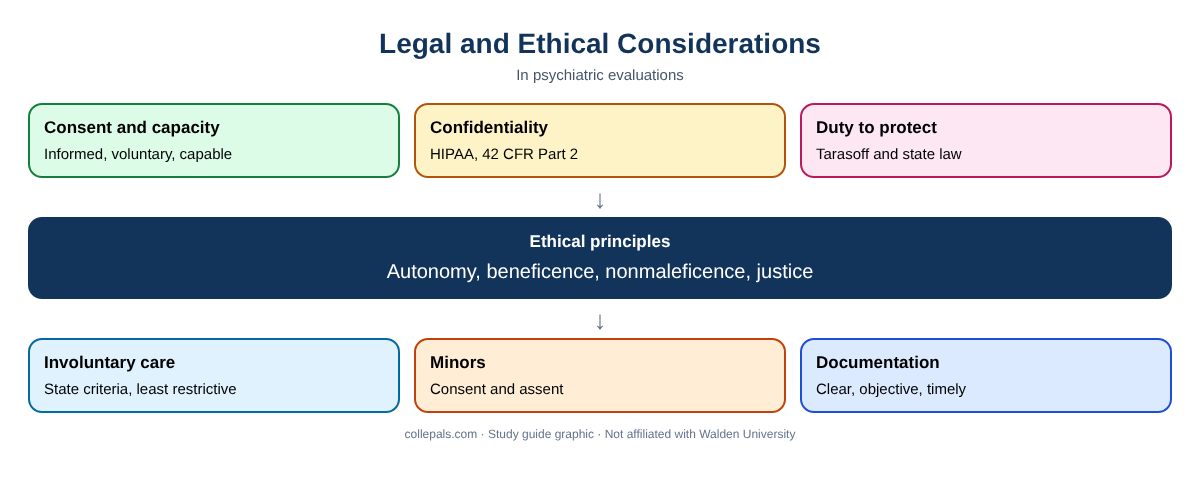
Key considerations include informed consent and decision-making capacity, confidentiality and its limits under HIPAA and 42 CFR Part 2, duty to warn or protect under state law following Tarasoff, mandatory reporting of abuse, involuntary evaluation and treatment criteria, care of minors and the ethical principles of autonomy, beneficence, nonmaleficence and justice. Laws vary by state.
Informed Consent and Capacity
Patients have the right to make informed decisions about evaluation and treatment. Capacity is decision-specific: a patient may be able to consent to one decision but not another. Assess whether the patient can understand relevant information, appreciate how it applies to them, reason about options and communicate a choice. Document your assessment.
Confidentiality and Its Limits
The HIPAA Privacy Rule protects health information, and federal regulations at 42 CFR Part 2 add stricter protections for records from certain substance use disorder treatment programs. Explain the limits of confidentiality at the start of the evaluation, including risk of harm and mandatory reporting.
Duty to Warn or Protect
In Tarasoff v. Regents of the University of California (1976), the California Supreme Court held that mental health professionals may have a duty to protect identifiable third parties from a patient’s serious threat of violence. States now vary: some require action, some permit it and some have no statute. Know your state’s law and document risk assessment and actions taken.
Mandatory Reporting
Clinicians must report suspected child abuse or neglect and, in most states, abuse of elders or dependent adults. Reporting obligations override confidentiality.
Involuntary Evaluation and Treatment
State laws allow emergency evaluation or hospitalization when a person, because of mental illness, is a danger to self or others or, in some states, gravely disabled. Use the least restrictive appropriate setting and follow due process requirements.
Minors
Consent rules for minors vary by state; some allow adolescents to consent to certain mental health or substance use services. Seek assent from minors and involve guardians as required.
Ethical Principles
| Principle | Application in psychiatric evaluation |
|---|---|
| Autonomy | Respect informed choices, including refusal, when the patient has capacity |
| Beneficence | Act in the patient’s best interest, such as safety planning |
| Nonmaleficence | Avoid harm, such as unnecessary restraint or inappropriate prescribing |
| Justice | Provide fair, unbiased care regardless of race, income or diagnosis |
| Fidelity and veracity | Be honest and keep commitments, including about confidentiality limits |
The American Nurses Association (2025) Code of Ethics for Nurses provides the professional ethical framework for nurse practitioners, including respect for the dignity and rights of every person.
Applying This in NRNP 6635 Reflections
Identify the specific legal or ethical issue in your case, explain the relevant law or principle, describe how you would handle it and cite your sources. For example: “Because the patient described a plan to harm his coworker, I would assess the seriousness of the threat and follow my state’s duty-to-protect statute.” See how to write a psychiatric evaluation reflection.
Frequently Asked Questions
Does Tarasoff apply in every state?
No. Duty-to-warn or duty-to-protect laws vary by state; some are mandatory, some permissive and some states have none.
Can a patient refuse psychiatric treatment?
A patient with decision-making capacity generally can, except in emergencies or when state involuntary treatment criteria are met through legal processes.
What is 42 CFR Part 2?
A federal regulation that provides additional confidentiality protections for records from certain substance use disorder treatment programs.
Get Help With Legal and Ethical Reflections at Collepals
Comprehensive psychiatric evaluations take time, and NRNP 6635 often requires a new one every few weeks. Collepals.com supports PMHNP students with:
- Guidance on organizing your case into the comprehensive psychiatric evaluation template.
- Help comparing DSM-5-TR criteria and building three well-supported differential diagnoses.
- Current, evidence-based references formatted in APA 7.
- Model evaluations, case presentations and reflections you can study, plus editing and proofreading of your drafts.
Browse our free model assignments or learn more about our nursing assignment writing service.
Use Collepals examples as study guides and follow your university’s academic integrity and AI policies when you submit your own work.
More NRNP 6635 study guides
- NRNP 6635 Comprehensive Psychiatric Evaluation: Complete Guide
- How to Write a Comprehensive Psychiatric Evaluation for PMHNP Students
- How to Write a Psychiatric Evaluation Reflection
- Social Determinants of Health in Psychiatric Patient Evaluations
- How to Select Evidence-Based References for PMHNP Psychiatric Evaluations
Collepals is an independent study resource and is not affiliated with or endorsed by Walden University. Course requirements, templates and rubrics change; always follow your current syllabus and course template. This article is educational and is not clinical advice for any individual patient.
References
American Nurses Association. (2025). Code of ethics for nurses. https://codeofethics.ana.org
Tarasoff v. Regents of the University of California, 17 Cal. 3d 425 (1976).
Get a plagiarism-free answer to this question
Send us your instructions and we’ll match you with the best writer in your subject.
- 100% human-written, zero AI
- Turnitin report included
- Confidential — we never share your data
- Free revisions & refunds