How to Develop Three Differential Diagnoses in Psychiatric Evaluations
Need help with this assignment?Get an original answer from a qualified tutor — from $10/page.
Get it written →Most NRNP 6635 comprehensive psychiatric evaluations ask for three differential diagnoses, ranked, with an explanation of why each is supported or ruled out. Differential diagnosis is the heart of diagnostic reasoning, and it is where many students lose points by listing diagnoses without justification. This guide explains how to develop three differential diagnoses in psychiatric evaluations, with a worked example.
Quick answer
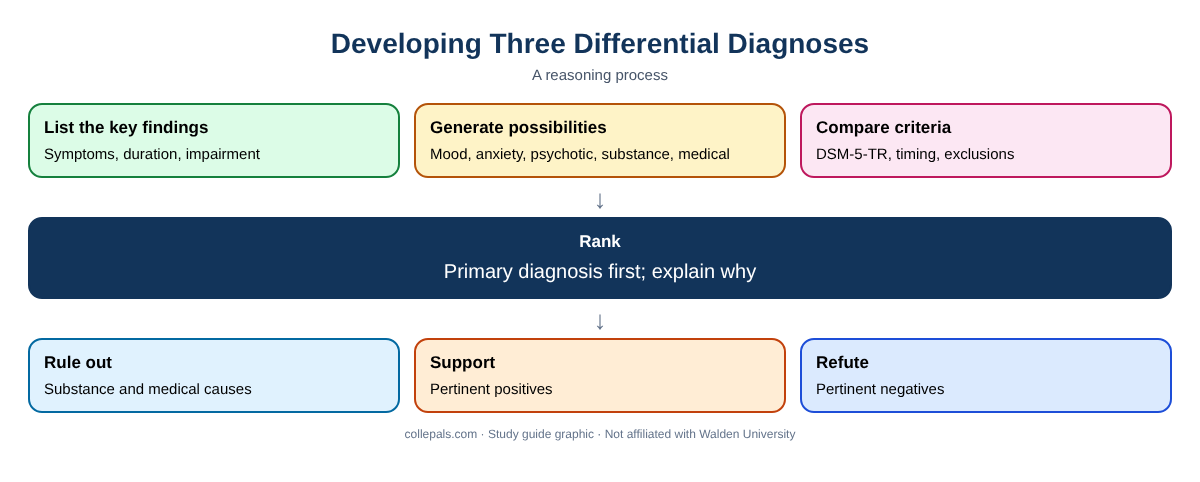
List the patient’s key findings, generate diagnoses that could explain them (including substance-induced and medical causes), compare each with DSM-5-TR criteria for core symptoms, duration, impairment and exclusions, then rank them. Explain the pertinent positives and negatives for each and state why the primary diagnosis fits best.
The patient in this guide is fictional and is used for study purposes only. Diagnostic criteria are summarized in our own words; consult the DSM-5-TR directly for exact criteria, and base your evaluation on your assigned case.
Step 1: Summarize the Key Findings
Write a one- or two-sentence problem statement: “34-year-old woman with three months of depressed mood, anhedonia, insomnia, weight loss and guilt after job loss, with passive death wishes and no history of manic symptoms.”
Step 2: Generate Possibilities Across Categories
- Primary psychiatric disorders in the same family (for example, depressive, bipolar or anxiety disorders).
- Substance/medication-induced disorders, such as alcohol, stimulants, steroids or withdrawal.
- Disorders due to another medical condition, such as thyroid disease, anemia, neurological illness or sleep apnea.
- Disorders with overlapping features, such as adjustment disorder, PTSD or personality disorders.
Step 3: Compare Each With DSM-5-TR Criteria
For each candidate, check core symptoms, number of symptoms required, duration, distress or impairment and exclusion criteria (American Psychiatric Association, 2022). See how to compare DSM-5-TR criteria in psychiatric case studies for a table-based method.
Step 4: Rank and Justify
Place the diagnosis that best fits the evidence first. For the others, explain what supports them and what argues against them, and what additional information would confirm or rule them out.
Worked Example
| Differential | Supporting findings | Findings against | Conclusion |
|---|---|---|---|
| 1. Major depressive disorder, single episode, moderate | Depressed mood and anhedonia for 3 months; insomnia, weight loss, fatigue, guilt, poor concentration (7 symptoms); functional impairment | No history of manic or hypomanic episodes reported | Primary diagnosis: criteria met |
| 2. Bipolar II disorder, current episode depressed | Depressive episode; family history of bipolar disorder in an aunt | Denies past periods of elevated mood or decreased need for sleep; collateral not yet obtained | Less likely; reassess with MDQ and collateral |
| 3. Hypothyroidism-related depressive symptoms (depressive disorder due to another medical condition) | Fatigue, low mood, weight change | Weight loss rather than gain; TSH pending | Rule out with TSH before finalizing |
In this fictional example, the primary diagnosis meets criteria, the second is a clinically important rule-out because misdiagnosing bipolar disorder as unipolar depression can lead to inappropriate antidepressant monotherapy, and the third addresses a medical cause. See NRNP 6635 major depressive disorder case study and bipolar disorder psychiatric evaluation.
Tips
- Choose differentials that are genuinely plausible for this patient, not a random list.
- Always consider substance and medical causes.
- Use specifiers when appropriate, such as severity and episode type.
- Cite the DSM-5-TR and at least one current scholarly source for your reasoning.
- Make sure your MSE and history support the diagnosis you rank first.
Frequently Asked Questions
Do all three differentials need to be psychiatric?
Not necessarily. Including a substance-induced or medical cause is often appropriate and shows strong reasoning.
What if two diagnoses both meet criteria?
Consider comorbidity. Explain whether both should be diagnosed, and which is primary for treatment.
How detailed should the justification be?
Address each relevant criterion with patient evidence, then summarize why the diagnosis is supported or not.
Need Help With Your Differential Diagnoses? Ask Collepals
Comprehensive psychiatric evaluations take time, and NRNP 6635 often requires a new one every few weeks. Collepals.com supports PMHNP students with:
- Guidance on organizing your case into the comprehensive psychiatric evaluation template.
- Help comparing DSM-5-TR criteria and building three well-supported differential diagnoses.
- Current, evidence-based references formatted in APA 7.
- Model evaluations, case presentations and reflections you can study, plus editing and proofreading of your drafts.
Browse our free model assignments or learn more about our nursing assignment writing service.
Use Collepals examples as study guides and follow your university’s academic integrity and AI policies when you submit your own work.
More NRNP 6635 study guides
- NRNP 6635 Comprehensive Psychiatric Evaluation: Complete Guide
- How to Write a Mental Status Examination for a Psychiatric Patient
- How to Compare DSM-5-TR Criteria in Psychiatric Case Studies
- NRNP 6635 Major Depressive Disorder Case Study
- NRNP 6635 Bipolar Disorder Psychiatric Evaluation
- How to Develop a Psychiatric Treatment Plan Using DSM-5-TR
Collepals is an independent study resource and is not affiliated with or endorsed by Walden University. Course requirements, templates and rubrics change; always follow your current syllabus and course template. This article is educational and is not clinical advice for any individual patient.
References
American Psychiatric Association. (2022). Diagnostic and statistical manual of mental disorders (5th ed., text rev.). https://doi.org/10.1176/appi.books.9780890425787
Boland, R., Verduin, M. L., & Ruiz, P. (Eds.). (2022). Kaplan & Sadock’s synopsis of psychiatry (12th ed.). Wolters Kluwer.
Get a plagiarism-free answer to this question
Send us your instructions and we’ll match you with the best writer in your subject.
- 100% human-written, zero AI
- Turnitin report included
- Confidential — we never share your data
- Free revisions & refunds