NRNP 6635 Schizophrenia and Psychotic Disorders Case Study
Need help with this assignment?Get an original answer from a qualified tutor — from $10/page.
Get it written →Psychotic disorders are among the most challenging NRNP 6635 cases because several diagnoses share similar symptoms and differ mainly in duration and the relationship to mood episodes. This case study walks through a schizophrenia and psychotic disorders evaluation, including how to separate schizophrenia from schizophreniform, schizoaffective and substance-induced psychotic disorders.
Quick answer
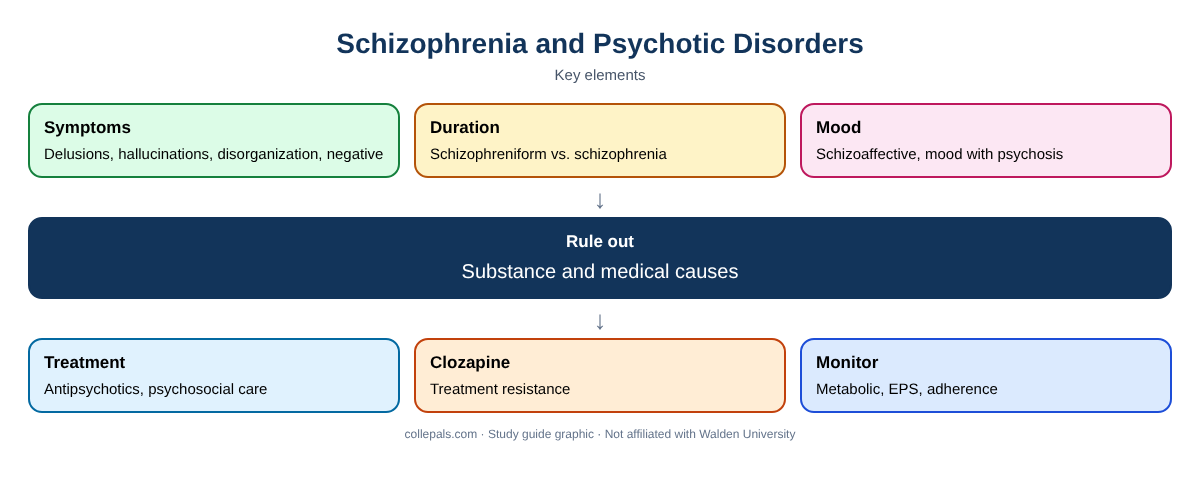
Document positive symptoms (delusions, hallucinations, disorganized speech or behavior) and negative symptoms, establish duration (less than 1 month, 1–6 months or at least 6 months), clarify the relationship to mood episodes, rule out substance and medical causes and recommend antipsychotic treatment with psychosocial interventions and metabolic monitoring.
The patient in this guide is fictional and is used for study purposes only. Diagnostic criteria are summarized in our own words; consult the DSM-5-TR directly for exact criteria, and base your evaluation on your assigned case.
The Case
Case summary
Fictional case: D.K., a 24-year-old man, is referred by his mother for eight months of social withdrawal, declining work performance and unusual beliefs. He says, “People at work are putting messages in my computer to control me.” He reports hearing a voice commenting on his actions for about four months. He stopped showering regularly and rarely leaves his room. He used cannabis occasionally in college but denies use in the past year; urine drug screen is negative. No mood episodes reported. MSE: disheveled, guarded, poor eye contact, flat affect, tangential at times, persecutory delusions, auditory hallucinations, no suicidal or homicidal ideation, poor insight.
DSM-5-TR Criteria for Schizophrenia (Summarized)
Schizophrenia requires two or more of five symptoms (delusions, hallucinations, disorganized speech, grossly disorganized or catatonic behavior and negative symptoms) for a significant part of one month, at least one being delusions, hallucinations or disorganized speech; a decline in functioning; and continuous signs of disturbance for at least six months, including prodromal or residual periods. Schizoaffective and mood disorders with psychotic features, substance effects and medical conditions must be excluded (American Psychiatric Association, 2022).
Differential Diagnoses
| Diagnosis | Key distinction | D.K. |
|---|---|---|
| Schizophrenia | At least 6 months of continuous signs with functional decline | 8 months of withdrawal and decline, 4 months of active psychosis: supported |
| Schizophreniform disorder | Same symptoms, 1 to less than 6 months | Duration exceeds 6 months: not supported |
| Substance/medication-induced psychotic disorder | Psychosis develops during or soon after substance use or withdrawal | No recent use; negative screen: less likely |
| Schizoaffective disorder | Major mood episode concurrent with psychosis, plus psychosis for 2+ weeks without mood symptoms | No mood episodes: not supported |
| Psychotic disorder due to another medical condition | Evidence of a causative medical condition | Consider labs and neurological exam to rule out |
Medical Workup
For first-episode psychosis, consider CBC, metabolic panel, TSH, urine drug screen, HIV and syphilis testing, B12 and, when indicated by neurological findings or atypical features, neuroimaging or EEG.
Treatment Plan
- Antipsychotic medication: the APA practice guideline recommends antipsychotic treatment for schizophrenia, with continued treatment when symptoms improve (Keepers et al., 2020). Choose based on side effect profile and patient preference.
- Clozapine: recommended for treatment-resistant schizophrenia and for patients with substantial suicide risk despite other treatment (Keepers et al., 2020).
- Psychosocial interventions: coordinated specialty care for first-episode psychosis, cognitive behavioral therapy for psychosis, psychoeducation, family interventions and supported employment (Keepers et al., 2020).
- Monitoring: weight, BMI, glucose or A1C, lipids, blood pressure, extrapyramidal symptoms and tardive dyskinesia using a structured tool such as the AIMS.
- Safety and engagement: assess suicide and violence risk, build trust despite poor insight and involve family with consent.
Frequently Asked Questions
How is schizophreniform disorder different from schizophrenia?
Schizophreniform disorder has the same symptoms but lasts at least one month and less than six months.
When is clozapine used?
For treatment-resistant schizophrenia and for patients with substantial suicide risk despite other treatments, with required monitoring.
Should cannabis use change the diagnosis?
Only if psychosis is attributable to the substance. Persistent psychosis beyond intoxication and withdrawal suggests a primary psychotic disorder.
Get Help With Your Psychosis Case Study at Collepals
Comprehensive psychiatric evaluations take time, and NRNP 6635 often requires a new one every few weeks. Collepals.com supports PMHNP students with:
- Guidance on organizing your case into the comprehensive psychiatric evaluation template.
- Help comparing DSM-5-TR criteria and building three well-supported differential diagnoses.
- Current, evidence-based references formatted in APA 7.
- Model evaluations, case presentations and reflections you can study, plus editing and proofreading of your drafts.
Browse our free model assignments or learn more about our nursing assignment writing service.
Use Collepals examples as study guides and follow your university’s academic integrity and AI policies when you submit your own work.
More NRNP 6635 study guides
- NRNP 6635 Comprehensive Psychiatric Evaluation: Complete Guide
- How to Develop Three Differential Diagnoses in Psychiatric Evaluations
- How to Compare DSM-5-TR Criteria in Psychiatric Case Studies
- NRNP 6635 Psychiatric Case Presentation: Complete Guide
- How to Develop a Psychiatric Treatment Plan Using DSM-5-TR
Collepals is an independent study resource and is not affiliated with or endorsed by Walden University. Course requirements, templates and rubrics change; always follow your current syllabus and course template. This article is educational and is not clinical advice for any individual patient.
References
American Psychiatric Association. (2022). Diagnostic and statistical manual of mental disorders (5th ed., text rev.). https://doi.org/10.1176/appi.books.9780890425787
Keepers, G. A., Fochtmann, L. J., Anzia, J. M., Benjamin, S., Lyness, J. M., Mojtabai, R., Servis, M., Walaszek, A., Buckley, P., Lenzenweger, M. F., Young, A. S., Degenhardt, A., & Hong, S.-H. (2020). The American Psychiatric Association practice guideline for the treatment of patients with schizophrenia. American Journal of Psychiatry, 177(9), 868–872. https://doi.org/10.1176/appi.ajp.2020.177901
Get a plagiarism-free answer to this question
Send us your instructions and we’ll match you with the best writer in your subject.
- 100% human-written, zero AI
- Turnitin report included
- Confidential — we never share your data
- Free revisions & refunds