NURS 6501 Pathophysiology Case Studies: Writing Guide
Need help with this assignment?Get an original answer from a qualified tutor — from $10/page.
Get it written →NURS 6501 case studies ask you to explain a patient’s presentation using advanced pathophysiology. This writing guide shows the typical prompt elements, a structure, a fictional mini-analysis and a template.
Quick answer
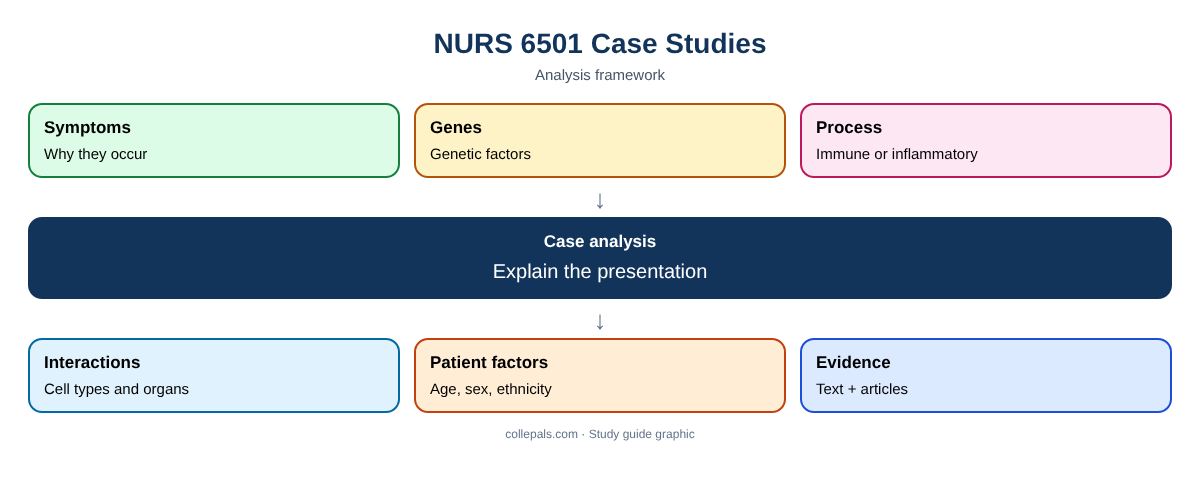
To write a NURS 6501 case study analysis, explain why the patient presents with each symptom, identify genetic factors, describe the underlying process such as inflammation or immunosuppression, explain how cells and organs interact and discuss how a patient factor such as age, sex or ethnicity changes the response, using headings that mirror the prompt and at least three scholarly sources.
Examples and patient cases on this page are fictional and written by Collepals for study purposes. NURS 6501 is Walden University’s Advanced Pathophysiology course; assignments vary by term, so follow your own syllabus and rubric. This content is educational, not clinical advice. Collepals is not affiliated with Walden University.
Sample document: a NURS 6501 case study analysis template with a fictional example (Word).
Typical NURS 6501 Case Study Questions
| Question | How to answer |
|---|---|
| Why does the patient present with these symptoms? | Link each symptom to its mechanism |
| Which genes or genetic factors are involved? | Name genes, inheritance or polymorphisms when relevant |
| What process (e.g., immunosuppression, inflammation) is occurring? | Describe cells, mediators and timing |
| How do cells and organs interact? | Trace the chain across systems |
| How would a patient factor change the response? | Age, sex, ethnicity, pregnancy or comorbidity |
Mini-Analysis (Fictional)
Scenario
A 67-year-old man presents with a hot, swollen first metatarsophalangeal joint after a weekend of heavy drinking. He takes a thiazide diuretic. Uric acid is elevated.
Why the symptoms: Hyperuricemia leads to monosodium urate crystal deposition in the cooler peripheral joint. Crystals activate the NLRP3 inflammasome in macrophages, releasing interleukin-1β, which recruits neutrophils and causes intense pain, swelling, warmth and redness (Rogers, 2023). Contributing factors: alcohol increases urate production and reduces excretion; thiazides reduce renal urate excretion. Genetics: variants in urate transporter genes such as SLC2A9 and ABCG2 influence urate levels. Patient factor: men and postmenopausal women are at higher risk because estrogen promotes urate excretion.
Structure Tips
- Use headings that match each prompt question.
- Explain, don’t list: “because” and “which leads to” are your friends.
- Cite the textbook plus current articles.
- Stay within the page limit.
Examples: Module 1 case study analysis, Module 6 case study analysis. For deeper analysis, see NURS 6501 Disease Process Analysis Assignments.
Frequently Asked Questions
How long is a NURS 6501 case study?
Usually one to two pages plus references.
Should I include treatment?
Only if asked; the focus is explaining mechanisms.
Do I need genetics in every case?
Address it whenever the prompt asks, even to say genetic factors are minor.
Get Help With Your NURS 6501 Case Study
Advanced pathophysiology assignments demand precise mechanisms, current evidence and clear APA writing. Collepals.com helps NURS 6501 and other advanced pathophysiology students:
- Explain disease mechanisms step by step, from cells to symptoms.
- Write case study analyses, discussion posts and peer responses.
- Build concept maps, presentations and research papers.
- Find current evidence, cite in APA 7 and get drafts edited and proofread.
Browse our free model assignments or learn more about our nursing assignment writing service.
Use Collepals examples as study guides and follow your school’s academic integrity and AI policies.
More NURS 6501 and pathophysiology guides
Collepals is an independent study resource. Follow your program’s instructions and rubric and write your own work.
References
Rogers, J. L. (Ed.). (2023). McCance & Huether’s pathophysiology: The biologic basis for disease in adults and children (9th ed.). Elsevier.
Get a plagiarism-free answer to this question
Send us your instructions and we’ll match you with the best writer in your subject.
- 100% human-written, zero AI
- Turnitin report included
- Confidential — we never share your data
- Free revisions & refunds