Asthma: Pathophysiology and Clinical Manifestations
Need help with this assignment?Get an original answer from a qualified tutor — from $10/page.
Get it written →Asthma pathophysiology explains how airway inflammation and hyperresponsiveness cause episodes of variable, largely reversible airflow obstruction. This guide covers triggers, the early and late phases, airway remodeling and how mechanisms explain symptoms and treatment.
Quick answer
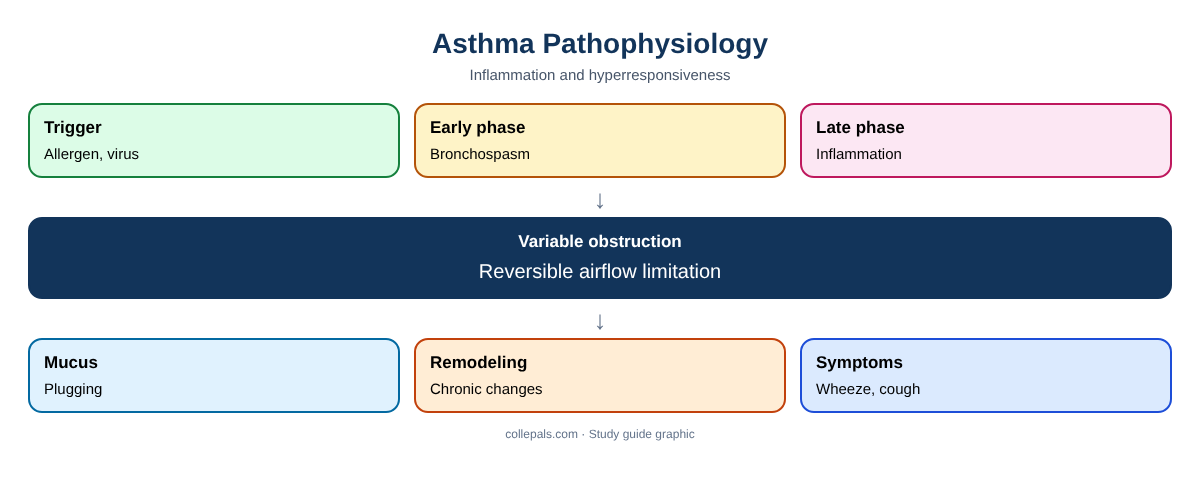
Asthma is a heterogeneous disease marked by chronic airway inflammation and airway hyperresponsiveness. In allergic (type 2) asthma, triggers activate mast cells and Th2 cells, releasing histamine, leukotrienes and cytokines (IL-4, IL-5, IL-13) that cause bronchospasm, mucosal edema, mucus production and eosinophilic inflammation. Obstruction is variable and largely reversible, but chronic inflammation can remodel airways.
Examples and patient cases on this page are fictional and written by Collepals for study purposes. NURS 6501 is Walden University’s Advanced Pathophysiology course; assignments vary by term, so follow your own syllabus and rubric. This content is educational, not clinical advice. Collepals is not affiliated with Walden University.
Sample document: an asthma pathophysiology study sheet (Word).
Triggers
- Allergens (dust mites, pollen, pet dander)
- Respiratory viral infections
- Exercise and cold air
- Smoke and pollution
- NSAIDs or aspirin in sensitive patients
Early and Late Phases
| Phase | Timing | Mechanism | Result |
|---|---|---|---|
| Early (acute) | Minutes | Allergen cross-links IgE on mast cells, releasing histamine, leukotrienes and prostaglandins | Bronchospasm, edema, mucus |
| Late | 4–8 hours | Eosinophils, Th2 lymphocytes and neutrophils infiltrate; cytokines sustain inflammation | Prolonged obstruction, hyperresponsiveness |
Airway Remodeling
Repeated inflammation thickens the basement membrane, enlarges smooth muscle, increases goblet cells and causes subepithelial fibrosis, which can make some obstruction less reversible over time (Rogers, 2023).
Symptoms Explained
- Wheezing: turbulent airflow through narrowed airways.
- Cough: airway irritation and mucus.
- Chest tightness and dyspnea: bronchoconstriction and air trapping.
- Nighttime symptoms: circadian changes in airway tone and inflammation.
Treatment Links
GINA recommends that adults and adolescents receive inhaled corticosteroid-containing treatment rather than short-acting bronchodilator alone, because inflammation drives exacerbations (Global Initiative for Asthma, 2025). Biologics target IgE, IL-5 or IL-4/IL-13 pathways in type 2 asthma. Compare with COPD: Pathophysiology and Disease Progression.
Frequently Asked Questions
What is the difference between asthma and COPD?
Asthma involves variable, largely reversible obstruction driven by type 2 inflammation; COPD involves persistent airflow limitation from neutrophilic inflammation and tissue destruction.
Why are inhaled corticosteroids central to asthma therapy?
They reduce the underlying airway inflammation.
What is status asthmaticus?
A severe exacerbation unresponsive to initial treatment that can cause respiratory failure.
Get Help With Asthma Pathophysiology
Advanced pathophysiology assignments demand precise mechanisms, current evidence and clear APA writing. Collepals.com helps NURS 6501 and other advanced pathophysiology students:
- Explain disease mechanisms step by step, from cells to symptoms.
- Write case study analyses, discussion posts and peer responses.
- Build concept maps, presentations and research papers.
- Find current evidence, cite in APA 7 and get drafts edited and proofread.
Browse our free model assignments or learn more about our nursing assignment writing service.
Use Collepals examples as study guides and follow your school’s academic integrity and AI policies.
More NURS 6501 and pathophysiology guides
Collepals is an independent study resource. Follow your program’s instructions and rubric and write your own work.
References
Global Initiative for Asthma. (2025). Global strategy for asthma management and prevention. https://ginasthma.org
Rogers, J. L. (Ed.). (2023). McCance & Huether’s pathophysiology: The biologic basis for disease in adults and children (9th ed.). Elsevier.
Get a plagiarism-free answer to this question
Send us your instructions and we’ll match you with the best writer in your subject.
- 100% human-written, zero AI
- Turnitin report included
- Confidential — we never share your data
- Free revisions & refunds