Sepsis: Pathophysiology and Multiorgan Dysfunction
Need help with this assignment?Get an original answer from a qualified tutor — from $10/page.
Get it written →Sepsis pathophysiology explains how the body’s response to infection can become dysregulated and injure its own organs. This guide covers the Sepsis-3 definitions, immune and endothelial mechanisms, septic shock and multiorgan dysfunction.
Quick answer
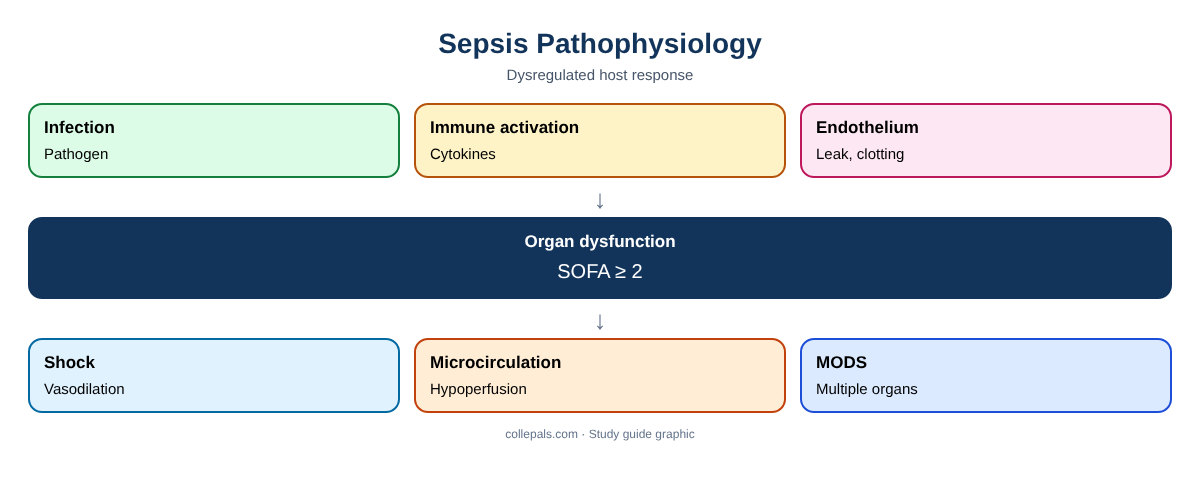
Sepsis is life-threatening organ dysfunction caused by a dysregulated host response to infection, identified by an acute rise in SOFA score of 2 or more points. Pathogen molecules trigger massive cytokine release, endothelial injury, capillary leak, vasodilation and microvascular clotting, reducing tissue perfusion and oxygen use. Septic shock adds vasopressor-dependent hypotension and lactate above 2 mmol/L despite fluids, and multiorgan dysfunction can follow.
Examples and patient cases on this page are fictional and written by Collepals for study purposes. NURS 6501 is Walden University’s Advanced Pathophysiology course; assignments vary by term, so follow your own syllabus and rubric. This content is educational, not clinical advice. Collepals is not affiliated with Walden University.
Sample document: a sepsis pathophysiology and organ dysfunction sheet (Word).
Sepsis-3 Definitions
- Sepsis: life-threatening organ dysfunction caused by a dysregulated host response to infection; organ dysfunction is an acute change in SOFA score of 2 or more points.
- Septic shock: sepsis with vasopressors required to maintain mean arterial pressure of 65 mm Hg or more and serum lactate above 2 mmol/L despite adequate fluid resuscitation (Singer et al., 2016).
Mechanisms
- Recognition: pattern recognition receptors (such as toll-like receptors) detect pathogen molecules like endotoxin.
- Cytokine storm: TNF, IL-1 and IL-6 amplify inflammation.
- Endothelial dysfunction: nitric oxide causes vasodilation; glycocalyx damage causes capillary leak.
- Coagulation activation: tissue factor triggers microthrombi while anticoagulant pathways fail, leading to DIC.
- Mitochondrial dysfunction: cells cannot use oxygen efficiently.
- Immunosuppression: later lymphocyte apoptosis raises risk of secondary infection (Rogers, 2023).
Multiorgan Dysfunction
| System | Mechanism | Manifestation |
|---|---|---|
| Cardiovascular | Vasodilation, capillary leak, myocardial depression | Hypotension, shock |
| Respiratory | Alveolar-capillary leak | ARDS, hypoxemia |
| Renal | Hypoperfusion, inflammation | Acute kidney injury, oliguria |
| Hepatic | Hypoperfusion, cholestasis | Elevated bilirubin |
| Hematologic | Consumptive coagulopathy | Thrombocytopenia, DIC |
| Neurological | Inflammation, hypoperfusion | Altered mental status |
| Metabolic | Anaerobic metabolism, impaired clearance | Elevated lactate |
Treatment Links
The Surviving Sepsis Campaign recommends prompt antimicrobials, fluid resuscitation for hypoperfusion, norepinephrine as first-line vasopressor and source control, all of which target these mechanisms (Evans et al., 2021). Related: Infectious Disease Pathophysiology: Nursing Assignment Guide and Inflammation and Immune Response: Pathophysiology Assignment Guide.
Frequently Asked Questions
What is SOFA?
The Sequential Organ Failure Assessment, which scores respiratory, coagulation, liver, cardiovascular, neurological and renal function.
Why does lactate rise in sepsis?
Tissue hypoperfusion and impaired cellular oxygen use increase anaerobic metabolism, and the liver clears lactate less efficiently.
Is SIRS still used to define sepsis?
Sepsis-3 replaced SIRS-based definitions with organ dysfunction criteria for adults.
Get Help With Sepsis Pathophysiology
Advanced pathophysiology assignments demand precise mechanisms, current evidence and clear APA writing. Collepals.com helps NURS 6501 and other advanced pathophysiology students:
- Explain disease mechanisms step by step, from cells to symptoms.
- Write case study analyses, discussion posts and peer responses.
- Build concept maps, presentations and research papers.
- Find current evidence, cite in APA 7 and get drafts edited and proofread.
Browse our free model assignments or learn more about our nursing assignment writing service.
Use Collepals examples as study guides and follow your school’s academic integrity and AI policies.
More NURS 6501 and pathophysiology guides
Collepals is an independent study resource. Follow your program’s instructions and rubric and write your own work.
References
Evans, L., Rhodes, A., Alhazzani, W., Antonelli, M., Coopersmith, C. M., French, C., Machado, F. R., Mcintyre, L., Ostermann, M., Prescott, H. C., Schorr, C., Simpson, S., Wiersinga, W. J., Alshamsi, F., Angus, D. C., Arabi, Y., Azevedo, L., Beale, R., Beilman, G., … Levy, M. (2021). Surviving sepsis campaign: International guidelines for management of sepsis and septic shock 2021. Critical Care Medicine, 49(11), e1063–e1143. https://doi.org/10.1097/CCM.0000000000005337
Rogers, J. L. (Ed.). (2023). McCance & Huether’s pathophysiology: The biologic basis for disease in adults and children (9th ed.). Elsevier.
Singer, M., Deutschman, C. S., Seymour, C. W., Shankar-Hari, M., Annane, D., Bauer, M., Bellomo, R., Bernard, G. R., Chiche, J.-D., Coopersmith, C. M., Hotchkiss, R. S., Levy, M. M., Marshall, J. C., Martin, G. S., Opal, S. M., Rubenfeld, G. D., van der Poll, T., Vincent, J.-L., & Angus, D. C. (2016). The third international consensus definitions for sepsis and septic shock (Sepsis-3). JAMA, 315(8), 801–810. https://doi.org/10.1001/jama.2016.0287
Get a plagiarism-free answer to this question
Send us your instructions and we’ll match you with the best writer in your subject.
- 100% human-written, zero AI
- Turnitin report included
- Confidential — we never share your data
- Free revisions & refunds