Acid-Base Disorders: Advanced Pathophysiology Guide
Need help with this assignment?Get an original answer from a qualified tutor — from $10/page.
Get it written →Acid base pathophysiology explains how the body keeps blood pH near 7.40 and what happens when that balance fails. This guide covers buffers, the four primary disorders, compensation, the anion gap and a stepwise approach to arterial blood gases.
Quick answer
Blood pH stays near 7.35–7.45 through chemical buffers (mainly bicarbonate), lungs that adjust CO2 within minutes and kidneys that adjust bicarbonate and acid excretion over days. The four primary disorders are metabolic acidosis and alkalosis (HCO3⁻ changes) and respiratory acidosis and alkalosis (PaCO2 changes), each with expected compensation. The anion gap separates causes of metabolic acidosis.
Examples and patient cases on this page are fictional and written by Collepals for study purposes. NURS 6501 is Walden University’s Advanced Pathophysiology course; assignments vary by term, so follow your own syllabus and rubric. This content is educational, not clinical advice. Collepals is not affiliated with Walden University.
Sample document: an acid-base disorders and ABG interpretation sheet (Word).
How pH Is Regulated
- Buffers: bicarbonate-carbonic acid, phosphate and proteins respond instantly.
- Lungs: change ventilation to adjust CO2 within minutes.
- Kidneys: reabsorb bicarbonate and excrete hydrogen ions over hours to days.
The Four Primary Disorders
| Disorder | Primary change | Compensation | Expected compensation | Common causes |
|---|---|---|---|---|
| Metabolic acidosis | ↓ HCO3⁻ | ↓ PaCO2 (hyperventilation) | Expected PaCO2 = 1.5 × HCO3⁻ + 8 ± 2 (Winter’s formula) | DKA, lactic acidosis, CKD, diarrhea |
| Metabolic alkalosis | ↑ HCO3⁻ | ↑ PaCO2 (hypoventilation) | PaCO2 rises ~0.7 per 1 mEq/L HCO3⁻ rise | Vomiting, diuretics, hyperaldosteronism |
| Respiratory acidosis | ↑ PaCO2 | ↑ HCO3⁻ (renal, days) | Acute: +1; chronic: +3.5 HCO3⁻ per 10 mm Hg PaCO2 | COPD, opioids, neuromuscular weakness |
| Respiratory alkalosis | ↓ PaCO2 | ↓ HCO3⁻ (renal) | Acute: −2; chronic: −4 to −5 HCO3⁻ per 10 mm Hg | Anxiety, pain, sepsis, pulmonary embolism |
Compensation rules follow a physiological approach to acid-base assessment (Berend et al., 2014).
Anion Gap
Anion gap = Na⁺ − (Cl⁻ + HCO3⁻), normally about 8–12 mEq/L (correct for low albumin). A high-gap metabolic acidosis reflects added acids, such as ketoacids, lactate, toxic alcohols or uremic acids; a normal-gap (hyperchloremic) acidosis reflects bicarbonate loss, such as diarrhea or renal tubular acidosis.
Stepwise ABG Interpretation
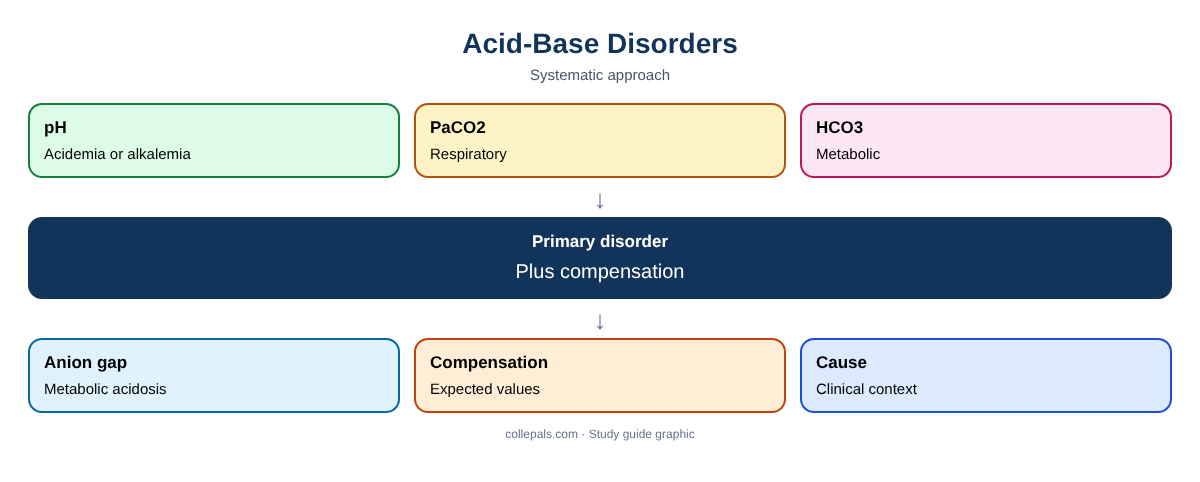
- Check pH: acidemia or alkalemia.
- Identify the primary disorder: PaCO2 or HCO3⁻.
- Check compensation against expected values; a mismatch suggests a mixed disorder.
- Calculate the anion gap for metabolic acidosis.
- Link to the clinical picture.
Applications: DKA in Diabetes Mellitus: Disease Mechanisms and Complications and COPD retention in COPD: Pathophysiology and Disease Progression.
Frequently Asked Questions
What is the normal PaCO2 and HCO3⁻?
About 35–45 mm Hg and 22–26 mEq/L.
Does compensation fully normalize pH?
Usually not; full correction suggests a mixed disorder.
Why does DKA cause Kussmaul breathing?
Deep, rapid breathing blows off CO2 to compensate for metabolic acidosis.
Get Help With Acid-Base Pathophysiology
Advanced pathophysiology assignments demand precise mechanisms, current evidence and clear APA writing. Collepals.com helps NURS 6501 and other advanced pathophysiology students:
- Explain disease mechanisms step by step, from cells to symptoms.
- Write case study analyses, discussion posts and peer responses.
- Build concept maps, presentations and research papers.
- Find current evidence, cite in APA 7 and get drafts edited and proofread.
Browse our free model assignments or learn more about our nursing assignment writing service.
Use Collepals examples as study guides and follow your school’s academic integrity and AI policies.
More NURS 6501 and pathophysiology guides
Collepals is an independent study resource. Follow your program’s instructions and rubric and write your own work.
References
Berend, K., de Vries, A. P. J., & Gans, R. O. B. (2014). Physiological approach to assessment of acid–base disturbances. New England Journal of Medicine, 371(15), 1434–1445. https://doi.org/10.1056/NEJMra1003327
Rogers, J. L. (Ed.). (2023). McCance & Huether’s pathophysiology: The biologic basis for disease in adults and children (9th ed.). Elsevier.
Get a plagiarism-free answer to this question
Send us your instructions and we’ll match you with the best writer in your subject.
- 100% human-written, zero AI
- Turnitin report included
- Confidential — we never share your data
- Free revisions & refunds