NURS 6501: Advanced Pathophysiology – Complete Course Guide
Need help with this assignment?Get an original answer from a qualified tutor — from $10/page.
Get it written →NURS 6501 is Walden University’s Advanced Pathophysiology course for MSN and nurse practitioner students. The five-credit course builds a thorough understanding of normal physiology and disease processes across the lifespan, so future advanced practice nurses can explain why patients present the way they do and plan care for them (Walden University, n.d.). This complete course guide explains what NURS 6501 covers, the assignments you can expect and how to study effectively.
Quick answer
NURS 6501 Advanced Pathophysiology is a five-credit Walden University course that covers normal physiology, alterations in health and the scientific basis of disease across the lifespan. Students typically complete case study analyses, knowledge checks, a midterm and a final exam, using McCance & Huether’s Pathophysiology. Success depends on explaining mechanisms from the cellular level to clinical signs and linking them to APRN practice.
Examples and patient cases on this page are fictional and written by Collepals for study purposes. NURS 6501 is Walden University’s Advanced Pathophysiology course; assignments vary by term, so follow your own syllabus and rubric. This content is educational, not clinical advice. Collepals is not affiliated with Walden University.
Sample document: a NURS 6501 study planner with a module checklist (Word).
What NURS 6501 Covers
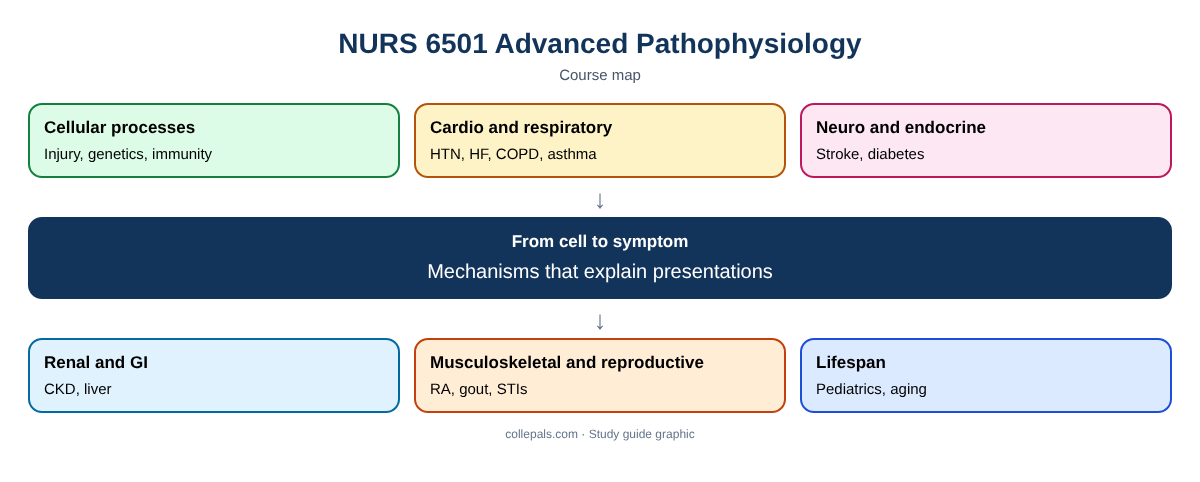
The course description emphasizes the biological basis of disease, alterations from normal function and how that knowledge supports treatment planning across the lifespan (Walden University, n.d.). Content usually progresses by body system:
| Topic area | Examples |
|---|---|
| Cellular processes and the immune system | Cell injury, genetics, inflammation, immunity, infection |
| Cardiovascular and respiratory | Hypertension, heart failure, MI, asthma, COPD, pneumonia |
| Gastrointestinal and hepatobiliary | GERD, peptic ulcer, liver and pancreatic disorders |
| Endocrine | Diabetes, thyroid, adrenal disorders |
| Neurological and musculoskeletal | Stroke, seizures, dementia, gout, RA, osteoporosis |
| Psychological disorders | Neurobiology of depression, anxiety, schizophrenia |
| Reproductive, infections and hematologic | STIs, prostate and ovarian disorders, anemias |
| Pediatrics and lifespan | Developmental differences, pediatric disorders |
Exact module order and topics vary by term; check your syllabus.
Core Textbook
Many sections use McCance & Huether’s Pathophysiology: The Biologic Basis for Disease in Adults and Children, 9th edition (Rogers, 2023). Its chapters move from normal structure and function to alterations, which mirrors how NURS 6501 assignments are graded.
Typical NURS 6501 Assignments
- Case study analyses: explain a patient’s symptoms, genetics, cell processes and patient factors. See NURS 6501 Pathophysiology Case Studies: Writing Guide.
- Knowledge checks: applied multiple-choice questions after each module.
- Midterm and final exams: cumulative, scenario-based questions.
- Discussions, concept maps or presentations in some sections. See NURS 6501 Assignments: Complete Student Guide.
How to Succeed
- Learn normal physiology first; every alteration is a departure from it.
- Practice explaining mechanisms in a chain: cause → cellular change → organ effect → symptom.
- Make one-page summaries per disorder with etiology, mechanism, manifestations and diagnostics.
- Use case questions to rehearse “why” answers, not just “what.”
- Start assignments early; cite your textbook and current peer-reviewed sources.
See also our NURS 6501 course description post.
Frequently Asked Questions
Is NURS 6501 hard?
Many students find it demanding because it requires understanding mechanisms, not memorizing facts; steady weekly study helps.
What textbook does NURS 6501 use?
Commonly McCance & Huether’s Pathophysiology (9th ed.); confirm in your syllabus.
How are students graded?
Typically through case study assignments, knowledge checks and exams; weights vary by term.
Is this an official Walden guide?
No. It is an independent study guide; always follow your course materials.
Get NURS 6501 Help at Collepals
Advanced pathophysiology assignments demand precise mechanisms, current evidence and clear APA writing. Collepals.com helps NURS 6501 and other advanced pathophysiology students:
- Explain disease mechanisms step by step, from cells to symptoms.
- Write case study analyses, discussion posts and peer responses.
- Build concept maps, presentations and research papers.
- Find current evidence, cite in APA 7 and get drafts edited and proofread.
Browse our free model assignments or learn more about our nursing assignment writing service.
Use Collepals examples as study guides and follow your school’s academic integrity and AI policies.
More NURS 6501 and pathophysiology guides
Collepals is an independent study resource. Follow your program’s instructions and rubric and write your own work.
References
Rogers, J. L. (Ed.). (2023). McCance & Huether’s pathophysiology: The biologic basis for disease in adults and children (9th ed.). Elsevier.
Walden University. (n.d.). NURS 6501 – Advanced pathophysiology [Course catalog]. https://academics.waldenu.edu/catalog/courses/nurs/6501
Get a plagiarism-free answer to this question
Send us your instructions and we’ll match you with the best writer in your subject.
- 100% human-written, zero AI
- Turnitin report included
- Confidential — we never share your data
- Free revisions & refunds