Chronic Kidney Disease: Pathophysiology and Progression
Need help with this assignment?Get an original answer from a qualified tutor — from $10/page.
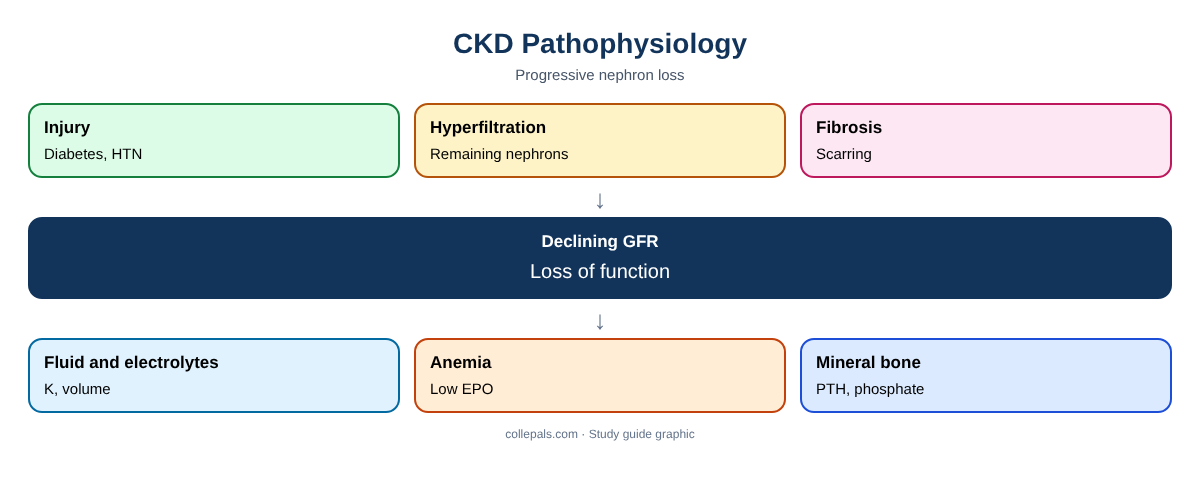
Get it written →CKD pathophysiology explains how initial kidney injury triggers a cycle of nephron loss that continues even after the original cause is controlled. This guide covers the definition and staging of chronic kidney disease, mechanisms of progression and systemic effects.
Quick answer
Chronic kidney disease is abnormal kidney structure or function lasting more than three months, such as GFR below 60 mL/min/1.73 m² or albuminuria (ACR ≥30 mg/g). After injury from diabetes, hypertension or other causes, remaining nephrons hyperfilter, which increases glomerular pressure, proteinuria, inflammation and fibrosis, so function declines progressively. Falling GFR disrupts fluid, electrolyte, acid-base, hormonal and mineral balance.
Examples and patient cases on this page are fictional and written by Collepals for study purposes. NURS 6501 is Walden University’s Advanced Pathophysiology course; assignments vary by term, so follow your own syllabus and rubric. This content is educational, not clinical advice. Collepals is not affiliated with Walden University.
Sample document: a CKD staging and pathophysiology sheet (Word).
Definition and Staging
KDIGO defines CKD as abnormalities of kidney structure or function present for more than three months with implications for health, staged by cause, GFR category and albuminuria category (KDIGO CKD Work Group, 2024).
| GFR category | GFR (mL/min/1.73 m²) | Description |
|---|---|---|
| G1 | ≥90 | Normal or high (with markers of damage) |
| G2 | 60–89 | Mildly decreased |
| G3a | 45–59 | Mildly to moderately decreased |
| G3b | 30–44 | Moderately to severely decreased |
| G4 | 15–29 | Severely decreased |
| G5 | <15 | Kidney failure |
Albuminuria is staged A1 (<30 mg/g), A2 (30–300 mg/g) and A3 (>300 mg/g). KDIGO 2024 also recommends combining creatinine and cystatin C to estimate GFR more accurately when available.
Mechanisms of Progression
- Hyperfiltration: surviving nephrons increase filtration, raising glomerular pressure and injuring them.
- Proteinuria: filtered proteins damage tubules and trigger inflammation.
- RAAS activation: angiotensin II raises glomerular pressure and promotes fibrosis.
- Fibrosis: TGF-β drives glomerulosclerosis and tubulointerstitial scarring (Rogers, 2023).
Systemic Effects
| Effect | Mechanism |
|---|---|
| Fluid overload, hypertension | Reduced sodium and water excretion |
| Hyperkalemia | Reduced potassium excretion |
| Metabolic acidosis | Reduced acid excretion and ammonia production |
| Anemia | Reduced erythropoietin production |
| Mineral and bone disorder | Phosphate retention, low active vitamin D, high PTH |
| Uremia | Retained toxins: fatigue, nausea, pruritus, pericarditis |
Leading causes are diabetes and hypertension: see Diabetes Mellitus: Disease Mechanisms and Complications and Hypertension: Pathophysiology and Disease Progression.
Frequently Asked Questions
Why does CKD cause anemia?
Damaged kidneys produce less erythropoietin.
Why are ACE inhibitors and ARBs used in CKD?
They lower glomerular pressure and proteinuria, slowing progression.
What causes CKD mineral and bone disorder?
Phosphate retention and reduced vitamin D activation raise PTH and disrupt bone.
Get Help With CKD Pathophysiology
Advanced pathophysiology assignments demand precise mechanisms, current evidence and clear APA writing. Collepals.com helps NURS 6501 and other advanced pathophysiology students:
- Explain disease mechanisms step by step, from cells to symptoms.
- Write case study analyses, discussion posts and peer responses.
- Build concept maps, presentations and research papers.
- Find current evidence, cite in APA 7 and get drafts edited and proofread.
Browse our free model assignments or learn more about our nursing assignment writing service.
Use Collepals examples as study guides and follow your school’s academic integrity and AI policies.
More NURS 6501 and pathophysiology guides
Collepals is an independent study resource. Follow your program’s instructions and rubric and write your own work.
References
Kidney Disease: Improving Global Outcomes CKD Work Group. (2024). KDIGO 2024 clinical practice guideline for the evaluation and management of chronic kidney disease. Kidney International, 105(4S), S117–S314. https://doi.org/10.1016/j.kint.2023.10.018
Rogers, J. L. (Ed.). (2023). McCance & Huether’s pathophysiology: The biologic basis for disease in adults and children (9th ed.). Elsevier.
Get a plagiarism-free answer to this question
Send us your instructions and we’ll match you with the best writer in your subject.
- 100% human-written, zero AI
- Turnitin report included
- Confidential — we never share your data
- Free revisions & refunds