NURS 6501 Assignments: Complete Student Guide
Need help with this assignment?Get an original answer from a qualified tutor — from $10/page.
Get it written →This guide explains the most common NURS 6501 assignments, what each one asks you to do and how instructors grade them. Use it alongside your syllabus and rubrics.
Quick answer
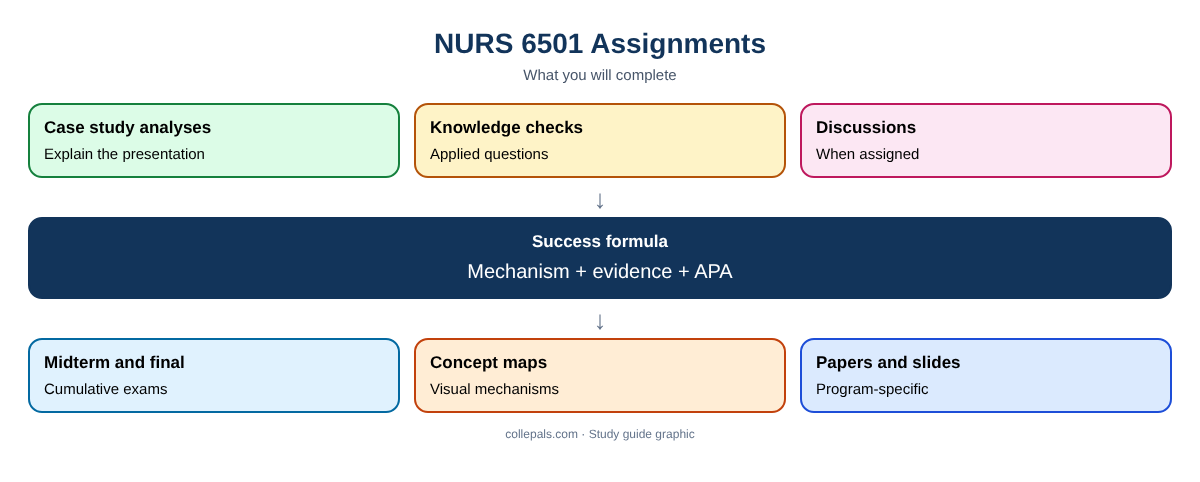
Common NURS 6501 assignments include case study analyses, module knowledge checks, a midterm and final exam and, in some sections, discussions, concept maps, presentations or papers. Each rewards accurate mechanisms explained from cell to symptom, attention to patient factors such as age and genetics, current evidence and correct APA formatting.
Examples and patient cases on this page are fictional and written by Collepals for study purposes. NURS 6501 is Walden University’s Advanced Pathophysiology course; assignments vary by term, so follow your own syllabus and rubric. This content is educational, not clinical advice. Collepals is not affiliated with Walden University.
Sample document: a NURS 6501 assignment tracker and rubric checklist (Word).
NURS 6501 Assignments at a Glance
| Assignment | Purpose | What graders look for |
|---|---|---|
| Case study analysis | Explain why a patient presents with given symptoms | Mechanisms; genes; immune/inflammatory processes; patient factors; 3+ sources |
| Knowledge check | Test applied understanding after modules | Read questions carefully; apply mechanisms |
| Midterm and final exam | Cumulative assessment | Practice scenario questions; review summaries |
| Discussion (some sections) | Explain and apply concepts with peers | Answer all parts; cite; respond substantively |
| Concept map (some sections) | Visualize a disease process | Linked etiology, mechanism, manifestations, diagnostics |
| Presentation or paper (some programs) | Deeper exploration of a disorder | Organized, evidence-based, APA |
The Case Study Analysis
The signature NURS 6501 assignment presents a short scenario and asks you to explain the presentation. Prompts commonly ask why the patient has the symptoms, which genes or genetic factors are involved, how processes such as immunosuppression or inflammation contribute, how cells and organs interact and how a factor such as age, sex or ethnicity changes the response. Full guide: NURS 6501 Pathophysiology Case Studies: Writing Guide. Examples: Module 1 case study analysis and Module 6 case study analysis.
Planning Your Workload
- Record every due date in one calendar during week 1.
- Read the module before starting the case study.
- Draft early; mechanisms take time to explain clearly.
- Use the rubric as a checklist before submitting.
Sources That Work
Your textbook (Rogers, 2023) plus current peer-reviewed articles and clinical guidelines. Avoid outdated sources and non-scholarly websites.
Frequently Asked Questions
How many sources does a NURS 6501 case study need?
Often at least three; follow the rubric.
Are discussions part of NURS 6501?
Some sections include them; others focus on case studies and knowledge checks.
How long is a case study analysis?
Typically one to two pages, not including the reference page; check your instructions.
Get Help With Your NURS 6501 Assignments
Advanced pathophysiology assignments demand precise mechanisms, current evidence and clear APA writing. Collepals.com helps NURS 6501 and other advanced pathophysiology students:
- Explain disease mechanisms step by step, from cells to symptoms.
- Write case study analyses, discussion posts and peer responses.
- Build concept maps, presentations and research papers.
- Find current evidence, cite in APA 7 and get drafts edited and proofread.
Browse our free model assignments or learn more about our nursing assignment writing service.
Use Collepals examples as study guides and follow your school’s academic integrity and AI policies.
More NURS 6501 and pathophysiology guides
Collepals is an independent study resource. Follow your program’s instructions and rubric and write your own work.
References
American Psychological Association. (2020). Publication manual of the American Psychological Association (7th ed.). https://doi.org/10.1037/0000165-000
Rogers, J. L. (Ed.). (2023). McCance & Huether’s pathophysiology: The biologic basis for disease in adults and children (9th ed.). Elsevier.
Get a plagiarism-free answer to this question
Send us your instructions and we’ll match you with the best writer in your subject.
- 100% human-written, zero AI
- Turnitin report included
- Confidential — we never share your data
- Free revisions & refunds