How to Write NURS 6501 Discussion Posts
Need help with this assignment?Get an original answer from a qualified tutor — from $10/page.
Get it written →Strong NURS 6501 discussion posts explain disease mechanisms accurately, answer every part of the prompt and connect pathophysiology to advanced practice. This guide gives a post structure, a sample post and a checklist.
Quick answer
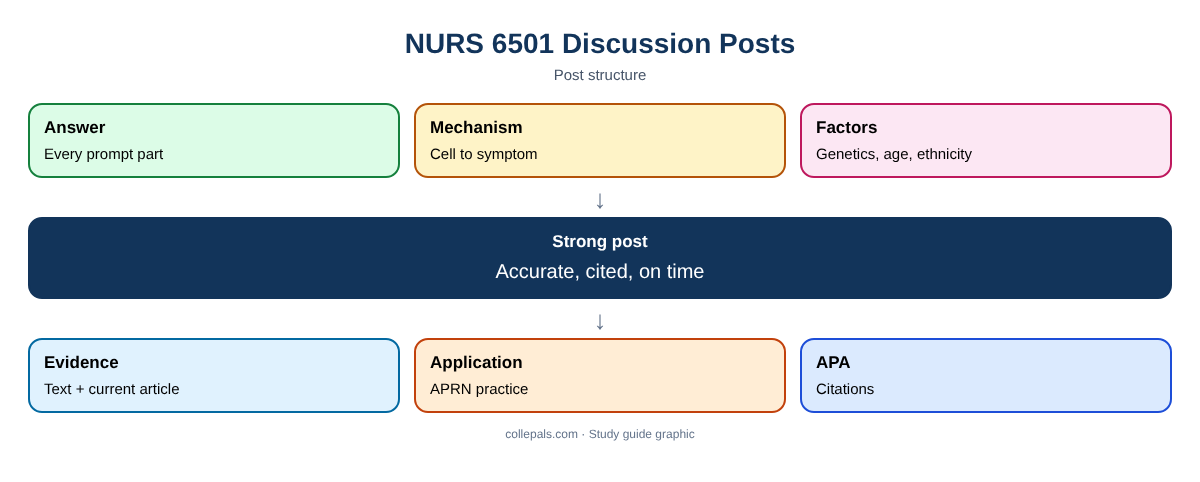
To write a NURS 6501 discussion post, answer each prompt part in order, explain mechanisms step by step from cellular changes to clinical signs, address patient factors such as genetics, age or ethnicity when asked, support claims with your textbook and current peer-reviewed sources and apply the content to APRN practice in APA format.
Examples and patient cases on this page are fictional and written by Collepals for study purposes. NURS 6501 is Walden University’s Advanced Pathophysiology course; assignments vary by term, so follow your own syllabus and rubric. This content is educational, not clinical advice. Collepals is not affiliated with Walden University.
Sample document: a sample NURS 6501 discussion post with a planning template (Word).
NURS 6501 Discussion Post Structure
- Direct answer: open with the main mechanism or conclusion.
- Mechanism chain: cause → cellular change → organ effect → symptom.
- Patient factors: genetics, age, sex, ethnicity or comorbidities.
- Clinical application: diagnosis or treatment implications for APRNs.
- References: textbook plus at least one current article.
Sample Post (Fictional Prompt)
Prompt: Explain why a patient with uncontrolled hypertension develops left ventricular hypertrophy.
Chronically elevated blood pressure increases afterload, so the left ventricle must generate higher pressure with every beat. To normalize wall stress, cardiomyocytes adapt by adding sarcomeres in parallel, producing concentric hypertrophy (Rogers, 2023). Angiotensin II and sympathetic activation further stimulate myocyte growth and fibroblast activity, adding fibrosis. Over time, the thick, stiff ventricle relaxes poorly, raising filling pressures and contributing to heart failure with preserved ejection fraction. For APRNs, this mechanism explains why controlling blood pressure, and agents that block the renin-angiotensin system, can slow or partly reverse hypertrophy.
Tips
- Define abbreviations on first use.
- Avoid listing facts without explaining how one leads to the next.
- Keep within the word limit; precision beats length.
- Post early to allow peer replies.
Example: NURS 6501 Module 1 discussion. Next: How to Respond to Classmates in NURS 6501.
Frequently Asked Questions
How long should a NURS 6501 discussion post be?
Usually 300–500 words; follow your rubric.
Can I use only the textbook?
Most rubrics require at least one additional scholarly source.
Should I include treatment?
Briefly, when it shows how the mechanism guides care.
Get Help With NURS 6501 Discussion Posts
Advanced pathophysiology assignments demand precise mechanisms, current evidence and clear APA writing. Collepals.com helps NURS 6501 and other advanced pathophysiology students:
- Explain disease mechanisms step by step, from cells to symptoms.
- Write case study analyses, discussion posts and peer responses.
- Build concept maps, presentations and research papers.
- Find current evidence, cite in APA 7 and get drafts edited and proofread.
Browse our free model assignments or learn more about our nursing assignment writing service.
Use Collepals examples as study guides and follow your school’s academic integrity and AI policies.
More NURS 6501 and pathophysiology guides
Collepals is an independent study resource. Follow your program’s instructions and rubric and write your own work.
References
American Psychological Association. (2020). Publication manual of the American Psychological Association (7th ed.). https://doi.org/10.1037/0000165-000
Rogers, J. L. (Ed.). (2023). McCance & Huether’s pathophysiology: The biologic basis for disease in adults and children (9th ed.). Elsevier.
Get a plagiarism-free answer to this question
Send us your instructions and we’ll match you with the best writer in your subject.
- 100% human-written, zero AI
- Turnitin report included
- Confidential — we never share your data
- Free revisions & refunds