How to Write an NURS 6501 Pathophysiology Reflection
Need help with this assignment?Get an original answer from a qualified tutor — from $10/page.
Get it written →A NURS 6501 reflection asks you to look back on what you learned in advanced pathophysiology and how it will shape your advanced practice. This guide explains how to structure the reflection, with a reflective model, sample paragraphs and a template.
Quick answer
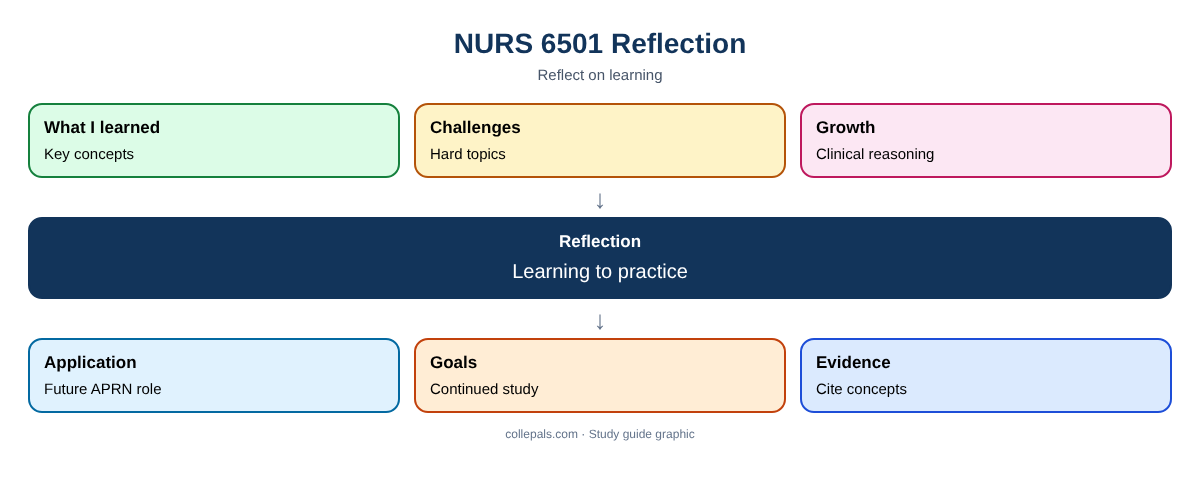
To write a NURS 6501 reflection, identify key concepts or cases that changed your thinking, describe challenges honestly, analyze why your understanding grew, connect learning to future APRN practice such as diagnosis and patient education and set goals for continued learning, using a reflective model and citing course concepts.
Examples and patient cases on this page are fictional and written by Collepals for study purposes. NURS 6501 is Walden University’s Advanced Pathophysiology course; assignments vary by term, so follow your own syllabus and rubric. This content is educational, not clinical advice. Collepals is not affiliated with Walden University.
Sample document: a NURS 6501 reflection template using Gibbs’ cycle (Word).
Using a Reflective Model
Gibbs’ cycle offers a simple structure; here is a fictional example:
| Stage | Question | Example |
|---|---|---|
| Description | What topic or case challenged you most? | Acid-base interpretation in the Module 2 knowledge check |
| Feelings | How did you feel? | Overwhelmed by compensation rules |
| Evaluation | What went well or poorly? | Memorizing failed; drawing pathways worked |
| Analysis | Why? | Understanding buffers and organ roles explained compensation |
| Conclusion | What did you learn? | Mechanisms are easier to remember than lists |
| Action plan | How will you use this? | Use stepwise ABG analysis in clinical practice |
Sample Reflection Paragraph
Example
The concept that changed my thinking most was the link between chronic inflammation and disease. I had seen inflammation as a short-term response to injury, but studying atherosclerosis, rheumatoid arthritis and type 2 diabetes showed me how persistent, low-grade inflammation drives tissue damage over years (Rogers, 2023). As a future family nurse practitioner, I will look for that thread when counseling patients about smoking, weight and activity, because each influences inflammation.
Tips
- Be specific: name modules, cases or disorders.
- Balance description with analysis.
- Connect to your specialty and patient population.
- Use first person and cite concepts where appropriate.
Related: NURS 6501: Advanced Pathophysiology – Complete Course Guide and Inflammation and Immune Response: Pathophysiology Assignment Guide.
Frequently Asked Questions
How long should a NURS 6501 reflection be?
Usually 1–2 pages or a discussion-length post; follow your rubric.
Do reflections need references?
Often at least the textbook; check instructions.
Can I mention struggles?
Yes. Honest reflection on challenges and how you overcame them shows growth.
Get Help With Your NURS 6501 Reflection
Advanced pathophysiology assignments demand precise mechanisms, current evidence and clear APA writing. Collepals.com helps NURS 6501 and other advanced pathophysiology students:
- Explain disease mechanisms step by step, from cells to symptoms.
- Write case study analyses, discussion posts and peer responses.
- Build concept maps, presentations and research papers.
- Find current evidence, cite in APA 7 and get drafts edited and proofread.
Browse our free model assignments or learn more about our nursing assignment writing service.
Use Collepals examples as study guides and follow your school’s academic integrity and AI policies.
More NURS 6501 and pathophysiology guides
Collepals is an independent study resource. Follow your program’s instructions and rubric and write your own work.
References
Rogers, J. L. (Ed.). (2023). McCance & Huether’s pathophysiology: The biologic basis for disease in adults and children (9th ed.). Elsevier.
Get a plagiarism-free answer to this question
Send us your instructions and we’ll match you with the best writer in your subject.
- 100% human-written, zero AI
- Turnitin report included
- Confidential — we never share your data
- Free revisions & refunds