Infectious Disease Pathophysiology: Nursing Assignment Guide
Need help with this assignment?Get an original answer from a qualified tutor — from $10/page.
Get it written →Infectious disease pathophysiology explains how microorganisms cause disease and how the host response shapes symptoms and outcomes. This nursing assignment guide covers pathogen virulence, host defenses, stages of infection and how to apply these concepts.
Quick answer
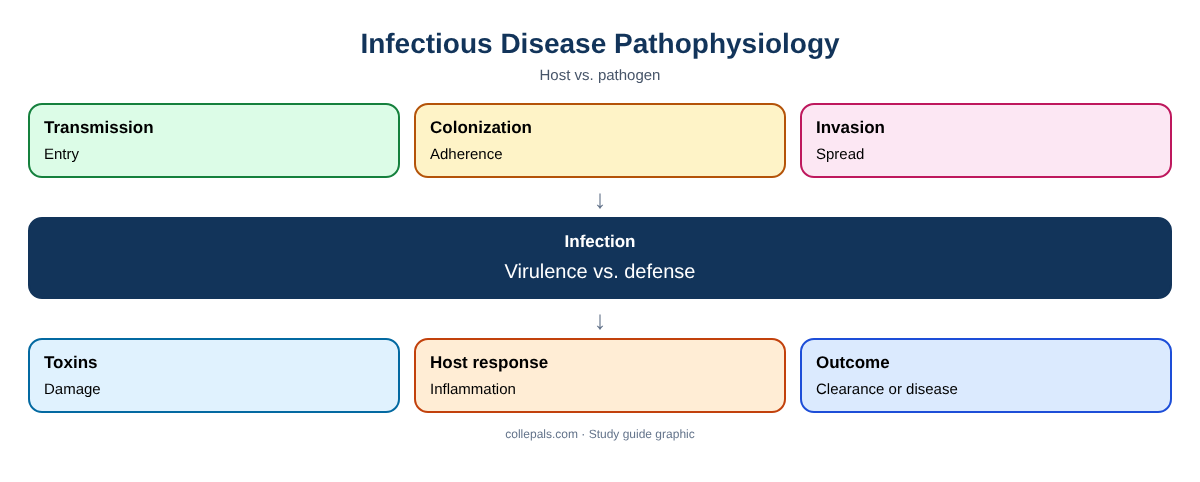
Infection results from the balance between pathogen virulence (adherence, invasion, toxins and immune evasion) and host defenses (barriers, innate and adaptive immunity). Disease progresses from transmission and colonization to invasion and tissue damage, and many symptoms come from the host’s inflammatory response rather than the microbe itself.
Examples and patient cases on this page are fictional and written by Collepals for study purposes. NURS 6501 is Walden University’s Advanced Pathophysiology course; assignments vary by term, so follow your own syllabus and rubric. This content is educational, not clinical advice. Collepals is not affiliated with Walden University.
Sample document: an infectious disease pathophysiology worksheet (Word).
Stages of Infectious Disease
| Stage | What happens |
|---|---|
| Transmission | Entry via respiratory droplets, contact, ingestion, vectors or blood |
| Adherence and colonization | Pili and adhesins attach to host cells |
| Invasion | Enzymes and toxins help spread through tissue |
| Evasion | Capsules, antigenic variation, intracellular survival |
| Damage | Exotoxins, endotoxin (LPS), and the host’s own inflammatory response |
| Outcome | Clearance, chronic infection, latency or dissemination |
Virulence Factors
- Exotoxins: secreted proteins with specific actions, such as tetanus toxin blocking inhibitory neurotransmitter release.
- Endotoxin: lipopolysaccharide in gram-negative cell walls that triggers cytokine release and can cause septic shock.
- Capsules: resist phagocytosis, as with Streptococcus pneumoniae.
- Intracellular survival: Mycobacterium tuberculosis survives within macrophages (Rogers, 2023).
Host Factors
Age, immunosuppression, diabetes, malnutrition, breaks in skin or mucosa and invasive devices increase susceptibility. Older adults and infants have less effective immune responses (see Aging and Pathophysiological Changes in the Human Body).
Example: Community-Acquired Pneumonia
Aspirated or inhaled bacteria overcome mucociliary clearance and alveolar macrophages; neutrophils and fluid fill the alveoli (consolidation), impairing gas exchange and causing hypoxemia, fever and productive cough. Severe cases can progress to sepsis (see Sepsis: Pathophysiology and Multiorgan Dysfunction).
Tips
- Separate the microbe’s direct effects from the host response.
- Link virulence factors to specific symptoms.
- Discuss antimicrobial resistance when relevant.
Frequently Asked Questions
Why do many infection symptoms come from the host?
Cytokines released during inflammation cause fever, malaise and tissue injury.
What is the difference between colonization and infection?
Colonization means microbes are present without disease; infection involves invasion and host damage.
How does endotoxin cause shock?
It triggers massive cytokine release, vasodilation and capillary leak.
Get Help With Infectious Disease Pathophysiology
Advanced pathophysiology assignments demand precise mechanisms, current evidence and clear APA writing. Collepals.com helps NURS 6501 and other advanced pathophysiology students:
- Explain disease mechanisms step by step, from cells to symptoms.
- Write case study analyses, discussion posts and peer responses.
- Build concept maps, presentations and research papers.
- Find current evidence, cite in APA 7 and get drafts edited and proofread.
Browse our free model assignments or learn more about our nursing assignment writing service.
Use Collepals examples as study guides and follow your school’s academic integrity and AI policies.
More NURS 6501 and pathophysiology guides
Collepals is an independent study resource. Follow your program’s instructions and rubric and write your own work.
References
Metlay, J. P., Waterer, G. W., Long, A. C., Anzueto, A., Brozek, J., Crothers, K., Cooley, L. A., Dean, N. C., Fine, M. J., Flanders, S. A., Griffin, M. R., Metersky, M. L., Musher, D. M., Restrepo, M. I., & Whitney, C. G. (2019). Diagnosis and treatment of adults with community-acquired pneumonia: An official clinical practice guideline of the American Thoracic Society and Infectious Diseases Society of America. American Journal of Respiratory and Critical Care Medicine, 200(7), e45–e67. https://doi.org/10.1164/rccm.201908-1581ST
Rogers, J. L. (Ed.). (2023). McCance & Huether’s pathophysiology: The biologic basis for disease in adults and children (9th ed.). Elsevier.
Get a plagiarism-free answer to this question
Send us your instructions and we’ll match you with the best writer in your subject.
- 100% human-written, zero AI
- Turnitin report included
- Confidential — we never share your data
- Free revisions & refunds