Autoimmune Disease: Pathophysiology and Disease Progression
Need help with this assignment?Get an original answer from a qualified tutor — from $10/page.
Get it written →Autoimmune pathophysiology explains how the immune system loses tolerance and attacks the body’s own tissues. This guide covers mechanisms of tolerance and its failure, hypersensitivity patterns, examples of autoimmune diseases and how they progress.
Quick answer
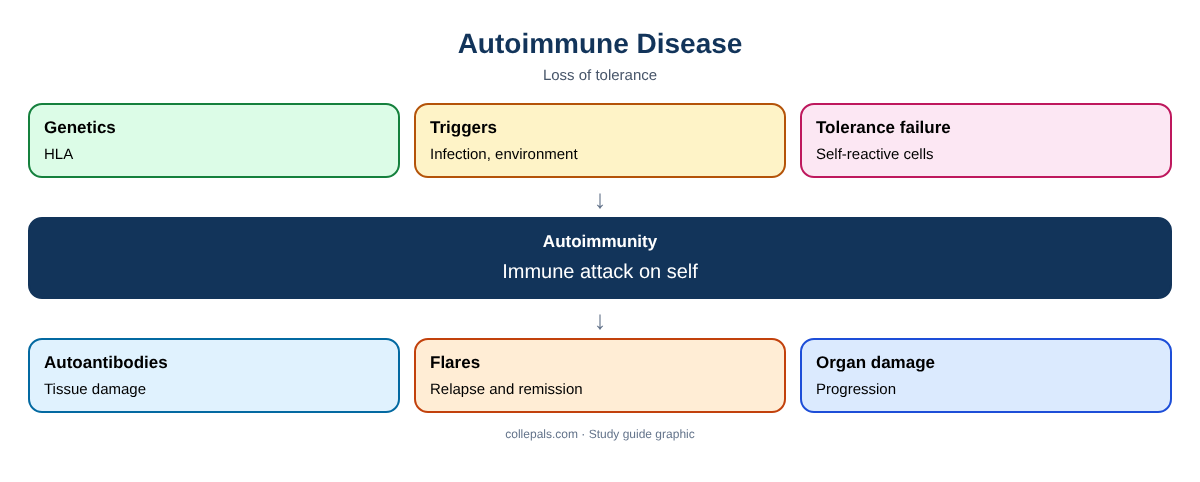
Autoimmune disease develops when genetic susceptibility (often HLA genes) and environmental triggers such as infection, smoking or hormones break immune tolerance, allowing self-reactive T and B cells to damage tissue through autoantibodies, immune complexes or cytotoxic T cells. Diseases often progress through relapses and remissions with cumulative organ damage.
Examples and patient cases on this page are fictional and written by Collepals for study purposes. NURS 6501 is Walden University’s Advanced Pathophysiology course; assignments vary by term, so follow your own syllabus and rubric. This content is educational, not clinical advice. Collepals is not affiliated with Walden University.
Sample document: an autoimmune disease mechanisms sheet (Word).
How Tolerance Normally Works
Central tolerance deletes most self-reactive lymphocytes in the thymus and bone marrow. Peripheral tolerance uses regulatory T cells, anergy and deletion to control those that escape (Rogers, 2023).
How Tolerance Fails
- Genetics: HLA variants such as HLA-DR4 (rheumatoid arthritis) and HLA-DR3/DR4 (type 1 diabetes).
- Molecular mimicry: microbial antigens resemble self-antigens.
- Release of hidden antigens after tissue injury.
- Defective regulatory T cells and cytokine imbalance.
- Hormones: many autoimmune diseases are more common in women.
Mechanisms of Tissue Damage
- Type II hypersensitivity: antibodies against cell surfaces (Graves disease, myasthenia gravis).
- Type III: immune complexes deposit in tissues (lupus nephritis).
- Type IV: T-cell mediated (type 1 diabetes, multiple sclerosis).
Examples
| Disease | Target | Key mechanism | Manifestations |
|---|---|---|---|
| Rheumatoid arthritis | Synovial joints | Anti-CCP, RF; TNF, IL-6 | Symmetric polyarthritis, erosions |
| Systemic lupus erythematosus | Multiple organs | Antinuclear and anti-dsDNA antibodies; immune complexes | Rash, arthritis, nephritis |
| Type 1 diabetes | Pancreatic beta cells | T-cell destruction; autoantibodies | Insulin deficiency |
| Graves disease | Thyroid | TSH-receptor stimulating antibodies | Hyperthyroidism |
| Multiple sclerosis | CNS myelin | T-cell and B-cell attack on myelin | Relapsing neurological deficits |
| Myasthenia gravis | Neuromuscular junction | Acetylcholine receptor antibodies | Fatigable weakness |
Disease Progression
Autoimmune diseases often show flares and remissions. Repeated inflammation causes cumulative damage, such as joint erosion in rheumatoid arthritis or kidney scarring in lupus. Early treatment aims to control inflammation before irreversible damage. See Rheumatoid Arthritis: Disease Mechanisms and Inflammation.
Frequently Asked Questions
Why are autoimmune diseases more common in women?
Hormonal effects on immunity and X-chromosome immune genes are thought to contribute.
What is molecular mimicry?
Immune responses to a microbe cross-react with similar self-antigens.
Can autoimmune diseases be cured?
Most are managed, not cured; treatment controls inflammation and prevents damage.
Get Help With Autoimmune Pathophysiology
Advanced pathophysiology assignments demand precise mechanisms, current evidence and clear APA writing. Collepals.com helps NURS 6501 and other advanced pathophysiology students:
- Explain disease mechanisms step by step, from cells to symptoms.
- Write case study analyses, discussion posts and peer responses.
- Build concept maps, presentations and research papers.
- Find current evidence, cite in APA 7 and get drafts edited and proofread.
Browse our free model assignments or learn more about our nursing assignment writing service.
Use Collepals examples as study guides and follow your school’s academic integrity and AI policies.
More NURS 6501 and pathophysiology guides
Collepals is an independent study resource. Follow your program’s instructions and rubric and write your own work.
References
Aletaha, D., Neogi, T., Silman, A. J., Funovits, J., Felson, D. T., Bingham, C. O., III, Birnbaum, N. S., Burmester, G. R., Bykerk, V. P., Cohen, M. D., Combe, B., Costenbader, K. H., Dougados, M., Emery, P., Ferraccioli, G., Hazes, J. M. W., Hobbs, K., Huizinga, T. W. J., Kavanaugh, A., … Hawker, G. (2010). 2010 rheumatoid arthritis classification criteria: An American College of Rheumatology/European League Against Rheumatism collaborative initiative. Arthritis & Rheumatism, 62(9), 2569–2581. https://doi.org/10.1002/art.27584
Rogers, J. L. (Ed.). (2023). McCance & Huether’s pathophysiology: The biologic basis for disease in adults and children (9th ed.). Elsevier.
Get a plagiarism-free answer to this question
Send us your instructions and we’ll match you with the best writer in your subject.
- 100% human-written, zero AI
- Turnitin report included
- Confidential — we never share your data
- Free revisions & refunds