How to Write an Advanced Pathophysiology Research Paper
Need help with this assignment?Get an original answer from a qualified tutor — from $10/page.
Get it written →An advanced pathophysiology research paper goes beyond describing a disease. It explains, with current evidence, how normal physiology breaks down, why symptoms appear and how mechanisms guide diagnosis and treatment. This guide walks through choosing a topic, searching the literature, organizing the paper and avoiding common mistakes.
Quick answer
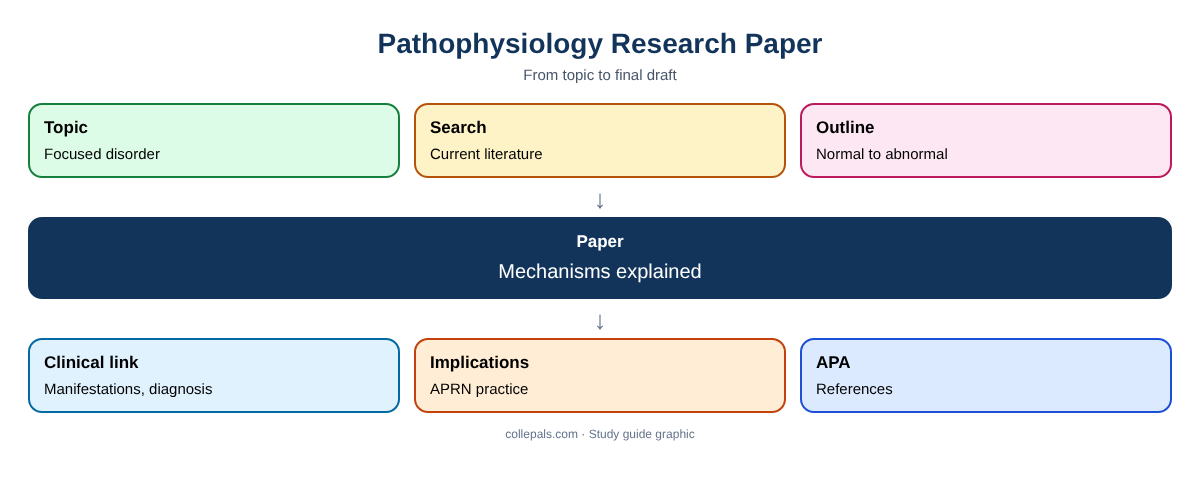
To write an advanced pathophysiology research paper, choose a focused disorder, search current peer-reviewed literature and guidelines, organize the paper from normal physiology to etiology, cellular mechanisms, manifestations, diagnosis and treatment implications, explain each step causally, address lifespan and population factors and conclude with implications for advanced practice, citing in APA 7.
Examples and patient cases on this page are fictional and written by Collepals for study purposes. NURS 6501 is Walden University’s Advanced Pathophysiology course; assignments vary by term, so follow your own syllabus and rubric. This content is educational, not clinical advice. Collepals is not affiliated with Walden University.
Sample document: an advanced pathophysiology research paper outline template (Word).
Choosing a Topic
- Narrow broad topics: “heart failure” → “neurohormonal activation in HFrEF.”
- Choose disorders with recent research or guideline updates.
- Connect to your intended APRN specialty.
Searching the Literature
- Use CINAHL, PubMed and your library’s databases.
- Prefer sources from the last five years plus landmark studies.
- Include a current clinical guideline when one exists.
- Use review articles to map mechanisms, then primary studies for detail.
Advanced Pathophysiology Research Paper Outline
| Section | Content |
|---|---|
| Introduction | Disorder, significance (prevalence, burden), thesis/purpose |
| Normal physiology | Structure and function of the affected system |
| Etiology and risk factors | Genetic, environmental, lifestyle |
| Pathophysiology | Cellular and molecular mechanisms; progression |
| Clinical manifestations | Signs and symptoms explained by mechanisms |
| Diagnosis | Tests and what they reveal about mechanisms |
| Treatment implications | How therapies target mechanisms |
| Lifespan and population factors | Age, sex, ethnicity, comorbidity |
| Conclusion | Synthesis and implications for APRN practice |
Writing Mechanisms Clearly
Weak vs. strong
Weak: “Diabetes causes kidney disease.”
Strong: “Chronic hyperglycemia increases glomerular hyperfiltration and promotes advanced glycation end products, which thicken the glomerular basement membrane and expand the mesangium; over time, albumin leaks into the urine and GFR declines (Rogers, 2023).”
Common Mistakes
- Describing symptoms without explaining mechanisms.
- Relying on textbooks alone.
- Skipping normal physiology.
- Overloading the paper with treatment details unrelated to mechanisms.
Related: NURS 6501 Disease Process Analysis Assignments and NURS 6501 Pathophysiology Presentations and PowerPoint Assignments.
Frequently Asked Questions
How long is an advanced pathophysiology research paper?
Commonly 5–10 pages; follow your instructions.
How many sources are needed?
Often 5–10 scholarly sources; check your rubric.
Can I include figures?
Yes, if labeled and cited; original diagrams strengthen mechanism explanations.
Get Help With Your Advanced Pathophysiology Research Paper
Advanced pathophysiology assignments demand precise mechanisms, current evidence and clear APA writing. Collepals.com helps NURS 6501 and other advanced pathophysiology students:
- Explain disease mechanisms step by step, from cells to symptoms.
- Write case study analyses, discussion posts and peer responses.
- Build concept maps, presentations and research papers.
- Find current evidence, cite in APA 7 and get drafts edited and proofread.
Browse our free model assignments or learn more about our nursing assignment writing service.
Use Collepals examples as study guides and follow your school’s academic integrity and AI policies.
More NURS 6501 and pathophysiology guides
Collepals is an independent study resource. Follow your program’s instructions and rubric and write your own work.
References
American Psychological Association. (2020). Publication manual of the American Psychological Association (7th ed.). https://doi.org/10.1037/0000165-000
Rogers, J. L. (Ed.). (2023). McCance & Huether’s pathophysiology: The biologic basis for disease in adults and children (9th ed.). Elsevier.
Get a plagiarism-free answer to this question
Send us your instructions and we’ll match you with the best writer in your subject.
- 100% human-written, zero AI
- Turnitin report included
- Confidential — we never share your data
- Free revisions & refunds