Social Determinants of Health in Psychiatric Patient Evaluations
Need help with this assignment?Get an original answer from a qualified tutor — from $10/page.
Get it written →Mental illness does not occur in a vacuum. Poverty, housing instability, discrimination and lack of insurance shape who develops psychiatric symptoms, how they present and whether they can access care. NRNP 6635 reflections frequently ask students to address social determinants of health (SDOH). This guide explains how to assess and address SDOH in psychiatric patient evaluations.
Quick answer
Use the Healthy People 2030 SDOH domains (economic stability, education access and quality, health care access and quality, neighborhood and built environment and social and community context) to screen for social risks, document how they affect symptoms, diagnosis, adherence and outcomes and adapt the treatment plan with referrals, lower-cost options and culturally responsive care.
What Are Social Determinants of Health?
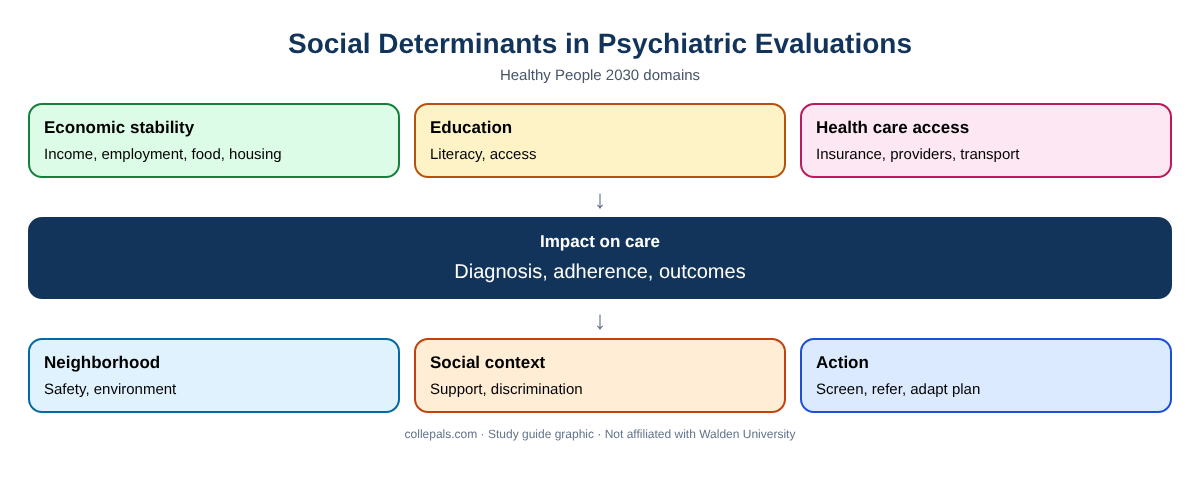
Healthy People 2030 defines social determinants of health as the conditions in the environments where people are born, live, learn, work, play, worship and age that affect health, functioning and quality of life, and groups them into five domains (Office of Disease Prevention and Health Promotion [ODPHP], n.d.). Compton and Shim (2015) describe how these factors, including discrimination, adverse early life experiences, poor education, unemployment, poverty, food insecurity, housing instability and limited access to care, shape mental health outcomes.
SDOH Domains and Psychiatric Examples
| Domain | Examples relevant to psychiatric care |
|---|---|
| Economic stability | Unemployment, debt, food insecurity, housing instability |
| Education access and quality | Health literacy, language barriers |
| Health care access and quality | Insurance gaps, provider shortages, transportation, wait times |
| Neighborhood and built environment | Violence exposure, unsafe housing, lack of green space |
| Social and community context | Isolation, discrimination, incarceration, family conflict, social support |
How SDOH Affect Psychiatric Evaluation and Care
- Risk and onset: chronic stressors increase risk for depression, anxiety and substance use.
- Presentation: cultural expression of distress may differ; the DSM-5-TR includes a Cultural Formulation Interview to support culturally informed assessment (American Psychiatric Association, 2022).
- Diagnosis: clinician bias and cultural misunderstanding can contribute to misdiagnosis, so structured, culturally informed assessment matters.
- Treatment access and adherence: cost, transportation and work schedules influence follow-up and medication use.
How to Address SDOH in Your Evaluation
- Screen with a standardized social needs tool or targeted questions about food, housing, transportation, utilities and safety.
- Document relevant findings in the psychosocial history.
- Adapt the plan: generic medications, telehealth, sliding-scale clinics, community mental health centers.
- Refer to social work, case management, housing or food assistance programs.
- Provide culturally responsive care, including interpreters and respect for the patient’s beliefs.
Sample reflection paragraph
The patient’s recent eviction and loss of employer-sponsored insurance are social determinants that threaten both her recovery and her ability to follow the treatment plan. I would refer her to a community mental health center with sliding-scale fees, prescribe a low-cost generic SSRI and connect her with social work for housing assistance. Addressing these needs is as important as medication choice for her long-term outcome.
For integrating this into the reflection, see how to write a psychiatric evaluation reflection.
Frequently Asked Questions
What are the five SDOH domains?
Economic stability, education access and quality, health care access and quality, neighborhood and built environment and social and community context (Healthy People 2030).
How do I screen for social needs?
Use a validated social needs screening tool or ask targeted questions about food, housing, transportation, utilities and safety.
Where should SDOH go in an NRNP 6635 evaluation?
Document them in the psychosocial history and discuss their impact and your response in the reflection and plan.
Get Help Addressing SDOH in Your Evaluation at Collepals
Comprehensive psychiatric evaluations take time, and NRNP 6635 often requires a new one every few weeks. Collepals.com supports PMHNP students with:
- Guidance on organizing your case into the comprehensive psychiatric evaluation template.
- Help comparing DSM-5-TR criteria and building three well-supported differential diagnoses.
- Current, evidence-based references formatted in APA 7.
- Model evaluations, case presentations and reflections you can study, plus editing and proofreading of your drafts.
Browse our free model assignments or learn more about our nursing assignment writing service.
Use Collepals examples as study guides and follow your university’s academic integrity and AI policies when you submit your own work.
More NRNP 6635 study guides
Collepals is an independent study resource and is not affiliated with or endorsed by Walden University. Course requirements, templates and rubrics change; always follow your current syllabus and course template. This article is educational and is not clinical advice for any individual patient.
References
American Psychiatric Association. (2022). Diagnostic and statistical manual of mental disorders (5th ed., text rev.). https://doi.org/10.1176/appi.books.9780890425787
Compton, M. T., & Shim, R. S. (Eds.). (2015). The social determinants of mental health. American Psychiatric Publishing.
Office of Disease Prevention and Health Promotion. (n.d.). Social determinants of health. Healthy People 2030. https://odphp.health.gov/healthypeople/priority-areas/social-determinants-health
Get a plagiarism-free answer to this question
Send us your instructions and we’ll match you with the best writer in your subject.
- 100% human-written, zero AI
- Turnitin report included
- Confidential — we never share your data
- Free revisions & refunds