NRNP 6635 Neurocognitive Disorders Case Study
Need help with this assignment?Get an original answer from a qualified tutor — from $10/page.
Get it written →Neurocognitive disorder cases in NRNP 6635 test your ability to distinguish dementia from delirium and depression, identify reversible causes and plan safe, person-centered care. This guide walks through a neurocognitive disorders case study with a fictional patient, differential diagnoses and a plan.
Quick answer
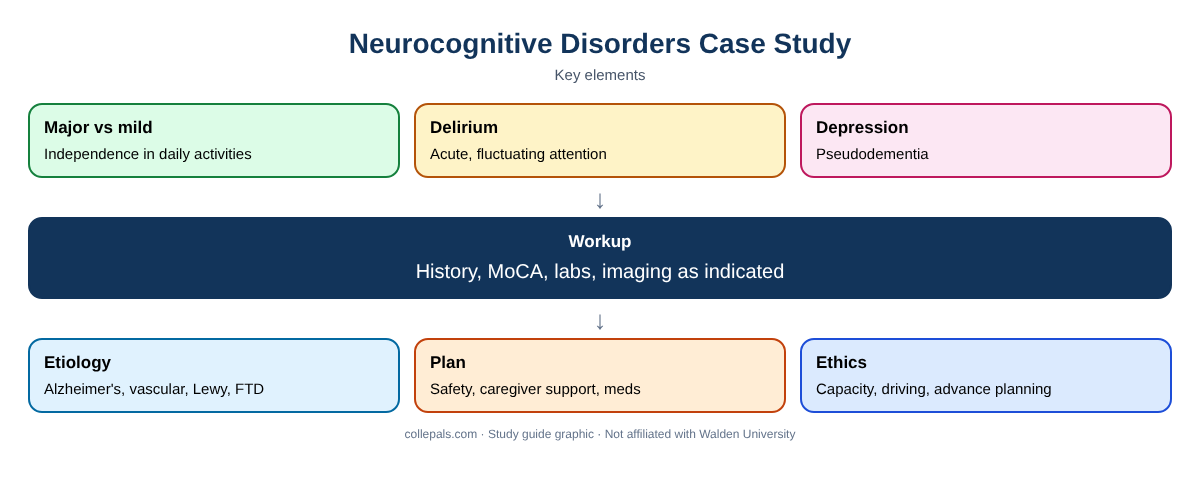
Determine whether cognitive decline is major (interferes with independence in everyday activities) or mild, exclude delirium (acute, fluctuating attention) and depression, screen cognition with a validated tool such as the MoCA, look for reversible causes including medications and labs and plan for safety, caregiver support, appropriate medications and advance care planning.
The patient in this guide is fictional and is used for study purposes only. Diagnostic criteria are summarized in our own words; consult the DSM-5-TR directly for exact criteria, and base your evaluation on your assigned case.
The Case
Case summary
Fictional case: R.H., a 76-year-old retired teacher, is brought by her daughter for two years of gradually worsening memory. She repeats questions, missed bill payments and got lost driving to a familiar store. She still bathes and dresses independently. No sudden onset or fluctuation. Medical history: hypertension, hyperlipidemia. Medications: lisinopril, atorvastatin, diphenhydramine nightly for sleep. MoCA: 19/30 with deficits in delayed recall and executive tasks. PHQ-9: 4. MSE: pleasant, well groomed, alert, oriented to person and place but not date, normal speech, no psychosis.
Major vs. Mild Neurocognitive Disorder (Summarized)
Both involve decline from a previous level in one or more cognitive domains (complex attention, executive function, learning and memory, language, perceptual-motor function or social cognition), based on concern and objective testing. In major NCD, deficits interfere with independence in everyday activities; in mild NCD, independence is preserved, though greater effort or accommodation may be needed. Deficits must not occur only during delirium or be better explained by another mental disorder (American Psychiatric Association, 2022).
R.H. needs help with complex activities such as finances and driving, which suggests major NCD; the diagnosis depends on careful assessment of her instrumental activities of daily living.
Differential Diagnoses
| Diagnosis | Key features | R.H. |
|---|---|---|
| Major NCD due to Alzheimer’s disease | Gradual onset, progressive memory and learning decline | Gradual 2-year decline with memory deficits: supported |
| Delirium | Acute onset, fluctuating attention and awareness, often medical cause | No acute onset or fluctuation: not supported, but anticholinergic medication is a risk |
| Major depressive disorder with cognitive symptoms | Depressed mood, poor effort on testing | PHQ-9 of 4: less likely |
| Vascular NCD | Stepwise decline, vascular risk factors, focal signs | Hypertension present; consider imaging |
Workup
- Cognitive screening: MoCA, which is sensitive to mild impairment (Nasreddine et al., 2005).
- Labs to identify contributing or reversible causes, commonly B12, TSH, CBC and metabolic panel (Arvanitakis et al., 2019).
- Medication review: diphenhydramine is strongly anticholinergic and can worsen cognition in older adults; taper and substitute nonpharmacologic sleep strategies.
- Neuroimaging when indicated to evaluate vascular or structural causes.
Treatment Plan
- Medications: cholinesterase inhibitors for mild to moderate Alzheimer’s disease and memantine for moderate to severe disease may offer modest symptomatic benefit (Arvanitakis et al., 2019).
- Behavioral symptoms: use nonpharmacologic approaches first; antipsychotics carry a boxed warning for increased mortality in older adults with dementia.
- Safety: address driving, finances, medication management and home safety.
- Caregiver support: education, respite and community resources.
- Ethics: assess decision-making capacity and encourage advance care planning while she can participate. See legal and ethical considerations.
Frequently Asked Questions
What distinguishes major from mild neurocognitive disorder?
Whether cognitive deficits interfere with independence in everyday activities.
How is delirium different from dementia?
Delirium has an acute onset and fluctuating attention and awareness, often from a medical cause; dementia usually develops gradually.
Which medications can worsen cognition in older adults?
Anticholinergic drugs such as diphenhydramine, as well as benzodiazepines and some other sedatives, can impair cognition.
Get Help With Your Neurocognitive Case Study at Collepals
Comprehensive psychiatric evaluations take time, and NRNP 6635 often requires a new one every few weeks. Collepals.com supports PMHNP students with:
- Guidance on organizing your case into the comprehensive psychiatric evaluation template.
- Help comparing DSM-5-TR criteria and building three well-supported differential diagnoses.
- Current, evidence-based references formatted in APA 7.
- Model evaluations, case presentations and reflections you can study, plus editing and proofreading of your drafts.
Browse our free model assignments or learn more about our nursing assignment writing service.
Use Collepals examples as study guides and follow your university’s academic integrity and AI policies when you submit your own work.
More NRNP 6635 study guides
- NRNP 6635 Comprehensive Psychiatric Evaluation: Complete Guide
- How to Write a Mental Status Examination for a Psychiatric Patient
- How to Develop Three Differential Diagnoses in Psychiatric Evaluations
- Legal and Ethical Considerations in Psychiatric Nursing Evaluations
- How to Develop a Psychiatric Treatment Plan Using DSM-5-TR
Collepals is an independent study resource and is not affiliated with or endorsed by Walden University. Course requirements, templates and rubrics change; always follow your current syllabus and course template. This article is educational and is not clinical advice for any individual patient.
References
American Psychiatric Association. (2022). Diagnostic and statistical manual of mental disorders (5th ed., text rev.). https://doi.org/10.1176/appi.books.9780890425787
Arvanitakis, Z., Shah, R. C., & Bennett, D. A. (2019). Diagnosis and management of dementia: Review. JAMA, 322(16), 1589–1599. https://doi.org/10.1001/jama.2019.4782
Nasreddine, Z. S., Phillips, N. A., Bédirian, V., Charbonneau, S., Whitehead, V., Collin, I., Cummings, J. L., & Chertkow, H. (2005). The Montreal Cognitive Assessment, MoCA: A brief screening tool for mild cognitive impairment. Journal of the American Geriatrics Society, 53(4), 695–699. https://doi.org/10.1111/j.1532-5415.2005.53221.x
Get a plagiarism-free answer to this question
Send us your instructions and we’ll match you with the best writer in your subject.
- 100% human-written, zero AI
- Turnitin report included
- Confidential — we never share your data
- Free revisions & refunds