Strategic Leadership in Nursing: Key Concepts for DNP Students
Need help with this assignment?Get an original answer from a qualified tutor — from $10/page.
Get it written →Strategic leadership is at the heart of DNP 880 Strategic Leadership and Business Management at Aspen University. DNP-prepared nurse leaders are expected to align people, resources and quality with an organization’s mission while leading change in complex systems. This guide explains the key concepts of strategic leadership in nursing that DNP students need to understand and apply in DNP 880 papers and discussions.
Quick answer
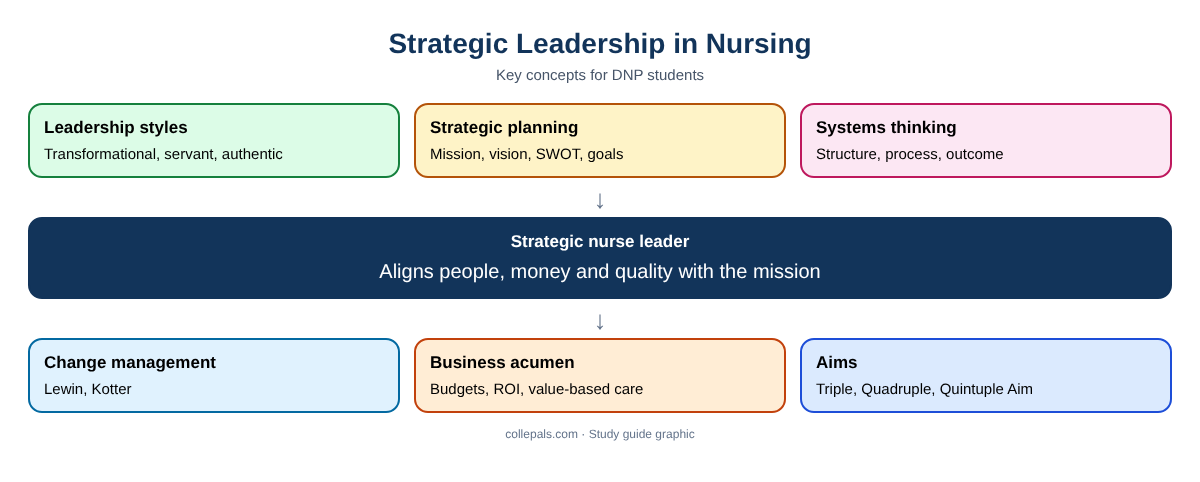
Strategic leadership in nursing combines leadership style (such as transformational leadership), strategic planning (mission, vision, SWOT and goals), systems thinking, change management (such as Lewin’s and Kotter’s models), business acumen (budgets, return on investment and value-based care) and a focus on the Triple, Quadruple and Quintuple Aims.
What Is Strategic Leadership in Nursing?
Strategic leadership is the ability to set long-term direction, make decisions that position an organization for success and mobilize people to achieve shared goals. For DNP-prepared nurses, it means leading beyond a single unit: shaping care delivery systems, influencing policy and making the business case for quality. The AACN (2021) Essentials reflect this through domains such as systems-based practice, quality and safety and personal, professional and leadership development.
Concept 1: Leadership Styles
| Style | Core idea | Use in nursing leadership |
|---|---|---|
| Transformational | Inspires followers through vision, intellectual stimulation, individualized consideration and role modeling (Bass & Riggio, 2006) | Engaging staff in change, building a culture of excellence |
| Servant | Leader prioritizes the growth and well-being of others | Supporting staff well-being and retention |
| Authentic | Self-awareness, transparency and ethical behavior | Building trust during difficult decisions |
| Transactional | Clear expectations, rewards and corrective action | Ensuring compliance with policies and standards |
Most effective leaders use more than one style. In DNP 880, you may be asked to identify your dominant style and how it fits your organization; see our leadership self-assessment and reflection writing guide.
Concept 2: Strategic Planning
Strategic planning translates mission and vision into goals and actions. Common tools include a SWOT analysis (strengths, weaknesses, opportunities, threats), environmental scanning, goal setting with measurable objectives and balanced scorecards that track quality, finance, people and growth. Nurse leaders contribute by bringing clinical, workforce and patient-experience perspectives to these plans.
Concept 3: Systems Thinking
Systems thinking recognizes that outcomes result from the interaction of structures, processes and people. Donabedian’s (1988) structure-process-outcome model is a practical lens: a high fall rate (outcome) may reflect staffing levels (structure) and inconsistent rounding (process). Strategic leaders look for root causes in the system rather than blaming individuals.
Concept 4: Change Management
Lewin’s three stages (unfreeze, change, refreeze) and Kotter’s eight steps, beginning with creating a sense of urgency and building a guiding coalition, help leaders plan change (Kotter, 2012). In DNP 880 papers, explain how you would create urgency with data, engage stakeholders, address resistance and sustain the change through policy, training and measurement.
Concept 5: Business Acumen
Nurse leaders must understand operating and capital budgets, productivity, return on investment and value-based payment. Strategic leaders frame quality initiatives as investments. For example, a hospital fall prevention program evaluated by Dykes et al. (2023) was associated with fewer falls and avoided costs, an argument executives understand. See cost-effectiveness strategies in healthcare management.
Concept 6: The Aims of Health Care Improvement
- Triple Aim: better patient experience, better population health and lower per capita cost (Berwick et al., 2008).
- Quadruple Aim: adds care of the provider, recognizing clinician burnout (Bodenheimer & Sinsky, 2014).
- Quintuple Aim: adds health equity (Nundy et al., 2022).
Using these aims shows that your recommendations balance patients, populations, costs, staff and equity.
Applying the Concepts in DNP 880
When you write about a leadership challenge, combine the concepts: identify the system problem, choose a leadership approach, plan the change, make the business case and show how the initiative advances the aims. This integrated thinking is what distinguishes doctoral-level leadership writing.
Frequently Asked Questions
What is the difference between strategic and operational leadership?
Operational leadership manages day-to-day functions; strategic leadership sets long-term direction and aligns resources with organizational goals.
Which leadership style is best for nurse leaders?
Transformational leadership is widely studied and associated with positive staff outcomes, but effective leaders adapt their style to the situation.
Why do DNP students need business skills?
Because quality improvements require resources, and leaders must justify investments in terms of outcomes and costs.
Strengthen Your Strategic Leadership Papers With Collepals
Balancing a DNP program with leadership responsibilities at work is demanding. Collepals.com supports DNP students in DNP 880 Strategic Leadership and Business Management and related courses. Our doctoral-level nursing writers and tutors can:
- Help you break down DNP 880 prompts and rubrics and plan your papers and discussion posts.
- Guide you to current scholarly evidence on leadership, quality improvement, cost and workforce topics.
- Provide model papers and discussion responses you can study for structure and depth.
- Edit and proofread your drafts for doctoral-level clarity and APA 7 formatting.
Browse our free model assignments or learn more about our nursing assignment writing service.
Use Collepals examples as study guides and follow Aspen University’s academic integrity and AI policies when you submit your own work.
More DNP 880 study guides
- DNP880 Strategic Leadership and Business Management: Complete Student Guide
- Evidence-Based Practice Models for Healthcare Quality Improvement
- Cost-Effectiveness Strategies in Healthcare Management
- Interprofessional Collaboration in Advanced Nursing Leadership
- Healthcare Workforce Management Strategies for Nurse Leaders
- DNP Leadership Self-Assessment and Reflection: A Writing Guide
Collepals is an independent study resource and is not affiliated with or endorsed by Aspen University. Course titles, numbers and requirements change; always follow your current syllabus, rubric and catalog.
References
American Association of Colleges of Nursing. (2021). The essentials: Core competencies for professional nursing education. https://www.aacnnursing.org/essentials
Bass, B. M., & Riggio, R. E. (2006). Transformational leadership (2nd ed.). Lawrence Erlbaum Associates.
Berwick, D. M., Nolan, T. W., & Whittington, J. (2008). The triple aim: Care, health, and cost. Health Affairs, 27(3), 759–769. https://doi.org/10.1377/hlthaff.27.3.759
Bodenheimer, T., & Sinsky, C. (2014). From triple to quadruple aim: Care of the patient requires care of the provider. Annals of Family Medicine, 12(6), 573–576. https://doi.org/10.1370/afm.1713
Donabedian, A. (1988). The quality of care: How can it be assessed? JAMA, 260(12), 1743–1748. https://doi.org/10.1001/jama.1988.03410120089033
Dykes, P. C., Curtin-Bowen, M., Lipsitz, S., Franz, C., Adelman, J., Adkison, L., Bogaisky, M., Carroll, D., Carter, E., Herlihy, L., Lindros, M. E., Ryan, V., Scanlan, M., Walsh, M.-A., Wien, M., & Bates, D. W. (2023). Cost of inpatient falls and cost-benefit analysis of implementation of an evidence-based fall prevention program. JAMA Health Forum, 4(1), Article e225125. https://doi.org/10.1001/jamahealthforum.2022.5125
Kotter, J. P. (2012). Leading change. Harvard Business Review Press.
Nundy, S., Cooper, L. A., & Mate, K. S. (2022). The quintuple aim for health care improvement: A new imperative to advance health equity. JAMA, 327(6), 521–522. https://doi.org/10.1001/jama.2021.25181
Get a plagiarism-free answer to this question
Send us your instructions and we’ll match you with the best writer in your subject.
- 100% human-written, zero AI
- Turnitin report included
- Confidential — we never share your data
- Free revisions & refunds