Interprofessional Collaboration in Advanced Nursing Leadership
Need help with this assignment?Get an original answer from a qualified tutor — from $10/page.
Get it written →Interprofessional collaboration in system-level management is named directly in the description of DNP 880 Strategic Leadership and Business Management at Aspen University. DNP-prepared nurse leaders rarely improve care alone; they lead and join teams of physicians, pharmacists, therapists, social workers, administrators and patients. This guide explains the core competencies of interprofessional collaboration, the evidence behind it and the strategies advanced nurse leaders use to make teams work.
Quick answer
Interprofessional collaboration means professions working together with patients toward shared goals. The IPEC competencies (values and ethics, roles and responsibilities, communication, and teams and teamwork) provide the framework. Nurse leaders build collaboration with structured communication tools such as TeamSTEPPS, shared goals and measures, clear roles, psychological safety and leadership support.
Why Interprofessional Collaboration Matters
Complex patients need coordinated care across professions and settings. When collaboration fails, patients experience duplicated tests, conflicting instructions and preventable harm. When it works, outcomes improve. A Cochrane review of 79 randomized trials found that collaborative care, in which primary care and mental health professionals work with a care manager, improved depression and anxiety outcomes compared with usual care (Archer et al., 2012). In a large study at Intermountain Healthcare, integrated team-based primary care was associated with higher rates of depression screening and fewer emergency department visits and hospital admissions (Reiss-Brennan et al., 2016).
The IPEC Core Competencies
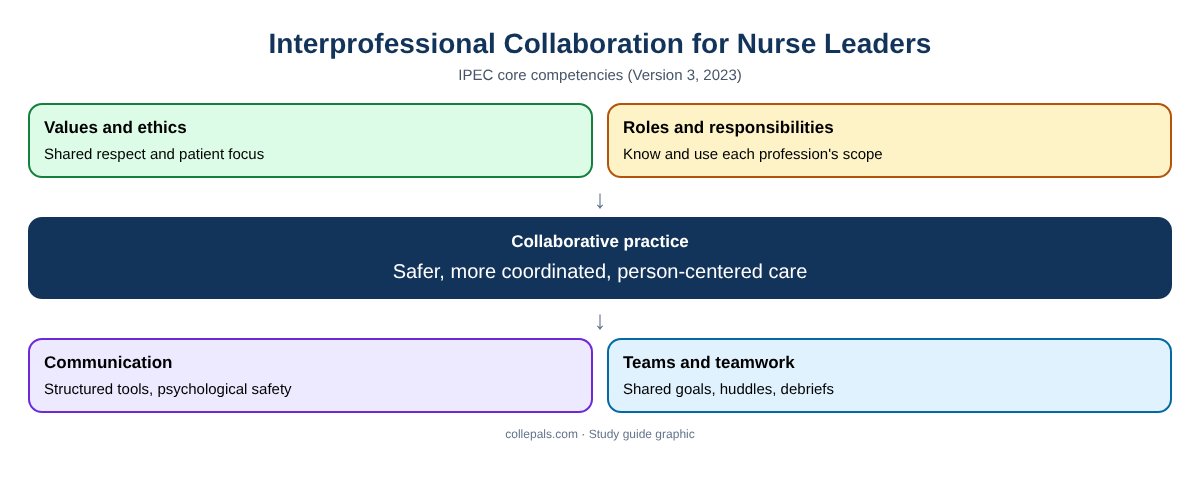
The Interprofessional Education Collaborative (IPEC, 2023) organizes collaborative practice into four competencies:
| Competency | What it means for nurse leaders |
|---|---|
| Values and ethics | Mutual respect, shared commitment to patients and communities, integrity and equity |
| Roles and responsibilities | Understanding your own and other professions’ roles to use each team member’s expertise |
| Communication | Clear, respectful, timely communication with team members, patients and families |
| Teams and teamwork | Applying team science to plan, deliver and evaluate care and improvement |
The AACN (2021) Essentials also include interprofessional partnerships as a domain of nursing education, reinforcing that collaboration is a core DNP competency.
Strategies for Nurse Leaders
1. Use structured communication tools
TeamSTEPPS, developed by the Agency for Healthcare Research and Quality (AHRQ, 2023), provides tools such as briefs, huddles, debriefs, SBAR and check-backs that improve communication and reduce errors. Leaders can implement these tools through training and coaching.
2. Build shared goals and measures
Teams collaborate better when they share a measurable goal, such as reducing readmissions or falls, and see the same data. Shared dashboards reduce “us versus them” thinking.
3. Clarify roles
Role confusion causes gaps and duplication. Clarify who does what in workflows, such as discharge planning or medication reconciliation, and ensure each professional practices at the top of their scope.
4. Create psychological safety
Team members must feel safe raising concerns, regardless of discipline or hierarchy. Leaders model this by inviting input, thanking people who speak up and responding to concerns.
5. Manage conflict constructively
Disagreement among professions is normal. Leaders should address conflict early, focus on shared patient goals and use structured approaches such as interest-based negotiation.
6. Secure leadership and structural support
Collaboration requires time, space and resources, such as protected time for huddles, co-located teams and shared electronic records. Nurse leaders advocate for these structures.
Common Barriers
- Hierarchy and professional silos.
- Different priorities, language and training across professions.
- Time pressure and staffing shortages.
- Incompatible information systems.
- Payment models that do not reward team-based care.
Applying This in DNP 880 Assignments
When writing about collaboration, identify the specific professions involved, the communication gaps you observed, the IPEC competencies at stake and a concrete strategy, such as implementing daily interprofessional huddles, with measures to evaluate it. Link collaboration to cost and quality outcomes to show strategic thinking; see cost-effectiveness strategies in healthcare management and how to identify gaps in healthcare service delivery.
Frequently Asked Questions
What is the difference between multidisciplinary and interprofessional care?
Multidisciplinary teams work in parallel; interprofessional teams work interactively toward shared goals with shared decision-making.
What are the IPEC core competencies?
Values and ethics, roles and responsibilities, communication, and teams and teamwork (Version 3, 2023).
What tools improve team communication?
TeamSTEPPS tools such as SBAR, huddles, briefs, debriefs and check-backs are widely used.
Get Support for Your Collaboration Papers at Collepals
Balancing a DNP program with leadership responsibilities at work is demanding. Collepals.com supports DNP students in DNP 880 Strategic Leadership and Business Management and related courses. Our doctoral-level nursing writers and tutors can:
- Help you break down DNP 880 prompts and rubrics and plan your papers and discussion posts.
- Guide you to current scholarly evidence on leadership, quality improvement, cost and workforce topics.
- Provide model papers and discussion responses you can study for structure and depth.
- Edit and proofread your drafts for doctoral-level clarity and APA 7 formatting.
Browse our free model assignments or learn more about our nursing assignment writing service.
Use Collepals examples as study guides and follow Aspen University’s academic integrity and AI policies when you submit your own work.
More DNP 880 study guides
- DNP880 Strategic Leadership and Business Management: Complete Student Guide
- Strategic Leadership in Nursing: Key Concepts for DNP Students
- Healthcare Workforce Management Strategies for Nurse Leaders
- How to Identify Gaps in Healthcare Service Delivery
- DNP Quality Improvement Project: Developing an Implementation Plan
Collepals is an independent study resource and is not affiliated with or endorsed by Aspen University. Course titles, numbers and requirements change; always follow your current syllabus, rubric and catalog.
References
Agency for Healthcare Research and Quality. (2023). TeamSTEPPS 3.0. https://www.ahrq.gov/teamstepps-program/index.html
American Association of Colleges of Nursing. (2021). The essentials: Core competencies for professional nursing education. https://www.aacnnursing.org/essentials
Archer, J., Bower, P., Gilbody, S., Lovell, K., Richards, D., Gask, L., Dickens, C., & Coventry, P. (2012). Collaborative care for depression and anxiety problems. Cochrane Database of Systematic Reviews, (10), Article CD006525. https://doi.org/10.1002/14651858.CD006525.pub2
Interprofessional Education Collaborative. (2023). IPEC core competencies for interprofessional collaborative practice: Version 3. https://www.ipecollaborative.org/ipec-core-competencies
Reiss-Brennan, B., Brunisholz, K. D., Dredge, C., Briot, P., Grazier, K., Wilcox, A., Savitz, L., & James, B. (2016). Association of integrated team-based care with health care quality, utilization, and cost. JAMA, 316(8), 826–834. https://doi.org/10.1001/jama.2016.11232
Get a plagiarism-free answer to this question
Send us your instructions and we’ll match you with the best writer in your subject.
- 100% human-written, zero AI
- Turnitin report included
- Confidential — we never share your data
- Free revisions & refunds